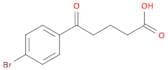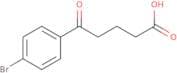
CAS 35333-26-7
:acido 5-(4-bromofenil)-5-ossopentanoico
Descrizione:
acido 5-(4-bromofenil)-5-ossopentanoico, con il numero CAS 35333-26-7, è un composto organico caratterizzato dalla sua struttura unica, che include uno scheletro di acido pentanoico sostituito da un gruppo 4-bromofenile e un gruppo funzionale chetone. Questo composto appare tipicamente come un solido a temperatura ambiente ed è solubile in solventi organici, riflettendo le sue caratteristiche idrofobiche dovute al moiety aromatico bromofenile. La presenza di entrambi i gruppi funzionali, acido carbossilico e chetone, suggerisce che possa presentare proprietà acide e partecipare a varie reazioni chimiche, come esterificazione o condensazione. Inoltre, l'atomo di bromo introduce una notevole elettronegatività, potenzialmente influenzando la reattività del composto e le interazioni con altre molecole. Questo composto potrebbe essere di interesse nella ricerca farmaceutica o nella sintesi organica a causa della sua potenziale attività biologica e utilità nello sviluppo di nuove entità chimiche. I dati di sicurezza devono essere consultati per la manipolazione e lo stoccaggio, come per tutte le sostanze chimiche.
Formula:C11H11BrO3
InChI:InChI=1/C11H11BrO3/c12-9-6-4-8(5-7-9)10(13)2-1-3-11(14)15/h4-7H,1-3H2,(H,14,15)
SMILES:C(CC(=O)c1ccc(cc1)Br)CC(=O)O
Ordinare per
Purezza (%)
0
100
|
0
|
50
|
90
|
95
|
100
3 prodotti.
5-(4-Bromophenyl)-5-oxovaleric acid
CAS:Formula:C11H11BrO3Purezza:97%Colore e forma:SolidPeso molecolare:271.10725-(4-Bromophenyl)-5-oxovaleric acid
CAS:<p>5-(4-Bromophenyl)-5-oxovaleric acid is a molecule that has been synthesized to be used as a cancer drug. It is an amide derivative of the natural compound valproic acid and is being developed for the treatment of cancers, such as leukemia and melanoma. 5-(4-Bromophenyl)-5-oxovaleric acid has been shown to inhibit the function of integrin, which plays a role in cell adhesion and migration, with potential applications in wound healing. <br>The molecule has also been shown to have chemokine binding properties and may be useful in the treatment of diseases where chemokines are involved, such as HIV or AIDS. This compound also binds to CCR5 receptor and inhibits HIV entry into cells. The molecule has also been shown to antagonize survivin, an antiapoptotic protein that protects cells from undergoing apoptosis and prevents tumor suppression. The affinity of 5-(4-bromophenyl</p>Formula:C11H11BrO3Purezza:Min. 95%Peso molecolare:271.12 g/mol