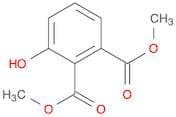
CAS 36669-02-0
:Acido 1,2-benzendicarbossilico, 3-idrossi-, estere dimetilico
Descrizione:
Acido 1,2-benzendicarbossilico, 3-idrossi-, estere dimetilico, comunemente noto come dimetil 3-idrossiftalato, è un composto organico caratterizzato dai suoi gruppi funzionali esteri e da un gruppo idrossile attaccato a un anello benzenico. Questo composto presenta due gruppi carbossilato che sono esterificati con metanolo, risultando nella sua forma di estere dimetilico. È tipicamente un liquido o solido incolore o giallo pallido, a seconda della temperatura e della purezza. La presenza del gruppo idrossile contribuisce alla sua solubilità in solventi polari, mentre la struttura aromatica fornisce stabilità e potenziale per varie reazioni chimiche. Questo composto è spesso utilizzato nella sintesi di altri materiali organici, così come in applicazioni come plastificanti, solventi e intermedi nella sintesi organica. Le sue proprietà chimiche includono volatilità e reattività moderate, rendendolo adatto per varie applicazioni industriali. I dati di sicurezza devono essere consultati per le linee guida di manipolazione ed esposizione, come per qualsiasi sostanza chimica.
Formula:C10H10O5
Ordinare per
Purezza (%)
0
100
|
0
|
50
|
90
|
95
|
100
5 prodotti.
Dimethyl 3-hydroxyphthalate
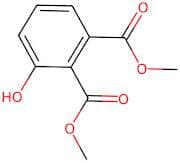
CAS:Formula:C10H10O5Purezza:98%Colore e forma:SolidPeso molecolare:210.1834dimethyl 3-hydroxyphthalate
CAS:Formula:C10H10O5Purezza:98%Colore e forma:SolidPeso molecolare:210.185Dimethyl 3-Hydroxyphthalate
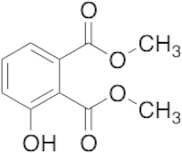
CAS:Prodotto controllatoApplications Dimethyl 3-Hydroxyphthalate is used as a reactant in the synthesis of proteolysis targeting chimeras.
References Schiedel, Matthias, et al.: J. of Med. Chem., 61(2), 482-491 (2018); Lebraud, Honorine, et al.: ACS Cent. Sci., 2(12), 927-934 (2016);Formula:C10H10O5Colore e forma:NeatPeso molecolare:210.18Dimethyl 3-hydroxyphthalate
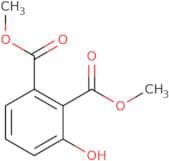
CAS:Dimethyl 3-hydroxyphthalate is a compound that is used in the production of phthalic acid esters. It can be synthesized by reacting chlorine with phthalic anhydride. The reaction system consists of aqueous solution of dimethyl 3-hydroxyphthalate, chlorine, and water. The electrons are accepted by chloride ions and the reaction proceeds through an electron transfer mechanism. Dimethyl 3-hydoxyphthalate undergoes desorption and spin resonance spectroscopy to determine its kinetic properties. Radical species are generated during the process and these radicals may react with other molecules to form new compounds, leading to mineralization or process efficiency. Phthalic acid esters are produced from this compound by oxidative polymerization reactions.Formula:C10H10O5Purezza:Min. 95%Peso molecolare:210.18 g/mol