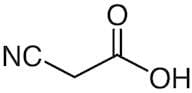
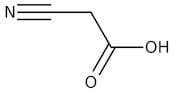
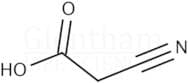
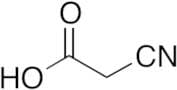
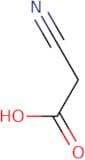
CAS 372-09-8
:Acido cianoacetico
Descrizione:
Acido cianoacetico, con il numero CAS 372-09-8, è un liquido incolore a giallo pallido noto per le sue proprietà distintive e applicazioni nella sintesi organica. Presenta sia un gruppo ciano (-CN) che un gruppo acido carbossilico (-COOH), rendendolo un composto versatile nel campo della chimica. La presenza del gruppo ciano contribuisce alla sua reattività, permettendogli di partecipare a varie reazioni chimiche, comprese le aggiunte nucleofile e le reazioni di condensazione. Acido cianoacetico è solubile in acqua e solventi organici, il che ne aumenta l'utilità in contesti di laboratorio. Viene utilizzato principalmente come intermedio nella sintesi di prodotti farmaceutici, agrochimici e altri composti organici. Inoltre, può servire come un blocco di costruzione per la preparazione di composti eterociclici. A causa della sua potenziale tossicità e della presenza del gruppo ciano, la manipolazione di Acido cianoacetico richiede adeguate precauzioni di sicurezza, inclusi l'uso di dispositivi di protezione individuale e una ventilazione adeguata.
Formula:C3H3NO2
InChI:InChI=1S/C3H3NO2/c4-2-1-3(5)6/h1H2,(H,5,6)
InChI key:InChIKey=MLIREBYILWEBDM-UHFFFAOYSA-N
SMILES:C(C(O)=O)C#N
Sinonimi:- 2-Cyanoacetic Acid
- Acetic Acid, Cyano
- Acetic acid, 2-cyano-
- Acide cyanoacetique
- Acido Cianoacetico
- Cyanessigsaeure
- Cyanessigsaure
- Cyano Acetic Acid
- Cyanoacetate
- Cyanoethanoic acid
- Malonic acid mononitrile
- Malonic mononitrile
- Methyl and Ethyl esters
- Monocyanoacetic acid
- Nsc 5571
- Vedi altri sinonimi
Ordinare per
Purezza (%)
0
100
|
0
|
50
|
90
|
95
|
100
9 prodotti.
Cyanoacetic Acid
CAS:Formula:C3H3NO2Purezza:>98.0%(T)Colore e forma:White to Almost white powder to crystalPeso molecolare:85.06Cyanoacetic acid, 97%
CAS:Cyanoacetic acid is used in pharmaceutical industry for producing vitamin B6 and caffeine. It is also used in making dyes, agricultural chemicals, and in the synthesis of phenylacetic acid esters. It acts as a precursor cyanoacrylates viz. ethyl cyanoacrylate. This Thermo Scientific Chemicals brand
Formula:C3H3NO2Purezza:97%Colore e forma:White to cream, Crystals or powder or crystalline powder or fused/lumpy solidPeso molecolare:85.06Cyanoacetic acid
CAS:Formula:NCCH2CO2HColore e forma:White to off-white powder to crystalsPeso molecolare:85.06Ref: 4Z-T-6958
5mgPrezzo su richiesta10mgPrezzo su richiesta25mgPrezzo su richiesta50mgPrezzo su richiesta100mgPrezzo su richiestaCyanoacetic Acid
CAS:Prodotto controllatoApplications Cyanoacetic acid is a dangerous compound that is commonly used as a synthetic intermediate. Cyanoacetic acid has also been found to have teratogenic effects on rat embryos.
Not a dangerous good if item is equal to or less than 1g/ml and there is less than 100g/ml in the package
References Simpson, M., et al.: Food Chem. Toxicol., 24, 634 (1986)Formula:C3H3NO2Colore e forma:NeatPeso molecolare:85.06Cyanoacetic acid - 70% aqueous solution
CAS:Cyanoacetic acid is an antimicrobial agent that can be used for the treatment of bowel disease, autoimmune diseases, and eye disorders. Cyanoacetic acid is a substrate molecule for sodium carbonate, which can be used to produce sodium carbonate by reacting with water. The reaction solution is then added to human serum or malonic acid to produce sodium carbonate, which can be used as a drug. Electrochemical impedance spectroscopy has been used as a tool to study the mechanism of cyanoacetic acid in treating inflammatory bowel disease.Formula:C3H3NO2Purezza:Min. 95%Colore e forma:Yellow PowderPeso molecolare:85.06 g/molCyanoacetic Acid-(Cyano-13C)
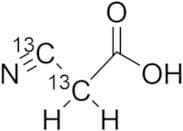
CAS:Prodotto controllatoFormula:C2CH3NO2Colore e forma:NeatPeso molecolare:87.047Cyanoacetic acid
CAS:Cyanoacetic acid is a reactive molecule that contains a hydroxyl group, an electrochemical double bond, and two carbonyl groups. It is also a pharmacological agent and a substrate molecule for many reactions. Cyanoacetic acid has been shown to have anti-inflammatory properties in human serum by inhibiting the production of prostaglandins. It also inhibits the enzyme fatty acid synthase, which may be responsible for the reduction in arachidonic acid levels in patients with autoimmune diseases. This compound has been used as a treatment for eye disorders such as pterygium and conjunctivitis.Formula:C3H3NO2Purezza:Min. 95%Colore e forma:White PowderPeso molecolare:85.06 g/mol