CAS 3757-88-8
:tributil(feniletinil)stannano
Descrizione:
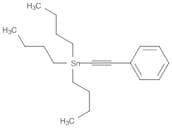
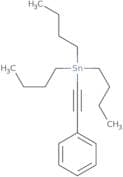
tributil(feniletinil)stannano, con il numero CAS 3757-88-8, è un composto organostannico caratterizzato dalla presenza di un atomo di stagno legato a tre gruppi butile e a un gruppo feniletilino. Questo composto presenta tipicamente un aspetto incolore o giallo pallido ed è noto per la sua volatilità relativamente bassa. È solubile in solventi organici, rendendolo utile in varie applicazioni chimiche. La presenza del gruppo feniletilino conferisce una reattività unica, in particolare nelle reazioni di accoppiamento, che possono essere sfruttate nella sintesi organica e nella scienza dei materiali. I composti organostannici come tributil(feniletinil)stannano sono spesso studiati per le loro potenziali applicazioni nella catalisi, così come nello sviluppo di polimeri e altri materiali avanzati. Tuttavia, è importante notare che i composti organostannici possono comportare rischi ambientali e per la salute, portando a un controllo normativo. Dovrebbero essere osservate misure adeguate di gestione e smaltimento quando si lavora con questa sostanza per mitigare eventuali pericoli potenziali.
Formula:C20H32Sn
InChI:InChI=1/C8H5.3C4H9.Sn/c1-2-8-6-4-3-5-7-8;3*1-3-4-2;/h3-7H;3*1,3-4H2,2H3;/rC20H32Sn/c1-4-7-16-21(17-8-5-2,18-9-6-3)19-15-20-13-11-10-12-14-20/h10-14H,4-9,16-18H2,1-3H3
SMILES:CCCC[Sn](CCCC)(CCCC)C#Cc1ccccc1
Sinonimi:- Stannane, tributyl(2-phenylethynyl)-
- Stannane, tributyl(phenylethynyl)-
- Tributyl(phenylethynyl)stannane
Ordinare per
Purezza (%)
0
100
|
0
|
50
|
90
|
95
|
100
3 prodotti.
PHENYLETHYNYLTRI-N-BUTYLTIN
CAS:Formula:C20H32SnPurezza:60%Colore e forma:LiquidPeso molecolare:391.1691Tributyl(phenylethynyl)tin
CAS:Prodotto controllatoTributyl(phenylethynyl)tin (TBT) is a palladium complex that is used in the synthesis of organic compounds. TBT is prepared by the reaction of two equivalents of phenylethyne with tributyltin chloride followed by hydrolysis. TBT has been shown to catalyze the cross-coupling reactions between alkynes and aryl bromides, which typically proceed via palladium-catalyzed cross-coupled reactions. Cross-coupling reactions are an important synthetic method for constructing organic molecules from simple starting materials. The reaction rate and kinetics of these transformations can be controlled by changing the substituents on the palladium complex. TBT has also been shown to catalyze ring opening reactions, such as those occurring in nature or can be induced synthetically. This type of reaction is typically carried out using organometallic catalysts such as nickel or copper compounds, but TBT has been foundFormula:C20H32SnPurezza:Min. 95%Colore e forma:Clear LiquidPeso molecolare:391.18 g/mol