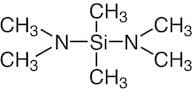
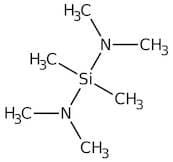
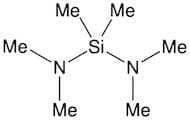
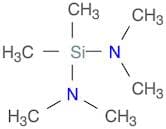
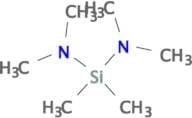
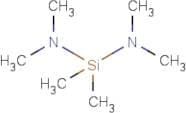
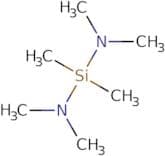
CAS 3768-58-9
:N,N,N′,N′,1,1-Esametilsilanodiammina
- Bdmads
- Bis(N,N-dimethylamino)dimethylsilane
- Dimethylbis(dimethylamino)silane
- Dimethyldi(N,N-dimethylamino)silane
- Dimethylsilylbis(dimethylamine)
- Hexamethylsilanediamine
- Ls 1440
- N,N,N',N',1,1-Hexamethylsilanediamine
- Silanediamine, hexamethyl-
- [(Dimethylamino)dimethylsilyl]dimethylamine
- silanediamine, N,N,N',N',1,1-hexamethyl-
- Vedi altri sinonimi
Bis(dimethylamino)dimethylsilane
CAS:Formula:C6H18N2SiPurezza:>97.0%(GC)Colore e forma:Colorless to Almost colorless clear liquidPeso molecolare:146.31Bis(dimethylamino)dimethylsilane, 97%
CAS:Bis(dimethylamino)-dimethyl silane has been used to silanize pH-sensitive microelectrodes, used to measure the membrane potential in oocytes, in an experimental procedure aimed towards cloning and characterizing human electrogenic Na+-cotransporter isoform (hhNBC). It is also used for microelectrodeFormula:C6H18N2SiPurezza:97%Colore e forma:Clear colorless, LiquidPeso molecolare:146.31Bis(dimethylamino)dimethylsilane, 99+% BDMADMS
CAS:Bis(dimethylamino)dimethylsilane, 99+% BDMADMS
Formula:N(CH3)2(CH3)2SiPurezza:99+%Colore e forma:colorless liq.Peso molecolare:146.31N,N,N′,N′,1,1-Hexamethylsilanediamine
CAS:Formula:C6H18N2SiColore e forma:LiquidPeso molecolare:146.3060Bis(dimethylamino)dimethylsilane
CAS:S01600 - Bis(dimethylamino)dimethylsilane
Formula:C6H18N2SiPurezza:>95%Colore e forma:LiquidPeso molecolare:146.309Bis(dimethylamino)dimethylsilane
CAS:Bis(dimethylamino)dimethylsilane
Purezza:95%Peso molecolare:146.31g/molRef: 54-OR928817
1mlPrezzo su richiesta5mlPrezzo su richiesta25gPrezzo su richiesta25mlPrezzo su richiesta100gPrezzo su richiesta100mlPrezzo su richiesta500mlPrezzo su richiestaBIS(DIMETHYLAMINO)DIMETHYLSILANE
CAS:Bridging Silicon-Based Blocking Agent
Used as a protecting group for reactive hydrogens in alcohols, amines, thiols, and carboxylic acids. Organosilanes are hydrogen-like, can be introduced in high yield, and can be removed under selective conditions. They are stable over a wide range of reaction conditions and can be removed in the presence of other functional groups, including other protecting groups. The tolerance of silylated alcohols to chemical transformations summary is presented in Table 1 of the Silicon-Based Blocking Agents brochure.
ALD Material
Atomic layer deposition (ALD) is a chemically self-limiting deposition technique that is based on the sequential use of a gaseous chemical process. A thin film (as fine as -0.1 Å per cycle) results from repeating the deposition sequence as many times as needed to reach a certain thickness. The major characteristic of the films is the resulting conformality and the controlled deposition manner. Precursor selection is key in ALD processes, namely finding molecules which will have enough reactivity to produce the desired films yet are stable enough to be handled and safely delivered to the reaction chamber.
Alkyl Silane - Conventional Surface Bonding
Aliphatic, fluorinated aliphatic or substituted aromatic hydrocarbon substituents are the hydrophobic entities which enable silanes to induce surface hydrophobicity. The organic substitution of the silane must be non-polar. The hydrophobic effect of the organic substitution can be related to the free energy of transfer of hydrocarbon molecules from an aqueous phase to a homogeneous hydrocarbon phase. A successful hydrophobic coating must eliminate or mitigate hydrogen bonding and shield polar surfaces from interaction with water by creating a non-polar interphase. Although silane and silicone derived coatings are in general the most hydrophobic, they maintain a high degree of permeability to water vapor. This allows coatings to breathe and reduce deterioration at the coating interface associated with entrapped water. Since ions are not transported through non-polar silane and silicone coatings, they offer protection to composite structures ranging from pigmented coatings to rebar reinforced concrete. A selection guide for hydrophobic silanes can be found on pages 22-31 of the Hydrophobicity, Hydrophilicity and Silane Surface Modification brochure.
Bis(Dimethylamino)dimethylsilane; Dimethylbis(dimethylamino)silane; Hexamethylsilanediamine; DMS
More reactive than SIB4120.0Couples silanol terminated siloxanesReacted with diols, diamines, and treatment for glassSummary of selective deprotection conditions is provided in Table 7 through Table 20 of the Silicon-Based Blocking Agents brochureFormula:C6H18N2SiPurezza:97%Colore e forma:Straw LiquidPeso molecolare:146.31Ref: 3H-SIB1072.0
2kgPrezzo su richiesta14kgPrezzo su richiesta100gPrezzo su richiesta160kgPrezzo su richiestaBis(dimethylamino)dimethylsilane
CAS:Bis(dimethylamino)dimethylsilane (Bis-DMAS) is a silylating agent that reacts with the hydroxy groups of siloxanes to form a cross-link. It can be used as a functional group for the synthesis of polymers, coatings, and adhesives. Bis-DMAS has also been used to improve the reactivity of other functional groups, such as carbonyls, amines, nitriles, and epoxides. It is reactive in air and moisture and should be stored in an inert atmosphere. Bis-DMAS reacts with metal surfaces to form a coating by reacting with both the metal surface and hydrogen atoms on the surface. The reaction temperature is dependent on the substrate: higher temperatures are needed for copper than aluminum due to copper's higher reactivity. The activation energies are different for each reaction type: thermal reactions have an activation energy of 40 kJ/mol while electrochemical reactions have an activation energy ofFormula:C6H18N2SiPurezza:Min. 95%Peso molecolare:146.31 g/mol