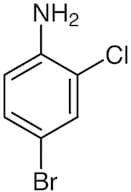
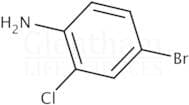
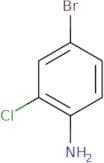
CAS 38762-41-3
:4-Bromo-2-cloroanilina
- 2-Chloro-4-bromoaniline
- 254-118-4
- 3-Bromo-5-Chloro-Aniline
- 4-Bromo-2-chlorobenzenamine
- 4-Bromo-2-chlorophenylamine
- Aniline, 4-bromo-2-chloro-
- Benzenamine, 4-bromo-2-chloro-
- Zr Bg De
- 4-Bromo-2-chloroaniline
4-Bromo-2-chloroaniline
CAS:Formula:C6H5BrClNPurezza:>98.0%(GC)Colore e forma:White to Light yellow to Light orange powder to crystalPeso molecolare:206.474-Bromo-2-chloroaniline, 98+%
CAS:This Thermo Scientific Chemicals brand product was originally part of the Alfa Aesar product portfolio. Some documentation and label information may refer to the legacy brand. The original Alfa Aesar product / item code or SKU reference has not changed as a part of the brand transition to Thermo SciFormula:C6H5BrClNPurezza:98+%Colore e forma:Cream to brown, Crystals or powder or crystalline powderPeso molecolare:206.474-Bromo-2-chloroaniline
CAS:4-Bromo-2-chloroanilineFormula:C6H5BrClNPurezza:98%Colore e forma: white crystalline needlesPeso molecolare:206.46759g/mol4-Bromo-2-chloroaniline, min. 99%
CAS:Formula:C6H5BrClNPurezza:min. 99%Colore e forma:White to off-white solidPeso molecolare:206.474-Bromo-2-chloroaniline
CAS:4-Bromo-2-chloroaniline (4BCA) is an exciplex that forms in the presence of hydrogen peroxide and chloride ions. It is unreactive with fluconazole and other related molecules, but is able to photoreduce hydrogen peroxide. The molecular mechanism of 4BCA is a result of its ability to form a covalent bond with DNA containing pyrimidine bases. This reaction results in the formation of pyrimidine dimers, which can lead to cell death through the inhibition of DNA synthesis and repair. 4BCA has been shown to be effective against cancer cells at high concentrations, but does not affect healthy cells. The effectiveness against cancer cells may be due to the fact that this exciplex reacts with uv irradiation and irradiation, which leads to a higher concentration of reactive oxygen species (ROS).
Formula:C6H5BrClNPurezza:Min. 95%Colore e forma:PowderPeso molecolare:206.47 g/mol