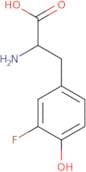
CAS 403-90-7
:3-Fluoro-DL-tirosina
Descrizione:
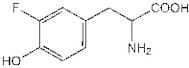
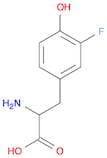
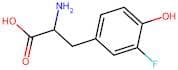
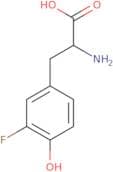
3-Fluoro-DL-tirosina è un derivato fluorurato dell'aminoacido tirosina, caratterizzato dalla presenza di un atomo di fluoro nella posizione meta dell'anello aromatico. Questo composto è un aminoacido non proteico, il che significa che non viene incorporato nelle proteine durante la traduzione, ma può essere utilizzato in varie applicazioni biochimiche. Presenta proprietà simili a quelle della tirosina, inclusa la capacità di partecipare a legami idrogeno e il suo ruolo come precursore nella sintesi dei neurotrasmettitori. L'introduzione dell'atomo di fluoro può influenzare la polarità, la reattività e l'interazione del composto con i sistemi biologici, influenzando potenzialmente le sue proprietà farmacologiche. 3-Fluoro-DL-tirosina è spesso utilizzato in contesti di ricerca, in particolare in studi relativi all'attività enzimatica, alla struttura delle proteine e allo sviluppo di farmaci. Come molti composti fluorurati, può presentare caratteristiche uniche in termini di stabilità e solubilità rispetto alle sue controparti non fluorurate. Devono essere osservate precauzioni di sicurezza e manipolazione, come per qualsiasi sostanza chimica, per mitigare potenziali rischi.
Formula:C9H10FNO3
InChI:InChI=1S/C9H10FNO3/c10-6-3-5(1-2-8(6)12)4-7(11)9(13)14/h1-3,7,12H,4,11H2,(H,13,14)
InChI key:InChIKey=VIIAUOZUUGXERI-UHFFFAOYSA-N
SMILES:C(C(C(O)=O)N)C1=CC(F)=C(O)C=C1
Sinonimi:- 2-Amino-3-(3-fluoro-4-hydroxyphenyl)propanoic acid
- 3-Fluoro-<span class="text-smallcaps">DL</span>-tyrosine
- 3-Fluorotyrosine
- <span class="text-smallcaps">DL</span>-3-Fluorotyrosin
- <span class="text-smallcaps">DL</span>-3-Fluorotyrosine
- <span class="text-smallcaps">DL</span>-Tyrosine, 3-fluoro-
- <span class="text-smallcaps">DL</span>-m-Fluorotyrosine
- Ba 2745
- Fluorthyrin
- H-DL-Tyr(3-F)-OH
- NSC 83231
- Pardinon
- Tyrosine, 3-fluoro-
- Tyrosine, 3-fluoro-, <span class="text-smallcaps">DL</span>-
- m-Fluoro-<span class="text-smallcaps">DL</span>-tyrosine
- DL-m-Fluorotyrosine
- Tyrosine, 3-fluoro-, DL-
- Vedi altri sinonimi
Ordinare per
Purezza (%)
0
100
|
0
|
50
|
90
|
95
|
100
6 prodotti.
3-Fluoro-DL-tyrosine, 97%
CAS:3-Fluoro-DL-tyrosine is used for tyrosine in the biosynthesis of proteins such as -galactosidases (Escherichia coli), bacteriorhodopsin and intestinal microvillar enzymes, aminopeptidase N, to study the effect of halogenated tryosines on the proteins properties. This Thermo Scientific Chemicals branFormula:C9H10FNO3Purezza:97%Colore e forma:White to pale cream, Crystals or powder or crystalline powderPeso molecolare:199.182-Amino-3-(3-fluoro-4-hydroxyphenyl)propanoic acid
CAS:Formula:C9H10FNO3Purezza:97%Colore e forma:SolidPeso molecolare:199.17903-Fluoro-DL-tyrosine
CAS:3-Fluoro-DL-tyrosineFormula:C9H10FNO3Purezza:97%Colore e forma: off white solidPeso molecolare:199.18g/mol3-Fluoro-DL-tyrosine
CAS:3-Fluoro-DL-tyrosine is a model system for the study of tyrosine transfer reactions. It is used to study the reaction mechanism and kinetics of tyrosine transfer from a donor molecule to an acceptor molecule. 3-Fluoro-DL-tyrosine reacts with trifluoroacetic acid to form 3,4-dihydroxybenzoic acid, which is a chemical analog of tyrosine. The hydroxyl group on this molecule can react with the proton on the amino acid side chain, forming a covalent bond that does not break down under normal conditions. This reaction is reversible and has been shown to be catalyzed by polymerase chain reactions (PCR).
Formula:C9H10FNO3Purezza:Min. 95%Colore e forma:PowderPeso molecolare:199.18 g/mol3-Fluoro-DL-tyrosine
CAS:3-Fluoro-DL-tyrosine is a useful scaffold, versatile building block, and useful intermediate. It can be used as a reaction component in the synthesis of complex compounds and as a reagent for the synthesis of speciality chemicals such as pharmaceuticals. 3-Fluoro-DL-tyrosine has CAS number 403-90-7 and is found in research chemical catalogues. This compound is a high quality product that can be used as a building block for pharmaceuticals or other research chemicals.Formula:C9H10FNO3Peso molecolare:199.18 g/molRef: 3D-F-6899
-Unit-ggPrezzo su richiesta1gPrezzo su richiesta3gPrezzo su richiesta5gPrezzo su richiesta10gPrezzo su richiesta25gPrezzo su richiesta