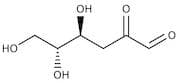
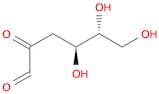
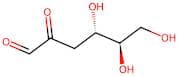
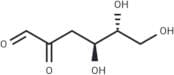
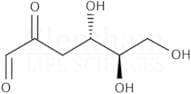
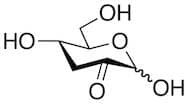
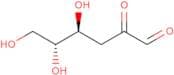
CAS 4084-27-9
:3-Desossiglucosone
Descrizione:
3-Desossiglucosone (3-DG) è un composto dicarbonilico reattivo derivato dal metabolismo del glucosio. È caratterizzato dalla sua struttura, che presenta un gruppo funzionale chetone e un gruppo funzionale aldeide, rendendolo un potente precursore nella formazione di prodotti finali di glicazione avanzata (AGEs). Questi AGEs sono implicati in varie condizioni patologiche, tra cui diabete e malattie cardiovascolari. Si sa che il 3-DG ha la capacità di reagire con aminoacidi, proteine e acidi nucleici, portando a modifiche che possono influenzare la funzione cellulare e contribuire allo stress ossidativo. Il composto è tipicamente presente in quantità traccia nei sistemi biologici e può formarsi attraverso processi di glicazione non enzimatica. La sua reattività e i potenziali effetti biologici lo rendono un argomento di interesse nella ricerca relativa ai disturbi metabolici e all'invecchiamento. Inoltre, 3-Desossiglucosone può essere analizzato utilizzando varie tecniche, tra cui cromatografia e spettrometria di massa, per studiare il suo ruolo nella salute e nella malattia.
Formula:C6H10O5
InChI:InChI=1S/C6H10O5/c7-2-4(9)1-5(10)6(11)3-8/h2,5-6,8,10-11H,1,3H2/t5-,6+/m0/s1
InChI key:InChIKey=ZGCHLOWZNKRZSN-NTSWFWBYSA-N
SMILES:[C@H](CC(C=O)=O)([C@@H](CO)O)O
Sinonimi:- 2-keto-3-Deoxyglucose
- 3-Deoxy-<span class="text-smallcaps">D</span>-erythro-hexos-2-ulose
- 3-Deoxy-<span class="text-smallcaps">D</span>-erythro-hexosulose
- 3-Deoxy-<span class="text-smallcaps">D</span>-glucosone
- 3-Deoxyglucosone
- <span class="text-smallcaps">D</span>-erythro-Hexos-2-ulose, 3-deoxy-
- <span class="text-smallcaps">D</span>-erythro-Hexosulose, 3-deoxy-
- D-erythro-hexos-2-ulose, 3-deoxy-
- 3-Deoxy-D-erythro-hexosulose
- D-erythro-Hexosulose, 3-deoxy-
- 3-Deoxy-D-erythro-hexos-2-ulose
Ordinare per
Purezza (%)
0
100
|
0
|
50
|
90
|
95
|
100
10 prodotti.
3-Deoxy-D-glucosone, 95%
CAS:Frequently used as a reference for the analysis and detection of glucose degradation products and glycating agents. Also used for cross-linking studies as it readily reacts with protein amino groups. This Thermo Scientific Chemicals brand product was originally part of the Alfa Aesar product portfolFormula:C6H10O5Purezza:95%Colore e forma:Yellow, Powder or crystals or crystalline powderPeso molecolare:162.143-Deoxy-D-glucosone
CAS:3-Deoxy-D-glucosoneFormula:C6H10O5Purezza:>95%Colore e forma: yellow amorphous solidPeso molecolare:162.14g/mol3-Deoxy-D-erythro-hexos-2-ulose
CAS:3-Deoxy-D-erythro-hexos-2-ulosePurezza:≥95%Colore e forma:Pale Yellow SolidPeso molecolare:162.14g/mol3-Deoxyglucosone
CAS:3-Deoxyglucosone(3-Deoxy-D-glucosone) is synthesized by the intermediate pathway of the melad and polyol reactions.3-Deoxyglucosone reacts rapidly with proteinFormula:C6H10O5Purezza:95%Colore e forma:SolidPeso molecolare:162.14Ref: 4Z-F-161011
5mgPrezzo su richiesta10mgPrezzo su richiesta25mgPrezzo su richiesta50mgPrezzo su richiesta100mgPrezzo su richiesta3-Deoxyglucosone
CAS:Formula:C6H10O5Purezza:One spotColore e forma:Pale yellow to yellow powder or solidPeso molecolare:162.143-Deoxyglucosone
CAS:Stability Hygroscopic, Light Sensitive, Temperature Sensitive
Applications An intermediate in the Maillard reaction of proteins with glucose, which is metabolised to 3-Deoxyfructose. An intermediate in the formation of pyrraline, which might contribute to a pathological effect, such as carcinogenesis.
References Kato, H. et al.: Agric. Biol. Chem., 51, 683 (1987), Hayase, F. et al.: J. Biol. Chem., 264, 3758 (1989), Kato, H. et al.: Biochimica et Biophysica Acta, 1035, 71 (1990)Formula:C6H10O5Colore e forma:White To YellowPeso molecolare:162.143-Deoxy-D-glucosone
CAS:3-Deoxy-D-glucosone is a compound that belongs to the group of monosaccharides and has a basic structure. It can be found in many types of biological samples, including blood. The x-ray diffraction data for 3-deoxy-D-glucosone shows an asymmetric unit of two molecules with a coordination geometry of 2.3. This compound is known to have high protein oxidation rates, which are caused by dna binding activity. 3-Deoxyglucosone has been shown to be involved in the pathogenic mechanism of many types of cancers.Formula:C6H10O5Purezza:Min. 95%Colore e forma:PowderPeso molecolare:162.14 g/mol