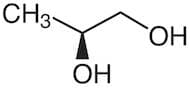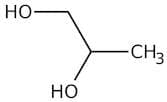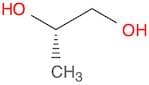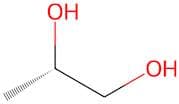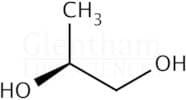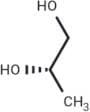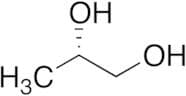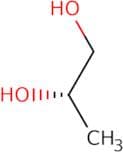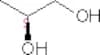
CAS 4254-15-3
:(+)-1,2-Propandiolo
Descrizione:
(+)-1,2-Propandiolo, noto anche come propilenglicole, è un liquido incolore, inodore e igroscopico con un sapore dolce. È un diolo, il che significa che contiene due gruppi idrossile (-OH), che contribuiscono alla sua solubilità in acqua e in vari solventi organici. Questo composto è comunemente usato in alimenti, prodotti farmaceutici e cosmetici come umettante, solvente e conservante grazie alla sua bassa tossicità e capacità di trattenere l'umidità. La sua formula chimica è C3H8O2 e ha un punto di ebollizione relativamente basso e un alto punto di ebollizione rispetto ad altre piccole molecole organiche. La designazione (+) indica che è l'enantiomero con specifica attività ottica, che può influenzare le sue interazioni nei sistemi biologici. Il propilenglicole è anche utilizzato nella produzione di antigelo e come vettore per aromi e fragranze. Il suo profilo di sicurezza è stato ben studiato ed è generalmente riconosciuto come sicuro (GRAS) dalle agenzie di regolamentazione quando utilizzato correttamente.
Formula:C3H8O2
InChI:InChI=1/C6H12O3/c1-5-3-8-4-6(2-7)9-5/h5-7H,2-4H2,1H3/t5?,6-/m0/s1
InChI key:InChIKey=DNIAPMSPPWPWGF-VKHMYHEASA-N
SMILES:[C@@H](CO)(C)O
Sinonimi:- (+)-1,2-Propanediol
- (2S)-1,2-Propanediol
- (2S)-Propane-1,2-diol
- (S)-(+)-1,2-propanediol
- (S)-(+)-Propane-1,2-diol
- (S)-(+)-Propylene glycol
- (S)-2-Hydroxy-1-propanol
- (S)-2-Hydroxypropanol
- 1,2(S)-Propanediol
- 1,2-Propanediol, (2S)-
- 1,2-Propanediol, (S)-
- 3-Deoxy-sn-glycerol
- <span class="text-smallcaps">L</span>-(+)-Propanediol
- <span class="text-smallcaps">L</span>-(+)-Propylene glycol
- <span class="text-smallcaps">L</span>-1,2-Propanediol
- d-Propylene glycol
- L-(+)-Propylene glycol
- PROPYELENE GLYCOL pure
- (S)-(+)-1,2-DIHYDROXYPROPANE
- (S)-(+)-PROPYLENE GLYCEROL
- PROPYLENE GLYCOL extrapure AR
- 1,2-PROPANEDIOL, 1000MG, NEAT
- (S)-(+)-1,2-Propanediol,99%
- (S)-(+)-1,2-Propanediol,97%
- S-1,2-Propancdiol
- ALUMINUM NITRATE NONAHYDRATE 98+% &
- (S)-(+)-PROPANEDIOL
- Vedi altri sinonimi
Ordinare per
Purezza (%)
0
100
|
0
|
50
|
90
|
95
|
100
10 prodotti.
(S)-(+)-1,2-Propanediol
CAS:Formula:C3H8O2Purezza:>98.0%(GC)Colore e forma:Colorless to Light yellow to Light orange clear liquidPeso molecolare:76.10(S)-(+)-1,2-Propanediol, 97%
CAS:(S)-(+)-1,2-Propanediol acts as an organic solvent and diluent used in pharmaceutical preparations. It is also used as a chiral synthetic intermediate and substrate for enzyme studies. This Thermo Scientific Chemicals brand product was originally part of the Alfa Aesar product portfolio. Some documeFormula:C3H8O2Purezza:97%Colore e forma:Clear colorless, Liquid or viscous liquidPeso molecolare:76.10Ref: IN-DA0032FV
5gPrezzo su richiesta10g21,00€1kg120,00€25g25,00€50g25,00€100g28,00€250g55,00€25kgPrezzo su richiesta500g73,00€50kgPrezzo su richiesta(S)-(+)-1,2-Propanediol
CAS:(S)-(+)-1,2-PropanediolFormula:C3H8O2Purezza:98%Colore e forma: colourless liquidPeso molecolare:76.09g/molS(+)-Propylene glycol
CAS:Formula:C3H8O2Purezza:(GC) ≥ 96.0%Colore e forma:Clear, colourless liquidPeso molecolare:76.10(S)-(+)-1,2-Propanediol
CAS:(S)-(+)-1,2-Propanediol ((2S)-propane-1,2-diol) is an endogenous compound produced by the engineered bacterium Lactococcus lactis.Formula:C3H8O2Purezza:99.23%Colore e forma:Less To Light Yellow Liquid Colorless To Light Yellow LiquidPeso molecolare:76.09Ref: 4Z-T-02194
5mgPrezzo su richiesta10mgPrezzo su richiesta25mgPrezzo su richiesta50mgPrezzo su richiesta100mgPrezzo su richiesta(S)-(+)-Propane-1,2-diol
CAS:Prodotto controllatoApplications (S)-(+)-Propane-1,2-diol is a general reagent used in organic synthesis. (S)-(+)-Propane-1,2-diol is used in the synthesis of anti-tuberculosis agents inspired by BTZ043 for MDR resistant strains.
References Tiwari, R. et al.: ACS Med. Chem. Lett., 5, 587 (2014); Tiwari, R. et al.: J. Am. Chem. Soc., 135, 3539 (2013);Formula:C3H8O2Colore e forma:ColourlessPeso molecolare:76.09(S)-(+)-1,2-Propanediol
CAS:(S)-(+)-1,2-Propanediol is a diol that is a chemical compound with the molecular formula HOCHCHOH. It has an asymmetric carbon atom and can exist as two enantiomers (S)-(+)-1,2-propanediol and (R)-(-)-1,2-propanediol. The compound is produced in the laboratory by oxidation of propylene with hydrogen peroxide in the presence of a metal catalyst. It undergoes dehydration reactions to form sugars such as erythritol and xylitol. This process also occurs naturally in some plants and bacteria where glucose is oxidized to form glycerol. The conversion of propane-1,2-diol to glycerol is catalyzed by alcohol dehydrogenase from yeast or fungi such as Candida boidinii or Candida kefyr. It also reacts with other molecules such as proteins via amide formation to form new compounds called aFormula:C3H8O2Purezza:Min. 98%Colore e forma:Colorless Slightly Yellow Clear LiquidPeso molecolare:76.09 g/mol(S)-(+)-1,2-Propanediol
CAS:Formula:C3H8O2Purezza:97%Colore e forma:Liquid, ClearPeso molecolare:76.095