CAS 4498-32-2
:Dibenzepina
Descrizione:
Dibenzepina è un antidepressivo triciclico utilizzato principalmente nel trattamento della depressione e di alcuni disturbi d'ansia. Funziona inibendo il riassorbimento dei neurotrasmettitori, in particolare norepinefrina e serotonina, migliorando così l'umore e la stabilità emotiva. La struttura chimica di Dibenzepina consiste in un nucleo di dibenzocicloheptene, che contribuisce alle sue proprietà farmacologiche. Viene tipicamente somministrato per via orale ed è noto per i suoi effetti sedativi, rendendolo utile per i pazienti con insonnia associata alla depressione. Dibenzepina ha una emivita relativamente lunga, che consente una somministrazione una volta al giorno in molti casi. Tuttavia, come altri antidepressivi triciclici, può avere effetti collaterali, tra cui secchezza delle fauci, stitichezza e potenziali effetti cardiovascolari, richiedendo un attento monitoraggio. Il suo uso è diminuito con l'avvento di antidepressivi più recenti che spesso hanno profili di effetti collaterali più favorevoli. In generale, Dibenzepina rimane un'opzione rilevante in scenari clinici specifici, in particolare per i pazienti che potrebbero non rispondere ad altri trattamenti.
Formula:C18H21N3O
InChI:InChI=1S/C18H21N3O/c1-19(2)12-13-21-17-11-7-6-10-16(17)20(3)15-9-5-4-8-14(15)18(21)22/h4-11H,12-13H2,1-3H3
InChI key:InChIKey=QPGGEKPRGVJKQB-UHFFFAOYSA-N
SMILES:C(CN(C)C)N1C=2C(N(C)C=3C(C1=O)=CC=CC3)=CC=CC2
Sinonimi:- 10-(2-Dimethylaminoethyl)-5,10-Dihydro-5-Methyldibenzo(B,E)(1,4)Diazepin-11-One
- 10-[2-(Dimethylamino)ethyl]-5,10-dihydro-5-methyl-11H-dibenzo[b,e][1,4]diazepin-11-one
- 10-[2-(dimethylamino)ethyl]-5-methyl-5,10-dihydro-11H-dibenzo[b,e][1,4]diazepin-11-one
- 11H-Dibenzo[b,e][1,4]diazepin-11-one, 10-[2-(dimethylamino)ethyl]-5,10-dihydro-5-methyl-
- Dibenzepine
- Hf 1927
- Victoril
- Dibenzepin
Ordinare per
Purezza (%)
0
100
|
0
|
50
|
90
|
95
|
100
3 prodotti.
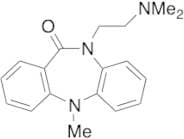
Dibenzepin
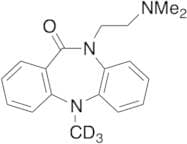
CAS:<p>Applications Antidepressant.<br> Not a dangerous good if item is equal to or less than 1g/ml and there is less than 100g/ml in the package<br>References Lehner, H., et al.: Arzneim.-Forsch., 17, 185 (1967), Egli, A., et al.: Anal. Profiles Drug Subs., 9, 181 (1980),<br></p>Formula:C18H21N3OColore e forma:NeatPeso molecolare:295.38Dibenzepin-d3
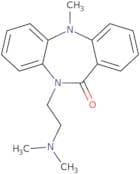
CAS:Prodotto controllato<p>Applications Antidepressant.<br> Not a dangerous good if item is equal to or less than 1g/ml and there is less than 100g/ml in the package<br>References Lehner, H., et al.: Arzneim.-Forsch., 17, 185 (1967), Egli, A., et al.: Anal. Profiles Drug Subs., 9, 181 (1980),<br></p>Formula:C18D3H18N3OColore e forma:NeatPeso molecolare:298.397Dibenzepin
CAS:Prodotto controllato<p>Dibenzepin is a tricyclic antidepressant drug that is used to treat depression, anxiety, and other mood disorders. Dibenzepin has been shown to increase the glomerular filtration rate in geriatric patients and can be used for the treatment of cardiac effects such as arrhythmia. Dibenzepin also has a linear calibration curve with an R2 value of 0.9996. This drug is metabolized by dextromethorphan via glucuronidation or sulfation, which are two common metabolic pathways. The therapeutic levels of this drug are determined by measuring serum prolactin levels or by using a linear calibration curve with an R2 value of 0.9996. The acute toxicities of dibenzepin can include bowel disease, locomotor activity, and heart rate changes in animals. These side effects can be avoided by performing sample preparation before analysis.</p>Formula:C18H21N3OPurezza:Min. 95%Colore e forma:Slightly Brown PowderPeso molecolare:295.38 g/mol