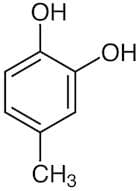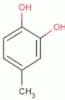
CAS 452-86-8
:4-Metilcatecolo
Descrizione:
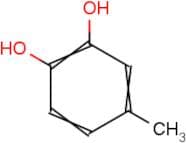
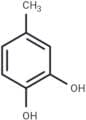
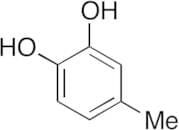
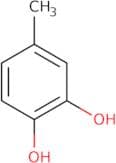
4-Metilcatecolo, noto anche come 4-metil-1,2-benzenodiolo, è un composto organico caratterizzato dalla sua struttura di catecolo con un gruppo metile in posizione para. Ha la formula molecolare C8H10O2 e presenta due gruppi idrossile (-OH) attaccati a un anello benzenico, il che contribuisce alla sua reattività e solubilità in solventi polari. Questo composto è tipicamente un liquido o solido incolore o giallo pallido, a seconda della sua purezza e temperatura. 4-Metilcatecolo mostra proprietà antiossidanti ed è utilizzato in varie applicazioni, inclusa come precursore nella sintesi di farmaci e agrochimici. Può anche fungere da stabilizzatore in alcune formulazioni grazie alla sua capacità di catturare radicali liberi. Il composto è sensibile all'ossidazione e deve essere maneggiato con cura per prevenire la degradazione. Inoltre, è importante considerare i dati di sicurezza, poiché può comportare rischi per la salute se inalato o ingerito, richiedendo misure di sicurezza appropriate durante la manipolazione e lo stoccaggio.
Formula:C7H8O2
InChI:InChI=1S/C7H8O2/c1-5-2-3-6(8)7(9)4-5/h2-4,8-9H,1H3
InChI key:InChIKey=ZBCATMYQYDCTIZ-UHFFFAOYSA-N
SMILES:OC1=C(O)C=CC(C)=C1
Sinonimi:- 1,2-Dihydroxy-4-methylbenzene
- 1-Methyl-3,4-dihydroxybenzene
- 2-Hydroxy-4-methylphenol
- 3,4-Dihydroxytoluene
- 4-Methyl-1,2-benzediol
- 4-Methyl-1,2-benzenediol
- 4-Methyl-1,2-dihydroxybenzene
- 4-Methylbenzcatechin
- 4-Methylbrenzcatechin
- 4-Methylcatechol
- 4-Methylpyrocatechol
- 4-Metilpirocatecol
- 5-Methylcatechol
- Catechol, 4-Methyl-
- Homocatechol
- Homopyrocatechol
- Nsc 17489
- Pyrocatechol, 4-methyl-
- Toluene-3,4-diol
- p-Methylcatechol
- p-Methylpyrocatechol
- 4-Methyl-1,2-benzenediol (4-methylpyrocatechol)
- 4-methyl-pyrocatecho
- 4-methyl-benzene-1,2-diol
- 4-methyl-2-benzenediol
- Vedi altri sinonimi
Ordinare per
Purezza (%)
0
100
|
0
|
50
|
90
|
95
|
100
10 prodotti.
4-Methylcatechol
CAS:Formula:C7H8O2Purezza:>98.0%(GC)Colore e forma:White to Light yellow to Light orange powder to lumpPeso molecolare:124.144-Methylcatechol, 96%
CAS:This Thermo Scientific Chemicals brand product was originally part of the Alfa Aesar product portfolio. Some documentation and label information may refer to the legacy brand. The original Alfa Aesar product / item code or SKU reference has not changed as a part of the brand transition to Thermo SciFormula:C7H8O2Purezza:96%Colore e forma:White to cream to brown or pale pink to pale gray, Crystals or powder or crystalline powder or flakes or lumps and/or chunksPeso molecolare:124.144-Methylcatechol
CAS:4-MethylcatecholFormula:C7H8O2Purezza:95%Colore e forma: white solidPeso molecolare:124.14g/mol4-Methylcatechol
CAS:4-Methylcatechol, a homoprotocatechuic acid metabolite, induces BDNF and inhibits Catechol 2,3-dioxygenase. Lack of BDNF may lead to neuropathic pain.Formula:C7H8O2Purezza:98.67%Colore e forma:SolidPeso molecolare:124.14Ref: 4Z-P-57147
5mgPrezzo su richiesta10mgPrezzo su richiesta25mgPrezzo su richiesta50mgPrezzo su richiesta100mgPrezzo su richiesta4-Methylcatechol
CAS:Applications 4-Methylcatechol is a potent inducer of nerve growth factor (NGF) synthesis in vitro and in vivo.
References Kaechi, K., et al.: J. Pharmacol. Exp. Ther., 272, 1300 (1995); Hanaoka, Y., et al.: J. Neurol. Sci., 122, 28 (1994)Formula:C7H8O2Colore e forma:NeatPeso molecolare:124.144-Methylcatechol
CAS:4-Methylcatechol is a plant compound that has been shown to have neurotrophic and anticarcinogenic properties. It is a natural product that can be found in the bark of the cinchona tree, and it has been used as an additive in skin care products for its antioxidant properties. 4-Methylcatechol has been shown to have anti-inflammatory effects and inhibit the growth of cancer cells in vitro. It also shows potential for the treatment of diabetic neuropathy, due to its ability to inhibit acetylcholine esterase activity. 4-Methylcatechol is a neurotrophic factor that affects cell nuclei and protein synthesis. This compound acts by binding with DNA, preventing DNA polymerase from adding new bases during replication. This effect inhibits RNA synthesis, which leads to cell death after prolonged exposure. In addition, 4-methylcatechol may be carcinogenic when administered orally or topically on skin cells in vivo or when applied exFormula:C7H8O2Purezza:Min. 95%Peso molecolare:124.14 g/mol