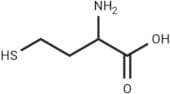
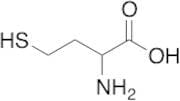
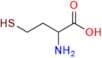
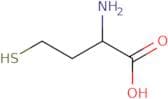
CAS 454-29-5
:(±)-Omocisteina
Descrizione:
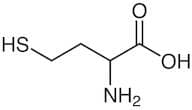
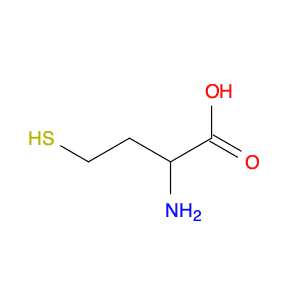
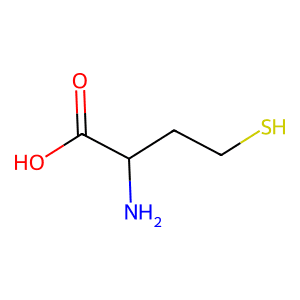
(±)-Omocisteina è un aminoacido contenente zolfo che svolge un ruolo cruciale nel metabolismo della metionina, un aminoacido essenziale. È un aminoacido non proteogenico, il che significa che non è incorporato nelle proteine, ma è coinvolto in vari processi biochimici. L'omocisteina esiste in diverse forme, inclusa l'omocisteina libera e i suoi derivati, come la tiolattone di omocisteina. Il composto è caratterizzato dalla sua natura chirale, avendo due enantiomeri, che possono influenzare la sua attività biologica. Livelli elevati di omocisteina nel sangue sono associati a un aumento del rischio di malattie cardiovascolari, poiché può portare a disfunzione endoteliale e promuovere l'aterosclerosi. L'omocisteina è anche coinvolta nel ciclo di metilazione, dove può essere rimetilata per formare metionina o convertita in cisteina attraverso la transulfurazione. Il suo metabolismo dipende da varie vitamine, in particolare B6, B12 e acido folico. Monitorare i livelli di omocisteina può essere importante in contesti clinici, in particolare per valutare il rischio cardiovascolare e lo stato nutrizionale.
Formula:C4H9NO2S
InChI:InChI=1S/C4H9NO2S/c5-3(1-2-8)4(6)7/h3,8H,1-2,5H2,(H,6,7)
InChI key:InChIKey=FFFHZYDWPBMWHY-UHFFFAOYSA-N
SMILES:C(CCS)(C(O)=O)N
Sinonimi:- 2-Amino-4-mercaptobutanoic acid
- 2-Amino-4-mercaptobutyric acid
- 2-Amino-4-sulfanylbutanoic acid
- <span class="text-smallcaps">DL</span>-Homocysteine
- Butyric acid, 2-amino-4-mercapto-, <span class="text-smallcaps">DL</span>-
- D-homocysteine
- DL-Homocysteine 2-Amino-4-mercaptobuyric acid
- Homocysteine
- NSC 206252
- Butyric acid, 2-amino-4-mercapto-, DL-
- DL-Homocysteine
Ordinare per
Purezza (%)
0
100
|
0
|
50
|
90
|
95
|
100
11 prodotti.
DL-Homocysteine
CAS:Formula:C4H9NO2SPurezza:>90.0%(T)Colore e forma:White to Almost white powder to crystalPeso molecolare:135.18DL-Homocysteine
CAS:Formula:C4H9NO2SPurezza:(Titration) ≥ 95.0%Colore e forma:White to off-white or pale pink powderPeso molecolare:135.18Ref: 4Z-C-77140
5mgPrezzo su richiesta10mgPrezzo su richiesta25mgPrezzo su richiesta50mgPrezzo su richiesta100mgPrezzo su richiestaDL-Homocysteine
CAS:DL-Homocysteine (2-Amino-4-mercaptobutyric acid) is a potential marker for tumor cell growth.Formula:C4H9NO2SPurezza:99.57% - ≥98%Colore e forma:SolidPeso molecolare:135.18DL-Homocysteine, 90%
CAS:Applications DL-Homocysteine is an allosteric antagonist at the dopamine d2 receptors. Mainly, L-Homocysteine (H591950) exists naturally and is recycled into methionine or converted into cysteine.
References Agnati, L. et al.: J. Proteome Res. 5, 3011 (2006); Stipanuk, M. et al.: Ann. Rev. Nutrition., 24, 539 (2004);Formula:C4H9NO2SPurezza:90%Colore e forma:Off WhitePeso molecolare:135.19Ref: ST-EA-CP-E38001
10mgPrezzo su richiesta25mgPrezzo su richiesta50mgPrezzo su richiesta100mgPrezzo su richiesta2-Amino-4-mercaptobutanoic acid
CAS:Formula:C4H9NO2SPurezza:98%Colore e forma:White powderPeso molecolare:135.18DL-Homocysteine
CAS:DL-Homocysteine is a sulfur-containing amino acid that is essential for the synthesis of methionine, and is an intermediate in the metabolism of L-methionine. DL-homocysteine has been shown to cause cardiac infarction in rats by inhibiting mitochondrial functions. This amino acid also inhibits the activity of enzymes that regulate homocysteine levels, such as cystathione beta-synthase and cystathione gamma-lyase. DL-homocysteine can be used as a fluorescent probe for detecting proteins involved in apoptosis. It also has proapoptotic effects on cells, causing them to undergo apoptosis.Formula:C4H9NO2SPurezza:Min. 95%Colore e forma:PowderPeso molecolare:135.19 g/mol