

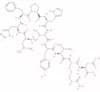
CAS 484-43-5
:(val5)-angiotensina I
Descrizione:
(val5)-angiotensina I, noto anche come Angiotensina I, è un ormone peptidico che gioca un ruolo cruciale nella regolazione della pressione sanguigna e dell'equilibrio dei fluidi nel corpo. È un decapeptide composto da dieci aminoacidi, specificamente derivato dal precursore angiotensinogeno, prodotto nel fegato. La struttura di (val5)-angiotensina I include una sequenza di aminoacidi che contribuiscono alla sua attività biologica, principalmente attraverso la sua interazione con i recettori dell'angiotensina. Questo peptide è un componente chiave del sistema renina-angiotensina, vitale per l'omeostasi cardiovascolare. La sua funzione principale è quella di agire come substrato per l'enzima convertitore dell'angiotensina (ACE), che lo converte in angiotensina II, un potente vasocostrittore. Il numero CAS 484-43-5 identifica in modo univoco questa sostanza nelle banche dati chimiche, facilitando il suo studio e la sua applicazione in farmacologia e medicina. In generale, (val5)-angiotensina I è significativo sia nei processi fisiologici che nelle interventi terapeutiche relative all'ipertensione e all'insufficienza cardiaca.
Formula:C61H87N17O14
InChI:InChI=1/C61H87N17O14/c1-32(2)22-40(62)51(82)71-43(25-37-28-65-30-68-37)53(84)74-45(24-35-12-8-7-9-13-35)59(90)78-21-11-15-47(78)56(87)72-44(26-38-29-66-31-69-38)55(86)77-50(34(5)6)58(89)73-42(23-36-16-18-39(79)19-17-36)54(85)76-49(33(3)4)57(88)70-41(14-10-20-67-61(63)64)52(83)75-46(60(91)92)27-48(80)81/h7-9,12-13,16-19,28-34,40-47,49-50,79H,10-11,14-15,20-27,62H2,1-6H3,(H,65,68)(H,66,69)(H,70,88)(H,71,82)(H,72,87)(H,73,89)(H,74,84)(H,75,83)(H,76,85)(H,77,86)(H,80,81)(H,91,92)(H4,63,64,67)/t40-,41-,42-,43-,44-,45-,46-,47-,49-,50-/m0/s1
SMILES:CC(C)C[C@@H](C(=N[C@@H](Cc1cnc[nH]1)C(=N[C@@H](Cc1ccccc1)C(=O)N1CCC[C@H]1C(=N[C@@H](Cc1cnc[nH]1)C(=N[C@@H](C(C)C)C(=N[C@@H](Cc1ccc(cc1)O)C(=N[C@@H](C(C)C)C(=N[C@@H](CCCNC(=N)N)C(=N[C@@H](CC(=O)O)C(=O)O)O)O)O)O)O)O)O)O)N
Sinonimi:- Angiotensin I, val(5)-
- 5-Val-angiotensin I
- Angiotensin I, valine(5)-
- Angiotensin I, 5-L-valine-
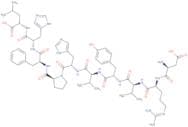
- L-leucyl-L-histidyl-L-phenylalanyl-L-prolyl-L-histidyl-L-valyl-L-tyrosyl-L-valyl-N~5~-(diaminomethylidene)-L-ornithyl-L-aspartic acid
Ordinare per
Purezza (%)
0
100
|
0
|
50
|
90
|
95
|
100
3 prodotti.
[Val5]-Angiotensin I (Bovine)
CAS:[Val5]-Angiotensin I (Bovine) is a peptide that activates angiotensin receptors. It is used as a research tool in the study of ion channels and protein interactions. The antibody recognizes the C-terminal region of angiotensin I, which can be used to inhibit the activation of these receptors by preventing binding to their ligands.Formula:C61H87N17O14•CH3COOH•5H2OPurezza:Min. 95%Peso molecolare:1,432.53 g/mol(Val5)-Angiotensin I trifluoroacetate salt
CAS:Angiotensin I is a peptide that belongs to the class of substances called angiotensins. This substance is found in many tissues and organs, including the brain, adrenal gland, and lung. Angiotensin I has been shown to be a pressor agent and also has biochemical effects on amino acid composition. The c-terminal sequence of this substance has been determined by incubating the molecule with pepsin at different pH values. The molecular weight of this substance is 938 Da and it has an amino acid composition of Asp-Arg-Val-Tyr-Val-His-Pro-Phe-His-Leu.Formula:C61H87N17O14Purezza:Min. 95%Peso molecolare:1,282.45 g/mol[Val5]-Angiotensin I (Bovine) (Bulk)
CAS:Angiotensin I (Bovine) is a synthetic substrate that is used for the measurement of Angiotensin I-converting enzyme activity in vitro. It has been incubated with rat or bovine tissue and can be used as a chromatographic standard. This substrate binds to the active site of the enzyme and undergoes hydrolysis, which generates an increase in pH. The resulting product is then measured fluorimetrically by measuring the decrease in absorbance at 350 nm. This peptide has been found to have a pressor effect and an inhibitory effect on acid secretion.
Formula:C61H87N17O14•CH3COOH•5H2OPurezza:Min. 95%Peso molecolare:1,432.53 g/mol
![[Val5]-Angiotensin I (Bovine)](/_next/image/?url=https%3A%2Fstatic.cymitquimica.com%2Fproducts%2F3D%2Fthumb%2FPAN-4069-V.jpg&w=3840&q=75)

![[Val5]-Angiotensin I (Bovine) (Bulk)](/_next/image/?url=https%3A%2Fstatic.cymitquimica.com%2Fproducts%2F3D%2Fthumb%2FPAN-4069.jpg&w=3840&q=75)