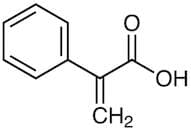
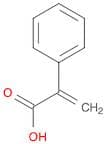
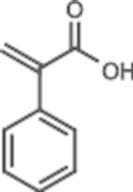
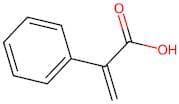
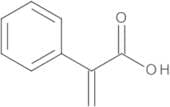
CAS 492-38-6
:Acido α-fenilacrilico
- 2-Phenylacrylic Acid
- 2-Phenylprop-2-Enoic Acid
- 2-Phenylpropenoic acid
- 2-Propenoic acid, 2-phenyl-
- Acrylic acid, 2-phenyl-
- Alpha-Phenylacrylic Acid
- Benzeneacetic acid, α-methylene-
- NSC 20987
- alpha-Toluic acid, alpha-methylene-
- α-Methylenebenzeneacetic acid
- α-Phenylacrylic acid
- α-Substituted Acrylic Acids
- Vedi altri sinonimi
Atropic Acid
CAS:Formula:C9H8O2Purezza:>93.0%(GC)Colore e forma:White to Almost white powder to crystalPeso molecolare:148.16Ref: IN-DA0033FD
1g22,00€5g26,00€10g34,00€25g54,00€50g91,00€100g126,00€75g130,00€200g181,00€300g267,00€1kg281,00€Atropic acid
CAS:Atropic acid (Acrylic acid) (Ipratropium EP Impurity D) is an impurity of Ipratropium bromide and Atropine Sulfate.Formula:C9H8O2Purezza:99.31%Colore e forma:SolidPeso molecolare:148.162-Phenylacrylic acid
CAS:2-Phenylacrylic acidFormula:C9H8O2Purezza:98%Colore e forma: off-white crystalline solidPeso molecolare:148.16g/molIpratropium Bromide EP Impurity D
CAS:Formula:C9H8O2Colore e forma:White To Off-White SolidPeso molecolare:148.16Ref: ST-EA-CP-I4004
10mgPrezzo su richiesta25mgPrezzo su richiesta50mgPrezzo su richiesta100mgPrezzo su richiestaAtropic Acid
CAS:Impurity Ipratropium EP Impurity D
Stability Light Sensitive
Applications Atropic acid (Ipratropium EP Impurity D) is an impurity of Ipratropium bromide (I740500) and Atropine Sulfate (A794625).
References Lyon, R., et al.: J. Pharm. Sci., 95, 1549 (2006), Loch, M., et al.: Toxicology, 233, 229 (2007), John, H., et al.: Anal. Bioanal. Chem., 396, 751 (2010),Formula:C9H8O2Colore e forma:NeatPeso molecolare:148.162-Phenylacrylic acid
CAS:2-Phenylacrylic acid is a chromatographic method that can be used as a cross-linking agent in the synthesis of polycarboxylic acids. It has been shown to protonate tiglic acid, which is an important component in the formation of polycarboxylic acids. 2-Phenylacrylic acid also has acidic properties and can be used as a conditioning agent for the synthesis of hydroxylated molecules. This compound has been shown to have hepatic steatosis-inducing effects and may also contribute to metabolic disorders such as diabetes mellitus type II. Molecular modeling studies have shown that 2-phenylacrylic acid is able to bind with human liver cells, which may be due to its hydroxyl group.
Formula:C9H8O2Purezza:Min. 95%Colore e forma:PowderPeso molecolare:148.16 g/mol