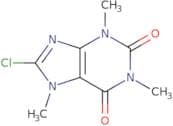
CAS 4921-49-7
:8-Clorocaffeina
Descrizione:
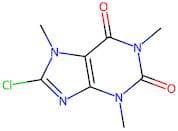
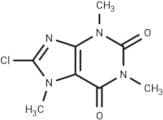
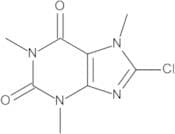
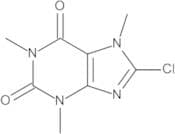
8-Clorocaffeina, con il numero CAS 4921-49-7, è un derivato clorurato della caffeina, un noto stimolante presente nel caffè e nel tè. Questo composto presenta un atomo di cloro sostituito nella posizione 8 della molecola di caffeina, il che altera le sue proprietà chimiche e l'attività biologica. Di solito appare come un solido cristallino bianco o bianco sporco ed è solubile in solventi organici, sebbene la sua solubilità in acqua possa essere limitata. La presenza dell'atomo di cloro può influenzare i suoi effetti farmacologici, potenzialmente migliorando o modificando le sue proprietà stimolanti rispetto alla caffeina. 8-Clorocaffeina è di interesse nella ricerca per le sue potenziali applicazioni in farmacologia e biochimica, in particolare negli studi relativi al sistema nervoso centrale. Come molti composti clorurati, è essenziale maneggiare 8-Clorocaffeina con cura, considerando la potenziale tossicità e l'impatto ambientale. In generale, la sua struttura e le sue proprietà uniche lo rendono un argomento di interesse sia nella chimica sintetica che in quella medicinale.
Formula:C8H9ClN4O2
InChI:InChI=1/C8H9ClN4O2/c1-11-4-5(10-7(11)9)12(2)8(15)13(3)6(4)14/h1-3H3
InChI key:InChIKey=HGKPGBJNNATDRR-UHFFFAOYSA-N
SMILES:CN1C2=C(C(=O)N(C)C1=O)N(C)C(Cl)=N2
Sinonimi:- 1H-Purine-2,6-dione, 8-chloro-3,7-dihydro-1,3,7-trimethyl-
- 1H-Purine-2,6-dione, 8-chloro-3,7-dihydro-1,3,7-trimethyl- (9CI)
- 8-Chloro-1,3,7-trimethylxanthine
- 8-Chlorocaffeine
- 8-chloro-1,3,7-trimethyl-3,7-dihydro-1H-purine-2,6-dione
- Brn 0232628
- Caffeine, 8-chloro-
- Nsc 6277
- 8-Chloro-3,7-dihydro-1,3,7-trimethyl-1H-purine-2,6-dione
- 5-26-14-00135 (Beilstein Handbook Reference)
- 8-Chloro-3,7-dihydro-1,3,7-trimethyl-1H-purine-2,6-dione
- 1,3,7-Trimethyl-8-chloroxanthine
- Caffeine EP Impurity A
- Dimenhydrinate EP Impurity E (8-Chlorocaffeine)
- Dimenhydrinate Impurity 3
- 8-Chloro-1,3,7-trimethyl-3,7-dihydr
- Dimenhydrinate Impurity 5 (Dimenhydrinate EP Impurity E)
- Caffeine Impurity 2
- Dimenhydrinate Impurity E
- Dimenhydrinate Related Compound E (8-chloro-3,7-dihydro-1,3,7-trimethyl-1H-purine-2,6-dione) (1206017)
- DiMenhydrinate Related CoMpound E
- Dimenhydrinate USP Related Compound E
- Vedi altri sinonimi
Ordinare per
Purezza (%)
0
100
|
0
|
50
|
90
|
95
|
100
9 prodotti.
Dimenhydrinate Related Compound E (8-chloro-3,7-dihydro-1,3,7-trimethyl-1H-purine-2,6-dione)
CAS:Vegetable alkaloids, natural or reproduced by synthesis, their salts and other derivatives, nesoiFormula:C8H9ClN4O2Colore e forma:White Off-White PowderPeso molecolare:228.04148-Chloro caffeine
CAS:8-Chloro caffeine binds to adenosine receptors with a Ki of 30 µM. It enhances UV-induced chromosomal aberrations in the Cl-I type Chinese hamster embryo lung cells. 8-Chloro caffeine is a derivative of the methylxanthine alkaloid caffeine.Formula:C8H9ClN4O2Colore e forma:SolidPeso molecolare:228.64Dimenhydrinate EP Impurity E (Dimenhydrinate USP Related Compound E)
CAS:Formula:C8H9ClN4O2Colore e forma:White To Off-White SolidPeso molecolare:228.648-Chloro Caffeine
CAS:Applications A halogenated analog of Caffeine (C080100) as potential radiosensitizing agent.
References Bruns, R.F., et al.: Biochem. Pharmacol., 30, 325 (1981),Formula:C8H9ClN4O2Colore e forma:White SolidPeso molecolare:228.64Ref: ST-EA-CP-D52005
10mgPrezzo su richiesta25mgPrezzo su richiesta50mgPrezzo su richiesta100mgPrezzo su richiestaDimenhydrinate Related Compound E
CAS:Prodotto controllatoDimenhydrinate Related Compound E is a test compound that has shown potentiation of the inhibitory properties of hydrochloric acid against a variety of enzymes. This compound inhibits the enzyme activity of cyclooxygenase-1 (COX-1) and COX-2, which are important in the production of prostaglandins. Dimenhydrinate Related Compound E also has anticancer activity, which may be due to its ability to cause DNA damage by inhibiting the synthesis of proteins needed for cell replication. The use of this compound may have genotoxic effects and chronic exposure should be avoided.Formula:C8H9ClN4O2Purezza:Min. 95%Peso molecolare:228.64 g/mol