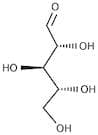
CAS 50-69-1
:Ribosio
- <span class="text-smallcaps">D</span>-Ribose
- D(-)Ribose (1.07605)
- D(minus)ribose cell culture tested
- D-ribosa
- Ribose
- Ribose, <span class="text-smallcaps">D</span>-
- Ribose, D-
- Ribose, Pure
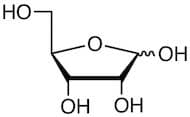
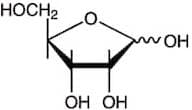
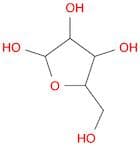
- beta-D-ribofuranose
- D-Ribose
- MeSH ID: D012266
- D-(-)-Ribose
- Vedi altri sinonimi
D-(-)-Ribose
CAS:Formula:C5H10O5Purezza:>98.0%(HPLC)Colore e forma:White to Almost white powder to crystalPeso molecolare:150.13D-(-)-Ribose, 98%
CAS:D-(-)-Ribose is mainly used as a very basic source of metabolism of life. It is also used as a precursor for virazole, adenosine, thymidine, cytidine, fluoro-thymidine, 2-methyl adenosine, pyrromonazole toxina and adenosine methionine. It is further used in the synthesis of vitamin B2 (riboflavin),Formula:C5H10O5Purezza:98%Colore e forma:White to cream to yellow to pale brown, Powder or crystalline powderPeso molecolare:150.13Ribose
CAS:Sugars, chemically pure, other than sucrose, lactose, maltose, glucose and fructose; sugar ethers and sugar esters, and their salts, nesoiFormula:C5H10O5Colore e forma:White PowderPeso molecolare:150.05282D-Ribose
CAS:D-RiboseFormula:C5H10O5Purezza:99%Colore e forma: white crystalline powderPeso molecolare:150.13g/molD-Ribose
CAS:Formula:C5H10O5Purezza:≥ 98.0%Colore e forma:White or almost white crystalline powderPeso molecolare:150.13D-Ribose(mixture of isomers)
CAS:D-Ribose, a non-essential 5-carbon sugar, is vital for DNA, RNA, ATP, ADP, and AMP, and is synthesized in the body.Formula:C5H10O5Purezza:99.81%Colore e forma:White To Off-White Crystalline PowderPeso molecolare:150.13D-Ribose
CAS:Prodotto controllatoApplications D-Ribose is produced by microorganism fermentation of glucose in a fermentation culture medium without adding calcium carbonate.
References Ostrowski, S., et al.: Science, 305, 71 (2004), Vavilin, D., et al.: Biochim. Biophys. Acta, 1708, 91 (2005), Fletcher, J., et al.: Anal. Chem., 79, 2199 (2007), Weissleder, R., et al.: Nature, 452, 580 (2008),Formula:C5H10O5Colore e forma:NeatPeso molecolare:150.13D-Ribose
CAS:D-ribose is a pentose that is used in the metabolism of plants and humans. It has been shown to inhibit binding of inhibitors to ribose and to exhibit significant cytotoxicity against tumor cells. D-Ribose also has an important role in energy metabolism, where it is involved in the synthesis of ATP. D-Ribose has been shown to be beneficial for patients with congestive heart failure, as it improves cardiac function and reduces the size of the heart. D-Ribose may also have a role in the treatment of infectious diseases by inhibiting viral replication, as well as preventing neuronal death.Formula:C5H10O5Purezza:Min. 99.0 Area-%Peso molecolare:150.13 g/molRef: 3D-R-5500
25gPrezzo su richiesta5kgPrezzo su richiesta10kgPrezzo su richiesta25kgPrezzo su richiesta2500gPrezzo su richiesta-Unit-kgkgPrezzo su richiestaD-Ribose
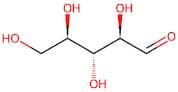
CAS:D-ribose (Rib) is an aldopentose, a component of RNA and a constituent of numerous cofactors, and certain vitamins. (Collins, 2006). Ribose is a component of bacterial polysaccharides found in Salmonella (Lindberg, 1990). Ribosylation leads to the production of significant amounts of advanced glycation end products, both extracellularly and intracellularly, it may be involved in cell dysfunction and subsequent cognitive impairments (Wei, 2012).
Formula:C5H10O5Purezza:Min. 98 Area-%Colore e forma:White Off-White PowderPeso molecolare:150.13 g/molD-Ribose, 99.0%+
CAS:D-Ribose is a pentose sugar that is the ribose sugar of D-arabinose. It is an inhibitor of bacterial growth and has been shown to inhibit binding of adenine nucleotides to their receptors in the human erythrocyte membrane. Ribose plays a vital role in energy metabolism, as it is a component of ATP and NADH. It also participates in the synthesis of DNA and RNA. Ribose can be found in many foods, such as pears, apples, potatoes, and rice. D-ribose has been shown to have significant cytotoxicity against cancer cells that are dependent on glycolysis for their energy needs. D-Ribose may also be used as a polymerase chain reaction (PCR) substrate to determine the presence of infectious diseases such as HIV or hepatitis C virus in human serum samples.Formula:C5H10O5Purezza:Min. 99.0 Area-%Peso molecolare:150.13 g/molRef: 3D-R-5495
1kgPrezzo su richiesta100gPrezzo su richiesta250gPrezzo su richiesta500gPrezzo su richiesta2500gPrezzo su richiesta-Unit-kgkgPrezzo su richiestaD-Ribose for tissue culture
CAS:Formula:C5H10O5Colore e forma:White to off - white, Hygroscopic powder, ClearPeso molecolare:150.13D-Ribose extrapure
CAS:Formula:C5H10O5Colore e forma:White to off-white, Hygroscopic powder, ClearPeso molecolare:150.13