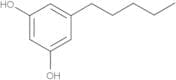
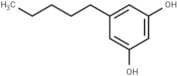
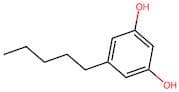
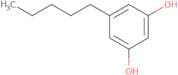
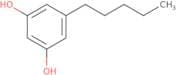
CAS 500-66-3
:Olivetolo
- 1,3-Benzenediol, 5-pentyl-
- 1,3-Dihydroxy-5-pentylbenzene
- 3,5-Dihydro-Amylbenzene
- 3,5-Dihydroxy-1-pentylbenzene
- 3,5-Dihydroxyamylbenzene
- 5-Pentyl-1,3-benzenediol
- 5-Pentyl-3-Benzenediol
- 5-Pentylbenzene-1,3-Diol
- 5-Pentylresorcinol
- 5-Pentyl 3,5-Dihydroxyamylbenzene
- 5-n-Amylresorcinol
- 5-n-Pentylresorcinol
- Oilvetol
- Olivetol
- Pentyl-3,5-dihydroxybenzene
- Resorcinol, 5-pentyl-
- Vedi altri sinonimi
Olivetol
CAS:Olivetol analytical standard provided with w/w absolute assay, to be used for quantitative titration.Formula:C11H16O2Purezza:(HPLC) ≥98%Colore e forma:PowderPeso molecolare:180.25Ref: IN-DA0035FJ
1kgPrezzo su richiesta5kgPrezzo su richiesta100mg19,00€1g25,00€5g27,00€10g33,00€25g61,00€100g151,00€500g500,00€Ref: 4Z-O-095001
5mgPrezzo su richiesta10mgPrezzo su richiesta25mgPrezzo su richiesta50mgPrezzo su richiesta100mgPrezzo su richiestaOlivetol
CAS:Olivetol, found in lichens, is an organic antioxidant and THC synthesis precursor.Formula:C11H16O2Purezza:99.98%Colore e forma:(Melting Point 102-106°F) (Ntp 1992)Peso molecolare:180.245-Pentylbenzene-1,3-diol
CAS:5-Pentylbenzene-1,3-diolFormula:C11H16O2Purezza:97%Colore e forma: light beige solidPeso molecolare:180.24g/molOlivetol
CAS:PolyphenolFormula:C11H16O2Purezza:≥ 90.0 % (HPLC)Colore e forma:PowderPeso molecolare:180.24Olivetol
CAS:Prodotto controllatoStability Light Sensitive
Applications Olivetol is a precursor in various syntheses of tetrahydrocannabinol.
References Kumano, T., et al.: Bioorg. Med. Chem., 16, 8117 (2008), Appendino, G., et al.: J. Nat. Prod., 71, 1427 (2008), Sampietro, D., et al.: Food Chem., 115, 1170 (2009),Formula:C11H16O2Colore e forma:NeatPeso molecolare:180.24Olivetol
CAS:Prodotto controllatoOlivetol is an organic compound found in several species of lichen. Olivetol is a precursor in synthesis of tetrahydrocannabinol (THC) and it acts as inhibitor of cannabinoid receptors CB1 and CB2. It has also been shown to inhibit the activity of cytochrome P450 enzymes and induce genotoxic effects in vitro. Olivetol has been shown to have anti-inflammatory properties in vivo, reducing the inflammatory response by inhibiting prostaglandin synthesis.
Formula:C11H16O2Purezza:Min. 98 Area-%Colore e forma:PowderPeso molecolare:180.24 g/molOlivetol
CAS:Prodotto controllatoOlivetol is an organic compound found in several species of lichen. Olivetol is a precursor in synthesis of tetrahydrocannabinol (THC) and it acts as inhibitor of cannabinoid receptors CB1 and CB2. It has also been shown to inhibit the activity of cytochrome P450 enzymes and induce genotoxic effects in vitro. Olivetol has been shown to have anti-inflammatory properties in vivo, reducing the inflammatory response by inhibiting prostaglandin synthesis.
Formula:C11H16O2Purezza:Min. 98 Area-%Peso molecolare:180.24 g/mol