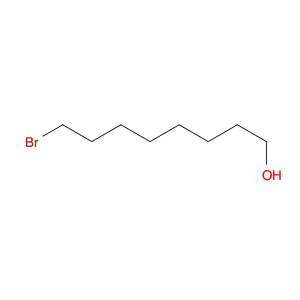
CAS 50816-19-8
:8-Bromo-1-octanol
- 1-Octanol, 8-bromo-
- 8-Bromooctan-1-ol
- 8-Bromooctanol
- 8-Hydroxy-1-bromooctane
- Octamethylene Bromohydrin
- 8-Bromo-1-octanol
8-Bromo-1-octanol
CAS:Formula:C8H17BrOPurezza:>90.0%(GC)Colore e forma:Colorless to Yellow to Orange clear liquidPeso molecolare:209.138-Bromo-1-octanol, 95%
CAS:It is used to produce 8-phenylselanyl-octan-1-ol by reaction with diphenyl-diselane. The reaction occurs with reagent sodium borohydride and solvent ethanol at ambient temperature. The yield is about 96%. 8-Bromo-1-octanol was used in the synthesis of (E)-10-hydroxy-2-decenoic acid (royal jelly acidFormula:C8H17BrOPurezza:95%Colore e forma:Clear colorless to pale yellow, LiquidPeso molecolare:209.138-Bromooctan-1-ol
CAS:Prodotto controllatoApplications 8-Bromooctan-1-ol (cas# 50816-19-8) is a useful research chemical.
Formula:C8H17BrOColore e forma:NeatPeso molecolare:209.128-Bromo-1-octanol
CAS:8-Bromo-1-octanol is a fluorescent compound that has been shown to be resistant to cancer. It can be used as a probe for the detection of malonic acid in urine samples, which are an indicator of oxidative stress. 8-Bromo-1-octanol is stable in the presence of alcohol groups, and can be used to prepare samples for population growth studies. This chemical has also been used to study the growth of bacteria such as Pseudomonas aeruginosa and Escherichia coli. 8-Bromo-1-octanol emits light at a wavelength of 490 nm when exposed to ultraviolet radiation, which makes it useful for detecting chlorine atoms in water samples. The product research involving this chemical includes its effects on k562 cells and P. aeruginosa. Studies have also been done on its hydroxyl group and fatty acids and fatty acid esters, which are found in animal fat and vegetable oils.
Formula:C8H17BrOPurezza:Min. 95%Colore e forma:Colorless Clear LiquidPeso molecolare:209.12 g/mol