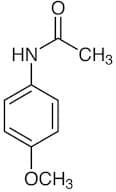
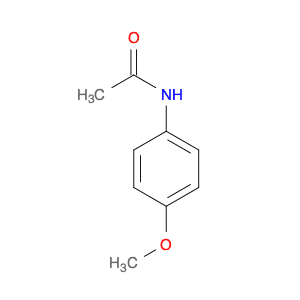
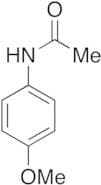
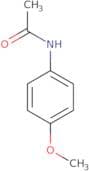
CAS 51-66-1
:N-(4-Metossifenil)acetamide
- 4-(Acetylamino)anisole
- 4-Acetamidoanisole
- 4-Acetamidophenyl methyl ether
- 4-Methoxyanilino methyl ketone
- Acetamide, N-(4-methoxyphenyl)-
- Aceto-p-anisidide
- Acetyl-p-anisidine
- Metacetin
- Methacetin
- N-(4-Methoxyphenyl)acetamide
- N-(p-Methoxyphenyl)acetamide
- N-Acetyl-4-methoxyaniline
- N-Acetyl-p-anisidine
- N-Acetyl-p-methoxyaniline
- NSC 4687
- p-Acetanasidine~N-(Methoxyphenyl)acetamide
- p-Acetaniside
- p-Acetanisidide
- p-Acetanisidine
- p-Methoxyacetanilide
- Vedi altri sinonimi
p-Acetanisidide
CAS:Formula:C9H11NO2Purezza:>98.0%(HPLC)(N)Colore e forma:White to Almost white powder to crystalPeso molecolare:165.19N-(4-Methoxyphenyl)acetamide
CAS:Formula:C9H11NO2Purezza:98%Colore e forma:SolidPeso molecolare:165.18914'-Methoxyacetanilide
CAS:4'-MethoxyacetanilideFormula:C9H11NO2Purezza:98%Colore e forma: pale purple solidPeso molecolare:165.19g/molRef: 4Z-A-248013
5mgPrezzo su richiesta10mgPrezzo su richiesta25mgPrezzo su richiesta50mgPrezzo su richiesta100mgPrezzo su richiestaMethacetin
CAS:Prodotto controllatoApplications Methacetin is evaluated in a breath test to predict early liver disfunction due to valproic acid and other cause. Methacetin breath test (MBT) is a rapid, non-invasive assessment of liver function in acute severe liver disease and a potential key tool in future dignosis.
References Dorloechter, L. et al.: Zeitsch. Ernaehrung., 36, 373 (1997); Holtmeier, J. et al.: Sand J. Gastroenterol., 41, 1336 (2006); Lalazar, G. et al.: World J. Gastroenterol., 15, 966 (2009);Formula:C9H11NO2Colore e forma:NeatPeso molecolare:165.19N-(4-Methoxyphenyl)acetamide
CAS:Formula:C9H11NO2Purezza:98%Colore e forma:Solid, White to almost white powderPeso molecolare:165.192Methacetin
CAS:Methacetin is a chemical compound that is used in the diagnosis of liver impairment. It is a fatty acid and an inhibitor of certain enzymes. Methacetin inhibits the activity of the enzyme acetyl-CoA carboxylase, which catalyzes the conversion of acetyl-CoA to malonyl-CoA, thereby reducing fatty acid synthesis. Methacetin has been shown to be effective in inhibiting the activity of rat liver microsomes at concentrations of 0.01 mM and above. In addition, methacetin has been found to increase the body mass index (BMI) in rats with hepatic impairment and can be used as a biomarker for this condition. Methacetin has been shown to have a molecular docking score of -4.2 kcal/mol when it was docked against human hepatitis B virus (HBV). This indicates that there are strong hydrogen bonding interactions between methacetin and HBV proteins.
Formula:C9H11NO2Purezza:Min. 95%Colore e forma:PowderPeso molecolare:165.19 g/mol