CAS 512-15-2
:Ciclopentolato
Descrizione:
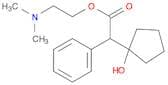
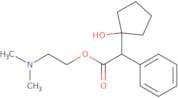
Ciclopentolato è un'ammina terziaria e un derivato dell'acido tropico, utilizzato principalmente come agente midriatico in oftalmologia per dilatare le pupille durante gli esami oculari. È caratterizzato dalla sua capacità di bloccare l'azione dell'acetilcolina sui recettori muscarinici nel muscolo sfintere dell'iride, portando alla dilatazione della pupilla. Ciclopentolato viene tipicamente somministrato come soluzione in collirio e ha un rapido inizio d'azione, con effetti che durano diverse ore. Il composto è noto per la sua relativamente bassa assorbimento sistemico, il che minimizza gli effetti collaterali. In termini di proprietà fisiche, Ciclopentolato è una polvere cristallina bianca a bianco sporco che è solubile in acqua e presenta un profilo di solubilità dipendente dal pH. La sua struttura chimica include un anello di ciclopentano, contribuendo alle sue uniche proprietà farmacologiche. Come per qualsiasi farmaco, è essenziale considerare i potenziali effetti collaterali, inclusi l'aumento della pressione intraoculare e la sensibilità alla luce, in particolare in individui suscettibili.
Formula:C17H25NO3
InChI:InChI=1S/C17H25NO3/c1-18(2)12-13-21-16(19)15(14-8-4-3-5-9-14)17(20)10-6-7-11-17/h3-5,8-9,15,20H,6-7,10-13H2,1-2H3
InChI key:InChIKey=SKYSRIRYMSLOIN-UHFFFAOYSA-N
SMILES:C(C(OCCN(C)C)=O)(C1(O)CCCC1)C2=CC=CC=C2
Sinonimi:- 1-Hydroxy-α-phenylcyclopentaneacetic acid, 2-(dimethylamino)ethyl ester
- 2-(Dimethylamino)Ethyl (1-Hydroxycyclopentyl)(Phenyl)Acetate
- 2-(Dimethylamino)ethyl 2-(1-hydroxycyclopentyl)-2-phenylacetate
- 2-Dimethylaminoethyl 1-hydroxy-α-phenylcyclopentaneacetate
- 2-Dimethylaminoethyl 2-(1-Hydroxycyclopentyl)-2-Phenylacetate
- <span class="text-smallcaps">DL</span>-Cyclopentolate
- Benzeneacetic acid, α-(1-hydroxycyclopentyl)-, 2-(dimethylamino)ethyl ester
- Ciclopentolato
- Cyclogyl
- Cyclopentaneacetic acid, 1-hydroxy-α-phenyl-, 2-(dimethylamino)ethyl ester
- Cyclopentoiate
- Cyclopentolat
- Cyclopentylate
- DL-Cyclopentolate
- Tsiklopentolat
- β-Dimethylaminoethyl (1-hydroxycyclopentyl)phenylacetate
- Mydrilate
- 2-Dimethylaminoethyl 1-hydroxy-alpha-phenylcyclopentaneacetate
- 2-dimethylaminoethyl 2-(1-hydroxycyclopentyl)-2-phenyl-ethanoate
- CYCLOPENTOLATE
- Benzeneacetic acid, a-(1-hydroxycyclopentyl)-, 2-(dimethylamino)ethylester
- 1-Hydroxy-alpha-phenylcyclopentaneacetic acid, 2-(dimethylamino)ethyl ester
- 2-(1-hydroxycyclopentyl)-2-phenyl-acetic acid 2-dimethylaminoethyl ester
- yclopentolate
- Benzeneacetic acid, alpha-(1-hydroxycyclopentyl)-, 2-(dimethylamino)ethyl ester
- α-(1-Hydroxycyclopentyl)benzeneacetic acid 2-(dimethylamino)ethyl
- beta-(Dimethylamino)ethyl (1-hydroxycyclopentyl)phenylacetate
- Cyplegin
- Vedi altri sinonimi
Ordinare per
Purezza (%)
0
100
|
0
|
50
|
90
|
95
|
100
3 prodotti.
2-(Dimethylamino)ethyl 2-(1-hydroxycyclopentyl)-2-phenylacetate
CAS:Formula:C17H25NO3Peso molecolare:291.38532-(Dimethylamino)ethyl 2-(1-hydroxycyclopentyl)-2-phenylacetate
CAS:Formula:C17H25NO3Purezza:95.0%Peso molecolare:291.391Cyclopentolate
CAS:Prodotto controllatoCyclopentolate is a muscarinic antagonist and is used as an ophthalmic drug to produce mydriasis. Cyclopentolate inhibits the metabolism of cyclopentyl-CoA via the 3-hydroxyacyl-CoA dehydrogenase, which leads to the accumulation of cyclopentyl-CoA in cells. This inhibition can cause metabolic disorders such as hyperlipidemia and diabetes mellitus, which are characterized by increased acid formation and reduced glucose uptake. Cyclopentolate also binds to DNA, inhibiting transcription, replication, and repair of DNA. The binding affinity of cyclopentolate to DNA is approximately 2500 times higher than that of other drugs in its class. Cyclopentolate has been shown to inhibit leukemia inhibitory factor (LIF) and the production of acid from fluorescein angiographyFormula:C17H25NO3Purezza:Min. 95%Colore e forma:White/Off-White SolidPeso molecolare:291.39 g/molRef: 3D-FC61687
1gPrezzo su richiesta2gPrezzo su richiesta100mg538,00€250mgPrezzo su richiesta500mgPrezzo su richiesta