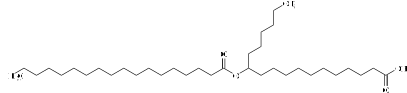
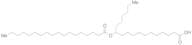
![12-[(1-Oxooctadecyl)oxy]octadecanoic acid](/_next/image/?url=https%3A%2Fstatic.cymitquimica.com%2Fcas-image%2Fthumb-webp%2F90627-12-1-oxooctadecyl-oxy-octadecanoic-acid.webp&w=3840&q=75)
CAS 51350-61-9
:Acido 12-[(1-ossottadecil)ossi]ottadecanoico
Descrizione:
Acido 12-[(1-ossottadecil)ossi]ottadecanoico, noto anche con il suo numero CAS 51350-61-9, è un derivato di acido grasso a catena lunga caratterizzato da una coda idrofobica di idrocarburi e da un gruppo funzionale acido carbossilico polare. Questo composto presenta un legame estere formato tra un acido ottadecanoico (acido stearico) e un gruppo ottadecanoyl, che contribuisce alla sua natura anfifilica. La presenza del gruppo oxo introduce una funzionalità carbonilica, migliorando la sua reattività e le potenziali applicazioni in vari processi chimici. Tipicamente, tali composti mostrano proprietà tensioattive, rendendoli utili nell'emulsificazione, solubilizzazione e come intermedi nella sintesi di molecole più complesse. Inoltre, le lunghe catene di idrocarburi possono influenzare le proprietà fisiche del composto, come il punto di fusione e la solubilità, che sono critiche per applicazioni in prodotti farmaceutici, cosmetici e scienza dei materiali. In generale, Acido 12-[(1-ossottadecil)ossi]ottadecanoico rappresenta un composto chimico versatile con potenziale utilità in diversi contesti industriali e di ricerca.
Formula:C36H70O4
InChI:InChI=1S/C36H70O4/c1-3-5-7-9-10-11-12-13-14-15-16-17-22-25-29-33-36(39)40-34(30-26-8-6-4-2)31-27-23-20-18-19-21-24-28-32-35(37)38/h34H,3-33H2,1-2H3,(H,37,38)
InChI key:InChIKey=HCUIHIKPUYHKSQ-UHFFFAOYSA-N
SMILES:C(OC(CCCCCCCCCCCCCCCCC)=O)(CCCCCCCCCCC(O)=O)CCCCCC
Sinonimi:- Octadecanoic acid, 12-[(1-oxooctadecyl)oxy]-
- 11-Carboxy-1-hexylundecyl stearate
- 12-SAHSA
- 12-[(1-Oxooctadecyl)oxy]octadecanoic acid
Ordinare per
Purezza (%)
0
100
|
0
|
50
|
90
|
95
|
100
4 prodotti.
Ref: 4Z-F-106065
5mgPrezzo su richiesta10mgPrezzo su richiesta25mgPrezzo su richiesta50mgPrezzo su richiesta100mgPrezzo su richiesta12-SAHSA
CAS:12-SAHSA is a metabolite of the amino acid methionine. It is involved in the regulation of insulin sensitivity and fatty acid metabolism. 12-SAHSA has been shown to decrease hepatic steatosis and inhibit the growth of cancer cells in vitro. 12-SAHSA is formed by oxidation of the hydroxy group in methionine, which can be analyzed using gas chromatography-mass spectrometry (GC-MS). This metabolite can be detected in human serum, tissues, and adipose tissue. The physiological function of 12-SAHSA is not yet clear, but it may play a role in fatty acid metabolism or as an intermediate in the production of other metabolites.Formula:C36H70O4Purezza:Min. 95%Peso molecolare:566.9 g/mol12-SAHSA
CAS:Branched fatty acid esters of hydroxy fatty acids (FAHFAs) are lipids recently discovered to be modulated by dietary influences such as fasting and high-fat feeding, and they play a role in enhancing insulin sensitivity. These compounds typically feature a carbon-16 or carbon-18 fatty acid (e.g., palmitoleic, palmitic, oleic, or stearic acid) esterified to a carbon-16 or carbon-18 hydroxy fatty acid. A specific example is 12-SAHSA, which consists of stearic acid linked to 12-hydroxy stearic acid. Notably, 12-SAHSA levels are found to be moderately increased in the serum of glucose tolerant AG4OX mice, a model characterized by adipose tissue-specific overexpression of the Glut4 glucose transporter.Formula:C36H70O4Colore e forma:SolidPeso molecolare:566.952