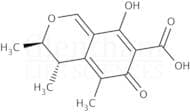
CAS 518-75-2
:Citrinina
Descrizione:
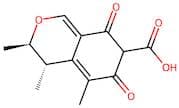
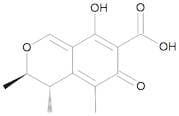
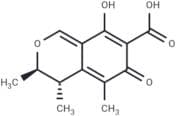
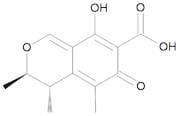
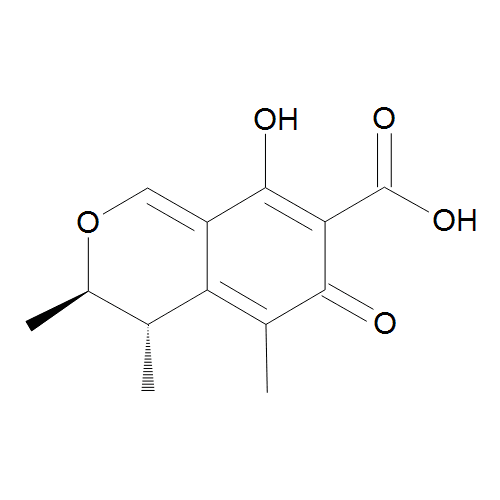
Citrinina è una micotossina prodotta da varie specie di funghi, in particolare quelle dei generi Penicillium e Monascus. È principalmente conosciuta per il suo colore giallastro ed è classificata come un polichetonico. Citrinina ha una formula molecolare di C13H14O5 e un peso molecolare di circa 250 g/mol. Questo composto è solubile in solventi organici come metanolo ed etanolo, ma ha una solubilità limitata in acqua. Citrinina è riconosciuta per i suoi effetti nefrotossici, che possono portare a danni renali negli esseri umani e negli animali in caso di esposizione. È stata implicata in varie preoccupazioni relative alla sicurezza alimentare, in particolare in prodotti fermentati e cereali contaminati dai funghi produttori. A causa del suo profilo tossicologico, Citrinina è soggetta a controllo normativo e si stanno facendo sforzi per monitorare e limitare la sua presenza nei prodotti alimentari. Inoltre, la ricerca continua sui suoi meccanismi biochimici e potenziali impatti sulla salute, sottolineando l'importanza di comprendere le micotossine nella sicurezza alimentare e nella salute pubblica.
Formula:C13H14O5
InChI:InChI=1S/C13H14O5/c1-5-7(3)18-4-8-9(5)6(2)11(14)10(12(8)15)13(16)17/h4-5,7,15H,1-3H3,(H,16,17)/t5-,7-/m1/s1
InChI key:InChIKey=CQIUKKVOEOPUDV-IYSWYEEDSA-N
SMILES:CC1=C2C(C(O)=C(C(O)=O)C1=O)=CO[C@H](C)[C@H]2C
Sinonimi:- (3R,4S)-4,6-Dihydro-8-hydroxy-3,4,5-trimethyl-6-oxo-3H-2-benzopyran-7-carboxylic acid
- 4,6-Dihydro-8-hydroxy-3,4,5-trimethyl-6-oxo-3H-2-benzopyran-7-carboxylic acid
- 3H-2-Benzopyran-7-carboxylic acid, 4,6-dihydro-8-hydroxy-3,4,5-trimethyl-6-oxo-, (3R-trans)-
- Citrinin
- 3H-2-Benzopyran-7-carboxylic acid, 4,6-dihydro-8-hydroxy-3,4,5-trimethyl-6-oxo-, (3R,4S)-
Ordinare per
Purezza (%)
0
100
|
0
|
50
|
90
|
95
|
100
12 prodotti.
Citrinin
CAS:CitrininFormula:C13H14O5Purezza:By hplc: 99.09% (Typical Value in Batch COA)Colore e forma: yellow crystalsPeso molecolare:250.25g/molCitrinin (Standard)
CAS:Citrinin (Standard) is the standard substance of Citrinin, and it is applicable for quantitative analysis, quality control, and related research in biochemical experiments. Citrinin is a mycotoxin that causes contamination in the food and is associated with different toxic effects. Citrinin also possesses a broad spectrum of bioactivities, including antifungal, antibacterial, and potential anticancer and neuroprotective effects in vitro.Formula:C13H14O5Peso molecolare:250.25Citrinin
CAS:Citrinin: a mycotoxin with antifungal, antibacterial, potential anticancer, and neuroprotective properties; contaminates food.Formula:C13H14O5Purezza:98%Colore e forma:Lemon-Yellow Needles From Alc SolidPeso molecolare:250.25Citrinin 100 µg/mL in Acetonitrile
CAS:Prodotto controllatoFormula:C13H14O5Colore e forma:Single SolutionPeso molecolare:250.25Ref: 4Z-C-206003
5mgPrezzo su richiesta10mgPrezzo su richiesta25mgPrezzo su richiesta50mgPrezzo su richiesta100mgPrezzo su richiestaRef: 4Z-C-206002
5mgPrezzo su richiesta10mgPrezzo su richiesta25mgPrezzo su richiesta50mgPrezzo su richiesta100mgPrezzo su richiestaRef: 4Z-C-206001
5mgPrezzo su richiesta10mgPrezzo su richiesta25mgPrezzo su richiesta50mgPrezzo su richiesta100mgPrezzo su richiesta(-)-Citrinin
CAS:Stability Hygroscopic
Applications Antibiotic substance produced by a white spore aspergilus which has been placed under the species name Aspergillus niveus. Also produced in small quantities by Penicillium citrinum.
Not a dangerous good if item is equal to or less than 1g/ml and there is less than 100g/ml in the package
References Ciegler, A., et al.: Appl. Microbiol., 26, 271 (1973), Creppy, E., et al.: Toxicol. Lett., 28, 29 (1985), DeGroene, E., et al.: Cancer Res., 56, 299 (1996),Formula:C13H14O5Colore e forma:YellowPeso molecolare:250.25(-)-Citrinin
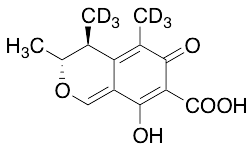
CAS:(-)-Citrinin is a mycotoxin, which is a secondary metabolite produced by certain species of fungi, including Penicillium, Aspergillus, and Monascus. It is predominantly isolated from the molds found in grains and other agricultural products. The mode of action of (-)-Citrinin involves the disruption of mitochondrial function, leading to impaired energy metabolism and potential cytotoxic effects. This compound inhibits the activity of various mitochondrial enzymes and disrupts the electron transport chain, which can lead to oxidative stress and cellular damage.Formula:C13H14O5Purezza:Min. 95%Peso molecolare:250.25 g/mol(-)-Citrinin 4,5-bis(trideuteromethyl)
CAS:Prodotto controllatoFormula:C13D6H8O5Colore e forma:NeatPeso molecolare:256.284