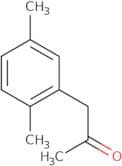
CAS 53291-89-7
:2,5-Dimetilfenilacetone
Descrizione:
2,5-Dimetilfenilacetone, con il numero CAS 53291-89-7, è un composto organico che appartiene alla classe delle chetoni. Presenta un gruppo fenilico sostituito con due gruppi metilici nelle posizioni 2 e 5, insieme a un gruppo funzionale di acetone. Questo composto è tipicamente un liquido incolore o giallo pallido con un odore caratteristico. È noto per il suo utilizzo nella sintesi organica e come potenziale intermedio nella produzione di vari farmaci e fragranze. La presenza del gruppo funzionale chetonico contribuisce alla sua reattività, permettendogli di partecipare a varie reazioni chimiche, come le aggiunte nucleofile. Inoltre, 2,5-Dimetilfenilacetone è relativamente stabile in condizioni standard, ma deve essere maneggiato con cura a causa dei potenziali rischi per la salute associati ai chetoni. La sua solubilità nei solventi organici lo rende utile in varie applicazioni, anche se è meno solubile in acqua. Devono essere seguiti protocolli adeguati di stoccaggio e manipolazione per garantire la sicurezza e mantenere la sua integrità.
Formula:C11H14O
InChI:InChI=1/C11H14O/c1-8-4-5-9(2)11(6-8)7-10(3)12/h4-6H,7H2,1-3H3
SMILES:Cc1ccc(C)c(c1)CC(=O)C
Sinonimi:- 1-(2,5-Dimethylphenyl)Propan-2-One
Ordinare per
Purezza (%)
0
100
|
0
|
50
|
90
|
95
|
100
3 prodotti.
(2,5-Dimethylphenyl)acetone
CAS:2,5-Dimethylphenyl)acetone is an analogue of amphetamine that has been shown to have similar binding and uptake properties in the brain. This drug was synthesized for use in positron emission tomography (PET) studies on the distribution of amphetamine analogues in the human brain. It is also used as a radioligand for studies on cerebral uptake of amphetamines. 2,5-Dimethylphenyl)acetone itself has no significant central nervous system activity. However, it can be used to determine whether other drugs are able to cross the blood-brain barrier and enter the brain. Radiofluorination with iodine-123, which emits positrons during decay, yields a compound that binds to amines such as dopamine and norepinephrine receptors in the brain. The presence of these amines can then be detected using PET imaging techniques.END>Formula:C11H14OPurezza:Min. 96 Area-%Colore e forma:Clear LiquidPeso molecolare:162.23 g/mol