CAS 535-34-2
:cistationina
Descrizione:
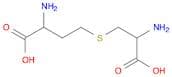
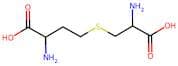
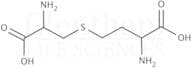
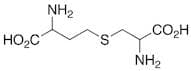
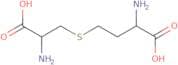
cistationina è un aminoacido che si trova naturalmente ed è un intermediario chiave nella via della transulfurazione, che è coinvolta nel metabolismo degli aminoacidi contenenti zolfo, in particolare metionina e cisteina. È un dipeptide formato dalla condensazione di omocisteina e serina, e svolge un ruolo cruciale nella sintesi della cisteina. cistationina è caratterizzato dalla sua formula strutturale, che include un legame tioetere e un gruppo acido carbossilico, contribuendo alla sua reattività e funzioni biologiche. Esiste in due forme stereoisomeriche, con la forma L biologicamente attiva. In termini di solubilità, cistationina è solubile in acqua, il che facilita le sue interazioni biologiche. Livelli elevati di cistationina nel corpo possono essere indicativi di alcuni disturbi metabolici, inclusa l'omocistinuria. Inoltre, cistationina può essere coinvolto in vari percorsi biochimici, influenzando i processi cellulari e contribuendo alla regolazione dello stress ossidativo. Il suo numero CAS, 535-34-2, è utilizzato per l'identificazione in database chimici e contesti normativi.
Formula:C7H14N2O4S
InChI:InChI=1/C7H14N2O4S/c8-4(6(10)11)1-2-14-3-5(9)7(12)13/h4-5H,1-3,8-9H2,(H,10,11)(H,12,13)/t4-,5?/m0/s1
InChI key:InChIKey=ILRYLPWNYFXEMH-UHFFFAOYSA-N
SMILES:C(CCSCC(C(O)=O)N)(C(O)=O)N
Sinonimi:- (3Alpha,5Alpha,17Alpha)-Androstane-3,17-Diol
- 2-Amino-4-[(2-amino-2-carboxyethyl)sulfanyl]butanoic acid
- 2-Azaniumyl-4-(2-azaniumyl-2-carboxylatoethyl)sulfanylbutanoate
- <span class="text-smallcaps">DL</span>-Allocystathionine
- <span class="text-smallcaps">DL</span>-Cystathionine
- <span class="text-smallcaps">DL</span>-Homocysteine, S-(2-amino-2-carboxyethyl)-
- Butyric acid, α-amino-γ-(2-amino-2-carboxyethylmercapto)-
- Cystathionine, <span class="text-smallcaps">DL</span>-
- Cystathionine, DL-
- DL-Allocystathionine
- DL-Cystathionine
- DL-Homocysteine, S-(2-amino-2-carboxyethyl)-
- Homocysteine, S-(2-amino-2-carboxyethyl)-
- NSC 118379
- S-(2-Amino-2-carboxyethyl)-DL-homocysteine
- S-(2-Amino-2-carboxyethyl)homocysteine
- S-(2-amino-2-carboxyethyl)-L-homocysteine
- S-[(2R)-2-amino-2-carboxyethyl]-L-homocysteine
- DL,DL-allo-Cystathionine, S-(2-Amino-2-carboxyethyl)homocysteine
- CYSTATHIONINE
- dl,dl-allo-cystathionine
- -2-Amino-4-((2-amino-2-carboxyethyl)
- 2-amino-4-[(2-amino-3-hydroxy-3-keto-propyl)thio]butyric acid
- 2-amino-4-(2-amino-3-hydroxy-3-oxopropyl)sulfanylbutanoic acid
- D,L-CYSTATHIONINE
- 2-aMino-4-((2-aMino-2-carboxyethyl)thio)butanoic acid
- 2-azanyl-4-(2-azanyl-3-hydroxy-3-oxo-propyl)sulfanyl-butanoic acid
- Allocystathionine
- Vedi altri sinonimi
Ordinare per
Purezza (%)
0
100
|
0
|
50
|
90
|
95
|
100
6 prodotti.
(2S)-2-Amino-4-((2-amino-2-carboxyethyl)thio)butanoic acid
CAS:Formula:C7H14N2O4SPurezza:97%Colore e forma:SolidPeso molecolare:222.2621D,L-Cystathionine
CAS:Formula:C7H14N2O4SPurezza:(HPLC) ≥ 90.0%Colore e forma:White to off-white powderPeso molecolare:222.30D,L-Cystathionine
CAS:Prodotto controllatoApplications Intermediate for transsulfuration whereby a mammal transfers the sulfur of methionine via homocysteine to cysteine.
References Thompson, J.W., et al.: J. Biol. Chem., 266, 17011 (1991), Yoshida, Y., et al.: Microbiol., 148, 3961 (2002), Jiracek, J., et al.: J. Med. Chem., 49, 3982 (2006),Formula:C7H14N2O4SColore e forma:NeatPeso molecolare:222.26D,L-Cystathionine
CAS:Cystathionine is a sulfur-containing amino acid that is the precursor of cysteine. Cystathionine synthase, the enzyme that catalyzes the formation of cystathionine, is inhibited by L-cysteine and glutathione. Cystathionine has been shown to be an important growth factor for fibroblasts and osteoblasts in culture as well as a regulator of gene expression. It also has been shown to be essential for iron homeostasis, as it increases iron absorption from the gut and reduces iron excretion in bile. Cystathionine is a highly reactive molecule with a high redox potential and can cause oxidative injury to cells, which may contribute to bowel disease. Cystathionine has been shown to have receptor activity in neurons, and its physiological effects are similar to those of glutamate.Formula:C7H14N2O4SPurezza:Min. 95%Colore e forma:PowderPeso molecolare:222.26 g/mol