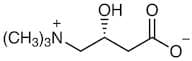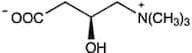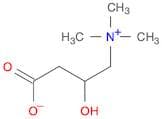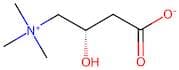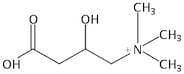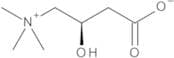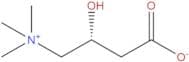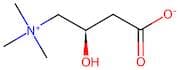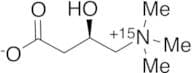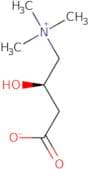
CAS 541-15-1
:(-)-Carnitina
- (-)-<span class="text-smallcaps">L</span>-Carnitine
- (-)-Carnitine
- (3R)-3-Hydroxy-4-(trimethylazaniumyl)butanoate
- (D)L-Carnitine
- (R)-(3-Carboxy-2-hydroxypropyl)trimethylammoniumhydroxid
- (R)-(3-carboxy-2-hydroxypropyl)trimethylammonium hydroxide
- (R)-Carnitine
- 1-Butanaminium, 2,4-dihydroxy-N,N,N-trimethyl-4-oxo-, inner salt, (2R)-
- 1-Propanaminium, 3-carboxy-2-hydroxy-N,N,N-trimethyl-, hydroxide, inner salt, (R)-
- 1-Propanaminium, 3-carboxy-2-hydroxy-N,N,N-trimethyl-, inner salt, (2R)-
- 1-Propanaminium, 3-carboxy-2-hydroxy-N,N,N-trimethyl-, inner salt, (R)-
- 3-Hydroxy-4-(trimethylammonio)butanoate
- <span class="text-smallcaps">L</span>-Carnipure
- Aminocarnifarm
- Ammonium Hydroxide Inner Salt, 1-(3-Carboxy-2-Hydroxypropyl)Trimethyl-2R-
- Ammonium, (3-carboxy-2-hydroxypropyl)trimethyl-, hydroxide, inner salt, <span class="text-smallcaps">L</span>-
- Ammonium, (3-carboxy-2-hydroxypropyl)trimethyl-, hydroxide, inner salt, L-
- Carniking
- Carniking 50
- Carnil
- Carnilean
- Carnipass
- Carnipass 20
- Carnitene
- Carnitor
- Carnivit
- Coaxel
- L-Carnipure
- L-Carnitine Base
- Levocarnitine
- Levocarnitinep
- Natrulon RC
- St 198
- Vitamin B<sub>T</sub>
- Vitamin BT
- hidroxido de (R)-(3-carboxi-2-hidroxipropil)trimetilamonio
- Vedi altri sinonimi
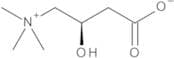
L-Carnitine
CAS:Formula:C7H15NO3Purezza:>98.0%(T)(HPLC)Colore e forma:White to Almost white powder to crystalPeso molecolare:161.20L-Carnitine, 98+%
CAS:L-Carnitine is widely used as a nutritional supplement in food and beverage industries. It is used as a food additive. It acts as a cyanide antidote. It is also used in reversing and preventing hyperthyroid symptoms. It is a vitamin-like nutrient, which plays an important role in human metabolism.
Formula:C7H15NO3Purezza:98+%Colore e forma:White, Crystals or powder or crystalline powderPeso molecolare:161.20Levocarnitine
CAS:Quaternary ammonium salts and hydroxides, whether or not chemically defined, otherFormula:C7H15NO3Colore e forma:White PowderPeso molecolare:161.10519(3R)-3-hydroxy-4-(trimethylazaniumyl)butanoate
CAS:Formula:C7H15NO3Purezza:%Colore e forma:SolidPeso molecolare:161.1989L-Carnitine
CAS:L-Carnitine aids fatty acid oxidation in mitochondria for energy, excluding the brain.Formula:C7H15NO3Purezza:99.29% - 99.94%Colore e forma:White Crystalline Hygroscopic Powder SolidPeso molecolare:161.20L-Carnitin 100 µg/mL in Acetonitrile
CAS:Formula:C7H15NO3Colore e forma:Single SolutionPeso molecolare:161.20Carnitine Chloride Impurity 6
CAS:Formula:C7H14ClN2·ClColore e forma:White To Off-White SolidPeso molecolare:161.65 35.45Ref: 4Z-C-7221
5mgPrezzo su richiesta10mgPrezzo su richiesta25mgPrezzo su richiesta50mgPrezzo su richiesta100mgPrezzo su richiestaL-Carnitine, USP grade
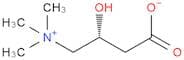
CAS:Formula:C7H15NO3Purezza:D-carnitine: ≤ 0.2%Colore e forma:White crystalline powderPeso molecolare:161.20(3R)-(-)-3-Hydroxy-4-(trimethylammonio)butanoate
CAS:(3R)-(-)-3-Hydroxy-4-(trimethylammonio)butanoateFormula:C7H15NO3Purezza:98%Colore e forma: white solidPeso molecolare:161.1989g/molL-Carnitine
CAS:Stability Hygroscopic
Applications Essential cofactor of fatty acid metabolism; required for the transport of fatty acids through the inner mitochondrial membrane. Synthetized primarily in the liver and kidney; highest concentrations found in heart and skeletal muscle. Dietary sources include red meat, dairy products, beans, avocado.
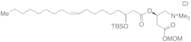
References Mitchell, M.E., et al.: Am. J. Clin. Nutr., 31, 293 (1978), Lango, R., et al.: Cardiovasc. Res., 51, 21 (2001), Vaz, F.M., et al.: Biochem. J., et al.: 361, 417 (2002), Karlic, H., et al.: Nutrition, 20, 709 (2004),Formula:C7H15NO3Colore e forma:NeatPeso molecolare:161.20Carnitine Methoxymethyl Ester Chloride Salt
CAS:Prodotto controllatoApplications Carnitine Methoxymethyl Ester Chloride Salt is an analog of Carnitine (C184110), an essential cofactor for the metabolism of fatty acids.
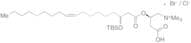
Formula:C9H20NO4·ClColore e forma:NeatPeso molecolare:241.7123-tert-Butyldimethylsilyloxyoleyl Carnitine Ester (Mixture of Chloride and Bromide Salts)
CAS:Prodotto controllatoApplications 3-tert-Butyldimethylsilyloxyoleyl Carnitine Ester (Mixture of Chloride and Bromide Salts) is an analog of Carnitine (C184110), an essential cofactor for the metabolism of fatty acids.
Formula:C31H62NO5SiBrorClColore e forma:NeatPeso molecolare:670.326923-tert-Butyldimethylsilyloxyoleyl O-(Methoxymethoxy)carnitine Ester Chloride Salt
CAS:Prodotto controllatoApplications 3-tert-Butyldimethylsilyloxyoleyl O-(Methoxymethoxy)carnitine Ester Chloride Salt is an analog of Carnitine (C184110), an essential cofactor for the metabolism of fatty acids.
Formula:C33H66ClNO6SiColore e forma:NeatPeso molecolare:636.42L-Carnitine extrapure, 99%
CAS:Formula:C7H15NO3Purezza:min. 99%Colore e forma:White, Crystalline compound, Clear, ColourlessPeso molecolare:161.20L-Carnitine-15N
CAS:Prodotto controllatoApplications L-Carnitine-15N is an isotopically labelled analog of L-Carnitine (C184110), which is an essential cofactor of fatty acid metabolism; required for the transport of fatty acids through the inner mitochondrial membrane. Synthetized primarily in the liver and kidney; highest concentrations found in heart and skeletal muscle.
References Mitchell, M.E., et al.: Am. J. Clin. Nutr., 31, 293 (1978); Lango, R., et al.: Cardiovasc. Res., 51, 21 (2001);Vaz, F.M., et al.: Biochem. J., et al.: 361, 417 (2002);Karlic, H., et al.: Nutr. J., 20, 709 (2004)Formula:C7H15NO3Colore e forma:NeatPeso molecolare:162.19Ref: ST-EA-CP-L33000
10mgPrezzo su richiesta25mgPrezzo su richiesta50mgPrezzo su richiesta100mgPrezzo su richiestaL-Carnitine
CAS:L-Carnitine is a naturally occurring amino acid that is involved in the metabolism of fatty acids. L-Carnitine has been shown to have antioxidant properties and can protect tissues against oxidative injury. It also plays an important role in energy metabolism, as well as the maintenance of mitochondrial functions. L-Carnitine has been used to treat atherosclerotic lesions in humans, kidney fibrosis, and blood sampling. L-Carnitine can be used to reduce the symptoms of hypoglycemia and has also been shown to inhibit the growth of infectious diseases such as Helicobacter pylori and Salmonella typhi, through scavenging of reactive oxygen radicals.
Formula:C7H15NO3Colore e forma:White PowderPeso molecolare:161.2 g/mol