CAS 54193-28-1
:Doxorubicinol
Descrizione:
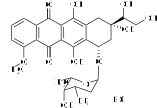
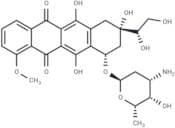
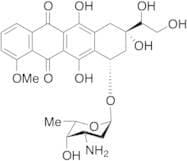
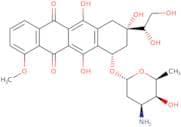
Doxorubicinol, con il numero CAS 54193-28-1, è un metabolita dell'antibiotico antraciclino doxorubicina, ampiamente utilizzato nella terapia del cancro. Questo composto mantiene alcune delle proprietà farmacologiche del suo farmaco genitore, inclusa l'attività antitumorale, ma ha un profilo diverso in termini di efficacia e tossicità. Doxorubicinol è caratterizzato dalla sua capacità di intercalare il DNA, interrompendo il processo di replicazione e portando alla morte cellulare, che è un meccanismo d'azione comune tra le antraciclina. È tipicamente meno potente della doxorubicina, ma può contribuire agli effetti terapeutici complessivi nei pazienti in trattamento. Il composto è anche noto per la sua potenziale cardiotossicità, un effetto collaterale associato alla doxorubicina, sebbene l'estensione possa variare. In termini di proprietà fisiche, Doxorubicinol è un solido cristallino rosso-arancio, solubile in acqua e solventi organici, il che facilita la sua formulazione per uso clinico. La sua struttura chimica include un sistema ad anello tetraciclico, caratteristico delle antraciclina, che contribuisce alla sua attività biologica.
Formula:C27H31NO11
InChI:InChI=1S/C27H31NO11/c1-10-22(31)13(28)6-17(38-10)39-15-8-27(36,16(30)9-29)7-12-19(15)26(35)21-20(24(12)33)23(32)11-4-3-5-14(37-2)18(11)25(21)34/h3-5,10,13,15-17,22,29-31,33,35-36H,6-9,28H2,1-2H3/t10-,13-,15-,16-,17-,22+,27-/m0/s1
InChI key:InChIKey=NKZRZOVSJNSBFR-FEMMEMONSA-N
SMILES:OC=1C2=C([C@@H](O[C@H]3C[C@H](N)[C@H](O)[C@H](C)O3)C[C@@]([C@H](CO)O)(O)C2)C(O)=C4C1C(=O)C=5C(C4=O)=C(OC)C=CC5
Sinonimi:- 5,12-Naphthacenedione, 10-[(3-amino-2,3,6-trideoxy-α-L-lyxo-hexopyranosyl)oxy]-8-(1,2-dihydroxyethyl)-7,8,9,10-tetrahydro-6,8,11-trihydroxy-1-methoxy-, [8S-[8α,8(R*),10α]]-
- 13-Dihydrodoxorubicin
- 5,12-Naphthacenedione, 10-[(3-amino-2,3,6-trideoxy-α-L-lyxo-hexopyranosyl)oxy]-8-[(1S)-1,2-dihydroxyethyl]-7,8,9,10-tetrahydro-6,8,11-trihydroxy-1-methoxy-, (8S,10S)-
- (8S,10S)-10-[(3-Amino-2,3,6-trideoxy-α-L-lyxo-hexopyranosyl)oxy]-8-[(1S)-1,2-dihydroxyethyl]-7,8,9,10-tetrahydro-6,8,11-trihydroxy-1-methoxy-5,12-naphthacenedione
- Adriamycinol
Ordinare per
Purezza (%)
0
100
|
0
|
50
|
90
|
95
|
100
6 prodotti.
Doxorubicinol hydrochloride
CAS:Formula:C27H32ClNO11Purezza:≥ 90.0% (sum of isomers)Colore e forma:Red to dark red/brown powderPeso molecolare:582.0Doxorubicinol
CAS:Doxorubicinol is the major circulating metabolite of doxorubicin with antineoplastic acitivity.Formula:C27H31NO11Colore e forma:SolidPeso molecolare:545.54Doxorubicinol (>90%)
CAS:Prodotto controllatoApplications Doxorubicinol is a cardiotoxic metabolite of Doxorubicin (D558000). Used as an antineoplastic.
References Freeland, M.M., et. al.: Anti-Cancer Drug, 23, 584 (2012)Formula:C27H31NO11Purezza:>90%Colore e forma:NeatPeso molecolare:545.54Doxorubicinol Hydrochloride (>90%)(Mixture of diastereomers)
CAS:Prodotto controllatoApplications A metabolite of Doxorubicin as neoplasm inhibitor.
References Smith, T.H.Formula:C27H31NO11•HClColore e forma:RedPeso molecolare:545.54 + 36.46Doxorubicinol,mixture of diastereomers
CAS:Doxorubicinol, a mixture of diastereomers, is an anthracycline antibiotic that inhibits the growth of cells by binding to DNA and preventing the production of RNA. Doxorubicinol has been shown to be effective in treating breast cancer and solid tumours, including those resistant to doxorubicin. This drug has also been shown to inhibit the production of matrix metalloproteinases that are involved in tumor invasion and metastasis. The concentration-time curve for doxorubicinol can be determined experimentally by blood sampling and measuring its metabolites. The ryanodine receptor is a calcium channel found on the surface membrane of cardiac muscle cells that regulates intracellular calcium levels. Doxorubicinol may bind to this receptor, which could account for its cardiotoxic effects.Formula:C27H31NO11Purezza:(%) Min. 90%Peso molecolare:545.54 g/mol