CAS 546-89-4
:Acetato di litio
Descrizione:
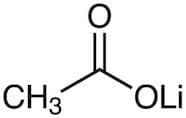
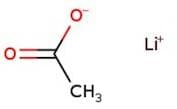
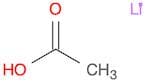
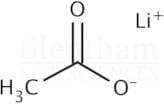
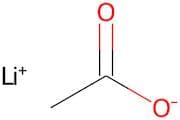
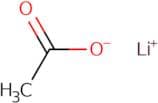
Acetato di litio è un composto organico con la formula C2H3LiO2 ed è classificato come un sale di litio dell'acido acetico. Appare come un solido cristallino bianco che è igroscopico, il che significa che può assorbire umidità dall'aria. Acetato di litio è solubile in acqua e in solventi organici polari, rendendolo utile in varie applicazioni. Ha un punto di fusione relativamente basso e può decomporsi quando riscaldato. Questo composto è spesso utilizzato nella ricerca biochimica, in particolare nella preparazione di tamponi contenenti litio e come reagente nella sintesi organica. Inoltre, Acetato di litio è stato studiato per i suoi potenziali effetti terapeutici nel trattamento dei disturbi dell'umore, poiché gli ioni di litio sono noti per avere proprietà stabilizzanti dell'umore. Le considerazioni di sicurezza includono maneggiarlo con cura, poiché può causare irritazione alla pelle e agli occhi. In generale, Acetato di litio è un composto versatile con una rilevanza significativa sia in contesti industriali che di ricerca.
Formula:C2H3LiO2
InChI:InChI=1/C2H4O2.Li/c1-2(3)4;/h1H3,(H,3,4);/q;+1/p-1
InChI key:InChIKey=QQGWBRJQPRTJDA-UHFFFAOYSA-N
SMILES:C(C)(O)=O.[Li]
Sinonimi:- Acetate de lithium
- Acetate, Lithium
- Acetato De Litio
- Acetic acid, lithium salt (1:1)
- Lithium Acetate
- Lithium ethanoate
- Lithiumacetat
- Quilone
- Quilonorm
- Quilonum
- Acetic acid lithium salt
- Lithium Acetate Anhydrous
- Lithium acetate andydrous
- Anhydrous Lithium Acetate
- Acetic acid, lithium salt
- LithiumAcetateDihydrateA.R.
- LithiumAcetateDihydrate,>96%
- lithiumethanate
- Lithiumacetatehydrate,Puratronic,99.998%(metalsbasis)
- lithium acetate solution
- LITHIUM ACETATE, 99.99%
- Lithium acetate, pure
- LITHIUM ACETATE PHIX(R) BUFFER
- Lithium acetate hydrate, Puratronic(R), 99.998% (metals basis)
- lithiumethanoate
- LITHIUMACETATE,CRYSTAL,REAGENT
- LITHIUM ACETATE SOLUTION 5M
- Lithiumethanoat
- Acetic acid lithium
- LithiumAcetateGr(Dihydrate)
- Vedi altri sinonimi
Ordinare per
Purezza (%)
0
100
|
0
|
50
|
90
|
95
|
100
8 prodotti.
Lithium Acetate
CAS:Formula:C2H3LiO2Purezza:>98.0%(T)Colore e forma:White to Almost white powder to crystalPeso molecolare:65.98Lithium acetate hydrate, Puratronic™, 99.998% (metals basis)
CAS:Lithium acetate hydrate is used in the laboratory as buffer for gel electrophoresis of DNA and RNA. It is also used to permeabilize the cell wall of yeast for use in DNA transformation. It is a metal acetate for proteomics research. This Thermo Scientific Chemicals brand product was originally partFormula:C2H3LiO2Purezza:99.998%Colore e forma:White, Crystals or powder or crystalline powder and/or chunksPeso molecolare:65.98Lithium acetate anhydrous
CAS:Formula:LiOOCCH3Purezza:≥ 99.0%Colore e forma:White to off-white crystalline powderPeso molecolare:65.99Lithium acetate 99+%
CAS:Formula:CH3COOLiPurezza:≥ 99.0%Colore e forma:White powder, crystals or crystalline powderPeso molecolare:65.98Lithium acetate
CAS:Formula:C2H3LiO2Purezza:98%Colore e forma:Solid, Crystalline Powder or PowderPeso molecolare:65.98Lithium acetate
CAS:Lithium acetate is a salt that is used in polymer chemistry. It has been shown to have an optimum concentration of 0.1 M and a thermal expansion coefficient of 8.6 × 10⁻⁵ K−1. Lithium acetate has been used as a component in the synthesis of polyvinyl pyrrolidone (PVP). Lithium acetate has also been used in polymerization reactions, such as cationic polymerization and Suzuki coupling reactions, which are often conducted in the presence of hydrochloric acid. Lithium acetate is also used as a model system for studying interactions between lithium ions and creatine kinase, which has implications for the treatment of diseases such as osteoporosis or prostate cancer. The transport rate of lithium ions through the cell membrane is increased by the addition of lithium acetate, which suggests that this compound may be helpful in treating conditions involving ion transport disorders.Formula:C2H4O2•LiPurezza:Min. 95%Colore e forma:PowderPeso molecolare:66.99 g/mol