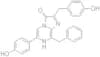
CAS 55779-48-1
:Coelenterazina
Descrizione:
Coelenterazina è un composto bioluminescente trovato principalmente in vari organismi marini, comprese alcune specie di meduse e creature delle profondità. È classificato come una luciferina, un tipo di molecola emittente luce che subisce una reazione chimica in presenza di ossigeno, catalizzata dall'enzima luciferasi, per produrre luce. Coelenterazina ha una formula molecolare che include carbonio, idrogeno, azoto e ossigeno, contribuendo alle sue proprietà uniche. Questo composto è notevole per il suo ruolo nella bioluminescenza, che svolge varie funzioni ecologiche come predazione, comunicazione e mimetismo. Oltre alla sua occorrenza naturale, Coelenterazina è utilizzato in ambienti di laboratorio per saggi bioluminescenti e tecniche di imaging, rendendolo prezioso nella ricerca biologica. La sua capacità di emettere luce in reazione con enzimi specifici lo rende uno strumento utile in biologia molecolare e biochimica. Il composto è anche di interesse nello studio della biologia marina e nello sviluppo di biosensori.
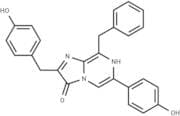
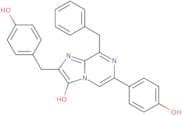
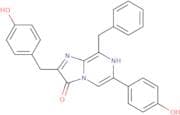
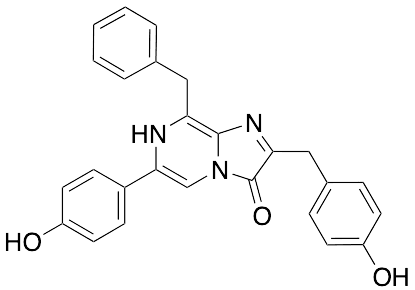
Formula:C26H21N3O3
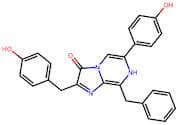
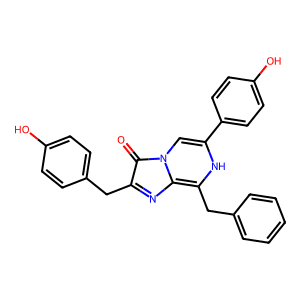
InChI:InChI=1S/C26H21N3O3/c30-20-10-6-18(7-11-20)15-23-26(32)29-16-24(19-8-12-21(31)13-9-19)27-22(25(29)28-23)14-17-4-2-1-3-5-17/h1-13,16,27,30-31H,14-15H2
InChI key:InChIKey=YHIPILPTUVMWQT-UHFFFAOYSA-N
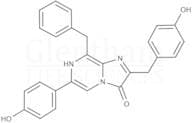
SMILES:C(C1=C2N(C=C(N1)C3=CC=C(O)C=C3)C(=O)C(CC4=CC=C(O)C=C4)=N2)C5=CC=CC=C5
Sinonimi:- 2-[(4-Hydroxyphenyl)Methyl]-6-(4-Hydroxyphenyl)-8-(Phenylmethyl)-Imdazo[1,2-A]Pyrazin-3-(7H)-One
- 6-(4-Hydroxyphenyl)-2-[(4-hydroxyphenyl)methyl]-8-(phenylmethyl)imidazo[1,2-a]pyrazin-3(7H)-one
- 8-Benzyl-2-(4-Hydroxybenzyl)-6-(4-Hydroxyphenyl)Imidazo[1,2-A]Pyrazin-3(7H)-One
- Coelenterazin
- Coelenterazine
- Coelenterazine luciferin
- Coelenterazine ntv
- Imidazo[1,2-a]pyrazin-3(7H)-one, 6-(4-hydroxyphenyl)-2-[(4-hydroxyphenyl)methyl]-8-(phenylmethyl)-
- Luciferin
- Luciferin (Oplophorus)
- NanoFuel
- Native coelenterazine
- Preluciferin
- Preluciferin (Watasenia)
- Vedi altri sinonimi
Ordinare per
Purezza (%)
0
100
|
0
|
50
|
90
|
95
|
100
12 prodotti.
Coelenterazine, native, Aequorea sp.
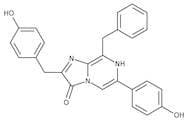
CAS:Coelenterazine, native, Aequorea sp.Formula:C26H21N3O3Peso molecolare:423.468-benzyl-6-(4-hydroxyphenyl)-2-[(4-hydroxyphenyl)methyl]-7H-imidazo[1,2-a]pyrazin-3-one
CAS:Formula:C26H21N3O3Purezza:98%Colore e forma:SolidPeso molecolare:423.4632Ref: IN-DA00I9Y7
25mgPrezzo su richiesta50mgPrezzo su richiesta100mgPrezzo su richiesta1mg153,00€5mg355,00€10mg679,00€Coelenterazine
CAS:CoelenterazineFormula:C26H21N3O3Colore e forma: yellow to brown crystalline powderPeso molecolare:423.46g/molCoelenterazine
CAS:Formula:C26H21N3O3Purezza:≥ 95.0%Colore e forma:Yellow to brown solidPeso molecolare:423.46Ref: 4Z-C-467001
5mgPrezzo su richiesta10mgPrezzo su richiesta25mgPrezzo su richiesta50mgPrezzo su richiesta100mgPrezzo su richiestaCoelenterazine
CAS:Coelenterazine is a superoxide anion-sensitive chemiluminescent probe.Cost-effective and quality-assured.Formula:C26H21N3O3Purezza:97.05% - 99.02%Colore e forma:Yellow SolidPeso molecolare:423.46Ref: TM-T6808
500µg57,00€1mg94,00€2mg138,00€5mg288,00€10mg442,00€25mg648,00€50mg888,00€100mg1.234,00€200mg1.648,00€Coelenterazine - lyopholised
CAS:Coelenterazine is a bio-luminescent substrate of luciferases such as Renilla luciferase (Rluc) and Gaussia luciferase (Gluc). The main applications of Coelenterazine are monitoring of reporter genes and chemiluminescence-based methods for Calcium detection. The substrate is also used in bioluminescence resonance energy transfer (BRET), ELISA, HTS and chemiluminescent detection of superoxide anion and peroxynitritein cells or tissues. About this grade Coelenterazine, native, dried (C-7002): in order to provide milligram and sub-milligram quantities of native Coelenterazine we pre-dissolve the substance; defined amounts of Coelenterazine are subsequently dried under nitrogen in individual vials. Coelenterazine, native, dried is identical in quality and chemistry to our product Coelenterazine, native which is provided as a powder. Information to the user: since Coelenterazine is sensitive to oxygen, degas your solvents for stock solutions, if possible. To dissolve Coelenterazine, native, dried please proceed as follows. 1) Add the appropriate amount of solvent. If possible through the septum using a needle. Otherwise open the cap with pliers. 2) Vortex the closed vial briefly to completely dissolve the content of the vial. 3) Take out the solution, if possible with a needle through the septum.Formula:C26H21N3O3Purezza:Min. 95 Area-%Peso molecolare:423.48 g/molCoelenterazine, native
CAS:Coelenterazine is the substrate for the enzymes Renilla luciferase, Gaussia luciferase and other luciferase enzymes. Marine organisms like squids, shrimps, fish and jellyfish use coelenterazine to produce spectacular bioluminescence (in analogy with insects which utilize firefly luciferine). Today, coelenterazine is used in numerous applications like immunoassays, ELISA, monitoring of reporter genes, chemiluminescence detection of superoxide anion and peroxynitritein cells or tissues. The substrate is also used in bioluminescence resonance energy transfer (BRET), HTS and protein based methods for Calcium detection. The isolation and structure determination of coelenterazine was reported independently by two different groups in the seventies who discovered the molecule in sea pansy (Renilla reniformis) and in the cnidarian Aequorea victoria, respectively. Interestingly it was also found that the luminescent jellyfish Aequorea victoria does not produce coelenterazine itself but it rather assimilates it through ingestion of small preys like shrimps and copepods. This product Coelenterazine, native, which is provided as a powder, is identical in quality and chemistry to our product Coelenterazine, native, dried.Formula:C26H21N3O3Purezza:Min. 95 Area-%Peso molecolare:423.48 g/molCoelenterazine Native (CLZN) ex. Aequorea Sp., 95%
CAS:Formula:C26H21N3O3Purezza:min 95% by TLCColore e forma:Slightly brownish yellow to yellow orange, Crystalline powderPeso molecolare:423.46Coelenterazine, native
CAS:Prodotto controllatoApplications Coelenterazine is a luminophore of the aequorin complex which is oxidized by oxygen to illuminate at 465nm when Ca2+ binds to the complex. Used to measure Ca2+ concentration in cells with high sensitivity an dlarge dynamic range.
References Fluck, R.A., et al.: J. Cell Biol., 115, 1259 (1991), Jones, K., et al.: Trends Biotechnol., 17, 477 (1999), Dubuisson, M.L., et al.: Biochem. Pharmacol., 60, 471 (2000)Formula:C26H21N3O3Colore e forma:NeatPeso molecolare:423.46

![8-benzyl-6-(4-hydroxyphenyl)-2-[(4-hydroxyphenyl)methyl]-7H-imidazo[1,2-a]pyrazin-3-one](/_next/image/?url=https%3A%2Fstatic.cymitquimica.com%2Fproducts%2FIN%2Fthumb%2FDA00I9Y7.jpg&w=3840&q=75)