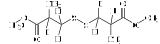
CAS 56-89-3
:(-)-Cistina
Descrizione:
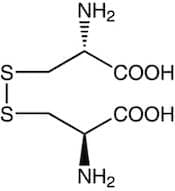
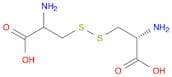
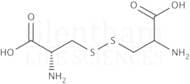
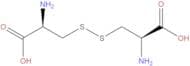
(-)-Cistina, con il numero CAS 56-89-3, è un amminoacido che si trova naturalmente e gioca un ruolo cruciale nella struttura e funzione delle proteine. È una forma dimera della cisteina, formata dall'ossidazione di due molecole di cisteina, risultando in un legame disolfuro tra i loro gruppi tiolici. Questo composto è caratterizzato dalla sua apparente cristallina bianca ed è solubile in acqua, il che facilita le sue funzioni biologiche. (-)-Cistina è essenziale per la stabilità delle strutture proteiche, in particolare nella formazione di strutture terziarie e quaternarie grazie alla sua capacità di formare ponti disolfuro. È anche coinvolto in vari processi metabolici ed è importante per la sintesi del glutatione, un antiossidante chiave nel corpo. In termini di significato biologico, (-)-Cistina si trova in molte proteine ed è vitale per mantenere l'equilibrio redox all'interno delle cellule. La sua presenza è particolarmente nota nella cheratina, che è un componente principale dei capelli, della pelle e delle unghie. In generale, (-)-Cistina è fondamentale per numerosi processi fisiologici e contribuisce all'integrità strutturale delle proteine.
Formula:C6H12N2O4S2
InChI:InChI=1/C3H6NO2S3/c5-3(6)2(4-7)1-9-8/h2H,1,4H2,(H,5,6)
InChI key:InChIKey=LEVWYRKDKASIDU-IMJSIDKUSA-N
SMILES:[C@H](CSSC[C@@H](C(O)=O)N)(C(O)=O)N
Sinonimi:- (-)-3,3-Dithiobis(2-aminopropionic acid)
- (2R,2'S)-3,3'-disulfanediylbis(2-ammoniopropanoate)
- (H-Cys-OH)2
- (H-Cys-OH)2 (Disulfide bond)
- 2-Amino-3-[(2-amino-2-carboxyethyl)dithio]propanoic acid
- 3,3'-Dithiobis(2-aminopropanoic acid)
- <span class="text-smallcaps">L</span>-(-)-Cystine
- <span class="text-smallcaps">L</span>-Alanine, 3,3′-dithiobis-
- <span class="text-smallcaps">L</span>-Cysteine disulfide
- <span class="text-smallcaps">L</span>-Cystin
- Alanine, 3,3'-dithiobis-
- Bis(β-amino-β-carboxyethyl) disulfide
- Cistina
- Cystin
- Cystine
- Cystine acid
- Cystine, <span class="text-smallcaps">L</span>-
- Cystine, L-
- Dicysteine
- H-(Cys)_2-OH
- L(-)-3,3-Dithiobis(2-aminopropanoic acid)
- L-(-)-Cysteine
- L-Alanine, 3,3'-dithiobis-
- L-Cysteine disulfide
- L-Cystin
- L-Cystine, synthetically derived
- L-Cystine,food grade
- Nsc 13203
- Oxidized <span class="text-smallcaps">L</span>-cysteine
- Oxidized L-cysteine
- Propanoic acid, 3,3'-dithiobis[2-amino-, [R-(R*,R*)]-
- [R-(R*,R*)]-3,3'-Dithiobis[2-aminopropanoic acid]
- β,β'-Diamino-β,β'-dicarboxydiethyl disulfide
- β,β'-Dithiodialanine
- L-Cystine
- (R,R)-3,3'-DITHIOBIS(2-AMINOPROPIONIC ACID)
- (R)-(-)-CYSTINE
- L-CYTISINE
- (r-(r*,r*))-3,3’-dithiobis(2-aminopropanoicacid)
- L-CYSTINE BASE
- 3,3’-dithiobis(2-aminopropanoicacid)
- H-L-CYSTINE
- 3,3’-dithiobis-l-alanin
- BETA,BETA'-DITHIOBIS-A-AMINOPROPIONIC ACID
- (R,R)-(-)-CYSTINE
- 3,3’-dithiobis(2-amino-,(r-(r*,r*))-propanoicaci
- 1-cystine
- Vedi altri sinonimi
Ordinare per
Purezza (%)
0
100
|
0
|
50
|
90
|
95
|
100
L-(-)-Cystine
CAS:Formula:C6H12N2O4S2Purezza:>98.0%(HPLC)(N)Colore e forma:White powder to crystalinePeso molecolare:240.29L-Cystine, 99%
CAS:L-Cystine is used as an antioxidant, protecting tissues against radiation and pollution. It finds application in protein synthesis. It is required for utilization of vitamin B6 and is useful in healing burns and wounds. It is also is required by certain malignant cell lines in the culture medium asFormula:C6H12N2O4S2Purezza:99%Colore e forma:White to pale cream, Crystals or powder or crystalline powderPeso molecolare:240.29L-Cystine, Cell Culture Reagent
CAS:L-cysteine acts as a major source of sulfur in cell culture. Cysteine has been used in pulse-chase experiments to study protein expression from an inducible promoter. L-Cysteine is used to supplement cell culture media. This Thermo Scientific Chemicals brand product was originally part of the Alfa AFormula:C6H12N2O4S2Colore e forma:White, Crystals or crystalline powderPeso molecolare:240.29Cystine
CAS:Other organo-sulfur acid compoundsFormula:C6H12N2O4S2Colore e forma:White Crystalline PowderPeso molecolare:240.02385Ref: 4Z-C-411
5mgPrezzo su richiesta10mgPrezzo su richiesta25mgPrezzo su richiesta50mgPrezzo su richiesta100mgPrezzo su richiestaL-Cystine, non-animal origin, Ph. Eur. grade
CAS:Formula:C6H12N2O4S2Colore e forma:White or almost white crystalline powderPeso molecolare:240.30L-Cystine
CAS:L-CystineFormula:C6H12N2O4S2Purezza:99% (Typical Value in Batch COA)Colore e forma: white powderPeso molecolare:240.30g/molL-Cystine, non-animal origin
CAS:Formula:C6H12N2O4S2Purezza:≤ 0.2%Colore e forma:White or almost white crystalline powderPeso molecolare:240.30L-Cystine
CAS:Formula:C6H12N2O4S2Purezza:98.5 - 101.0 %Colore e forma:White crystalline powderPeso molecolare:240.30Ref: 4Z-A-336005
5mgPrezzo su richiesta10mgPrezzo su richiesta25mgPrezzo su richiesta50mg803,00€100mg1.123,00€L-Cystine
CAS:L-Cystine (Cystine Acid) is not considered one of the 20 amino acids, L-Cystine (Cystine Acid) is a sulfur-containing derivative obtained from oxidation ofFormula:C6H12N2O4S2Purezza:99.59% - 99.85%Colore e forma:White Solid PowderPeso molecolare:240.30Ref: 4Z-C-4116
5mgPrezzo su richiesta10mgPrezzo su richiesta25mgPrezzo su richiesta50mgPrezzo su richiesta100mgPrezzo su richiestaL-Cystine
CAS:Impurity Acetylcysteine EP Impurity A
Applications L-Cystine is a non-essential amino acid for human development. L-Cystine is formed by the dimerization of two cysteines through the sulfur. Acetylcysteine EP Impurity A
References Fahey, R.C., et al.: J. Mol. Evol., 10, 155 (1977), Kao, P., et al.: J. Biol.Chem., 261, 8085 ( 1986), Nicke, A., et al.: J. Biol. Chem., 278, 3137 (2003),Formula:C6H12N2O4S2Colore e forma:WhitePeso molecolare:240.3