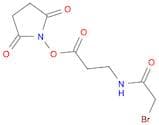
CAS 57159-62-3
:2,5-diossopirrolidin-1-il N-(bromoacetil)-beta-alaninato
- beta-alanine, N-(2-bromoacetyl)-, 2,5-dioxo-1-pyrrolidinyl ester
- 2,5-Dioxopyrrolidin-1-yl N-(bromoacetyl)-beta-alaninate
N-Succinimidyl 3-(Bromoacetamido)propionate
CAS:Formula:C9H11BrN2O5Purezza:95%Colore e forma:SolidPeso molecolare:307.09803-(2-Bromoacetamido)propanoic acid nhs ester
CAS:3-(2-Bromoacetamido)propanoic acid nhs esterPurezza:95%Peso molecolare:307.10g/molN-Succinimidyl 3-(Bromoacetamido)propionate
CAS:N-Succinimidyl 3-(Bromoacetamido)propionate, a cleavable PEG linker for PROTACs and ADCs, enables targeted drug delivery.Formula:C9H11BrN2O5Purezza:98%Colore e forma:White SolidPeso molecolare:307.1Succinimidyl 3-(bromoacetamido)propionate
CAS:Succinimidyl 3-(bromoacetamido)propionate (SBAP) is a reactive chemical that can be used to synthesize a variety of polymers. SBAP is used in the treatment of inflammatory bowel disease, where it acts as an immunosuppressant by suppressing antibody response to the bowel. SBAP has also been shown to increase collagen production and glycoconjugates, which are compounds found on the surface of cells that act as receptors for many types of bacteria and viruses. The polymerase chain reaction (PCR), which is used in DNA analysis, uses SBAP as a way to separate DNA fragments. For this reason, SBAP is often found in wastewater treatment plants. It has been shown that exposure to SBAP can cause infectious diseases in humans, such as tuberculosis and leprosy. This compound has also been studied for its effects on growth factor-β1 and body mass index, which may help with autoimmune diseases such as multiple
Formula:C9H11N2O5BrPurezza:Min. 98 Area-%Colore e forma:White PowderPeso molecolare:307.1 g/mol