CAS 58-55-9
:Teofillina
Descrizione:
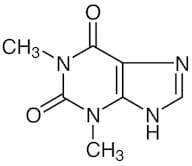
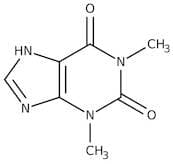
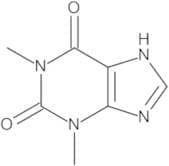
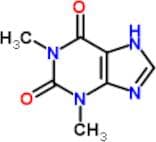
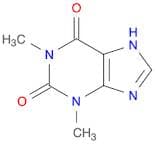
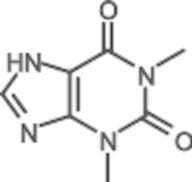
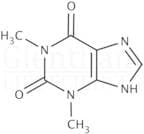
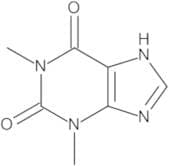
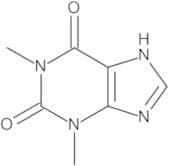
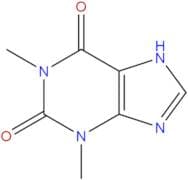
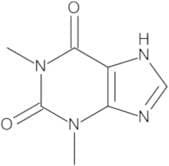
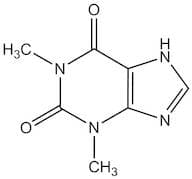
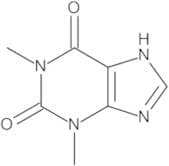
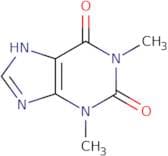
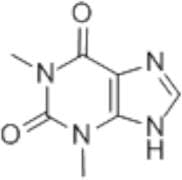
Teofillina è un composto di metilxantina che si trova naturalmente, principalmente nelle foglie di tè e nel cacao. È classificato come un broncodilatatore, il che significa che aiuta a rilassare e aprire le vie aeree nei polmoni, risultando utile nel trattamento di malattie respiratorie come l'asma e la broncopneumopatia cronica ostruttiva (BPCO). La formula chimica di Teofillina è C7H8N4O2, e ha un peso molecolare di circa 180,17 g/mol. Teofillina presenta una solubilità moderata in acqua ed è più solubile nei solventi organici. La sua struttura presenta un sistema ad anello simile alla purina, che contribuisce alla sua attività biologica. Teofillina agisce inibendo gli enzimi fosfodiesterasi, portando a livelli aumentati di AMP ciclico, che promuove il rilassamento della muscolatura liscia bronchiale. Inoltre, ha proprietà anti-infiammatorie e può migliorare la funzione muscolare respiratoria. Sebbene generalmente ben tollerato, Teofillina può avere effetti collaterali, in particolare a dosi più elevate, tra cui disturbi gastrointestinali, insonnia e aumento della frequenza cardiaca. Il suo uso terapeutico richiede un attento monitoraggio dei livelli ematici a causa del suo stretto indice terapeutico.
Formula:C7H8N4O2
InChI:InChI=1S/C7H8N4O2/c1-10-5-4(8-3-9-5)6(12)11(2)7(10)13/h3H,1-2H3,(H,8,9)
InChI key:InChIKey=ZFXYFBGIUFBOJW-UHFFFAOYSA-N
SMILES:O=C1C2=C(N(C)C(=O)N1C)N=CN2
Sinonimi:- 1,3-Dimethyl-1H-purine-2,6(3H,7H)-dione
- 1,3-Dimethyl-2,3,6,7-tetrahydro-1H-purine-2,6-dione
- 1,3-Dimethyl-2,3,6,9-tetrahydro-1H-purine-2,6-dione
- 1,3-Dimethyl-3,7-dihydro-purine-2,6-dione
- 1,3-Dimethylxanthine
- 1,3-dimethyl-3,4,5,7-tetrahydro-1H-purine-2,6-dione
- 3,7-Dihydro-1,3-dimethyl-1H-purine-2,6-dione
- 3,9-Dihydro-1,3-dimethyl-1H-purine-2,6-dione
- Accurbron
- Aerobin
- Aerolate
- Afonilm
- Apnecut
- Armophylline
- Asmax
- Austyn
- Bilordyl
- Brochoretard
- Bronkodyl
- Cetraphylline
- Chronophyllin
- Diffumal
- Dimethylxanthine
- Duraphyl
- Duraphyllin
- Egifilin
- Elan
- Elixophyllin
- Elixophylline
- Etheophyl
- Euphylong
- Insanovin
- LaBID
- Lanophyllin
- Lasma
- Liquophylline
- Nuelin
- Optiphyllin
- Parkophyllin
- Phylobid
- Physpan
- Pro-Vent
- Pseudotheophylline
- PulmiDur
- Pulmo-Timelets
- Respbid
- Respicur
- Slo-Bid
- Slo-Phyllin
- Solosin
- Sustaire
- Talotren
- Telb-DS
- Telbans
- Teofilina
- Teonova
- Teotard
- Tesona
- Theo-DS
- Theo-Dur
- Theo-Nite
- Theo-Sav
- Theobid
- Theochron
- Theoclear
- Theodel
- Theodrip
- Theofol
- Theograd
- Theolair
- Theon
- Theopek
- Theophyl
- Theophyllin
- Theoplus
- Theostat
- Theotard
- Theovent
- Throphylline
- Unifyl
- Unilong
- Uniphyl
- Uniphyllin
- Xanthium
- 1H-Purine-2,6-dione, 3,7-dihydro-1,3-dimethyl-
- 1H-Purine-2,6-dione, 3,9-dihydro-1,3-dimethyl-
- Vedi altri sinonimi
Ordinare per
Purezza (%)
0
100
|
0
|
50
|
90
|
95
|
100
26 prodotti.
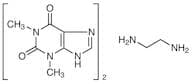
Aminophylline
CAS:Formula:C14H16N8O4·C2H8N2Purezza:>98.0%(HPLC)Colore e forma:White to Almost white powder to crystalPeso molecolare:420.43Theophylline
CAS:Formula:C7H8N4O2Purezza:>98.0%(T)(HPLC)Colore e forma:White to Almost white powder to crystalPeso molecolare:180.17Theophylline
CAS:<p>Theophylline has been used to study its effects on rat gene expression in the ubiquitin-proteasome pathway that regulates spermatogenesis and epididymal sperm quality. Theophylline has also been used as an internal standard for the measurement of plasma paracetamol levels in humans. This Thermo Scie</p>Formula:C7H8N4O2Colore e forma:White to off-white, PowderPeso molecolare:180.17Theophylline
CAS:TheophyllineFormula:C7H8N4O2Purezza:99.9%Colore e forma:White SolidPeso molecolare:180.06473Theophylline
CAS:Theophylline and aminophylline (excluding fenetylline) and their derivatives, salts thereof, not elsewhere specified or includedFormula:C7H8N4O2Colore e forma:White PowderPeso molecolare:180.17 g/molTheophylline Melting Point Standard (Approximately 271 degrees)
CAS:Theophylline and aminophylline (excluding fenetylline) and their derivatives, salts thereof, not elsewhere specified or includedFormula:C7H8N4O2Colore e forma:White Crystalline PowderPeso molecolare:180.06473Theophylline
CAS:Theophylline (1,3-Dimethylxanthine) is a methyl xanthine derivative from tea with diuretic, smooth muscle relaxant, bronchial dilation, cardiac and centralFormula:C7H8N4O2Purezza:99.65% - 99.98%Colore e forma:White Solid PowderPeso molecolare:180.16Theophylline (Dimenhydrinate EP Impurity A, Diprophylline EP Impurity B)
CAS:Formula:C7H8N4O2Colore e forma:White To Off-White SolidPeso molecolare:180.17Theophylline
CAS:Formula:C7H8N4O2Purezza:≥ 99.0%Colore e forma:White to off-white crystalline powderPeso molecolare:180.16Theophylline 100 µg/mL in Acetonitrile
CAS:Prodotto controllatoFormula:C7H8N4O2Colore e forma:Single SolutionPeso molecolare:180.16Theophylline
CAS:TheophyllineFormula:C7H8N4O2Purezza:≥ 98.0 % (HPLC)Colore e forma:PowderPeso molecolare:180.17Ref: ST-EA-CP-C47001
10mgPrezzo su richiesta25mgPrezzo su richiesta50mgPrezzo su richiesta100mgPrezzo su richiestaTheophylline
CAS:Prodotto controllato<p>Applications Xanthine derivative with diuretic, cardiac stimulant and smooth muscle relaxant activities; isomeric with theobromine. Small amounts occur in tea. Bronchodilator.<br> Not a dangerous good if item is equal to or less than 1g/ml and there is less than 100g/ml in the package<br>References Cohen, J.L., et al.: Anal. Profiles Drug Subs., 4, 466 (1975); Svedmyr, K., et al.: Allergy, 37, 111 (1982);<br></p>Formula:C7H8N4O2Colore e forma:Off-WhitePeso molecolare:180.161,3-Dimethyl-2,6-dioxo-1,2,3,6-tetrahydropurine
CAS:Prodotto controllato<p>1,3-Dimethyl-2,6-dioxo-1,2,3,6-tetrahydropurine (1,3DMP) is a drug that has been used experimentally as a congestive heart failure treatment. It is an analogue of theophylline and has been shown to have similar effects on the cardiovascular system. 1,3DMP can be metabolized by cytochrome P450 enzymes to form compounds that are active in the nucleus of cells and may affect gene expression. The drug has also been shown to have a protective effect on the bowel when administered with anhydrous sodium sulphate. 1,3DMP binds to DNA in the nucleus of cells and inhibits nuclear dna synthesis by competitive inhibition with the natural substrate S-adenosylmethionine. This binding prevents transcription of DNA into RNA and protein synthesis. 1,3DMP also binds to proteins in human serum and has pharmacological activities such as</p>Formula:C7H8N4O2Purezza:Min. 95%Colore e forma:PowderPeso molecolare:180.16 g/molTheophylline anhydrous pure, 99%
CAS:Formula:C7H8N4O2Purezza:min. 99%Colore e forma:White to off -white to light yellow, Crystalline powderPeso molecolare:180.16