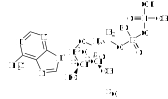
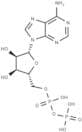
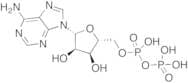
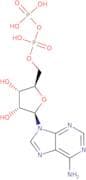
CAS 58-64-0
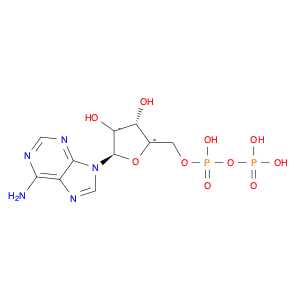
:5′-ADP
- 5'-(Trihidrogenodifosfato) De Adenosina
- 5'-(Trihydrogenodiphosphate) d'adenosine
- 5'-Adp
- ADP
- ADP (nucleotide)
- Adenosin-5'-(trihydrogendiphosphat)
- Adenosine 5'-(trihydrogen phosphate)
- Adenosine 5'-(trihydrogen pyrophosphate)
- Adenosine 5'-diphosphate
- Adenosine 5'-diphosphoric acid
- Adenosine 5'-pyrophosphate
- Adenosine 5'-pyrophosphoric acid
- Adenosine diphosphate
- Adenosine pyrophosphate
- α-ADP
- Vedi altri sinonimi
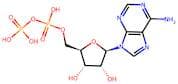
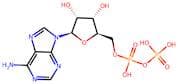
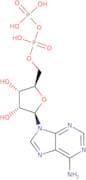
Adenosine 5'-diphosphate
CAS:Formula:C10H15N5O10P2Purezza:95%Colore e forma:SolidPeso molecolare:427.2011Adenosine 5''-diphosphate
CAS:Formula:C10H15N5O10P2Purezza:≥ 95.0%Colore e forma:White to off-white powderPeso molecolare:427.20Ref: 4Z-A-267031
5mgPrezzo su richiesta10mgPrezzo su richiesta25mgPrezzo su richiesta50mgPrezzo su richiesta100mgPrezzo su richiestaAdenosine 5'-diphosphate
CAS:Adenosine 5'-diphosphate (ADP) is a natural nucleotide derived from the dephosphorylation of ATP. ADP induces platelet aggregation. Cost effective and quality assured.Formula:C10H15N5O10P2Purezza:99.5% - >99.99%Colore e forma:SolidPeso molecolare:427.2Adenosine 5'-Diphosphate
CAS:Prodotto controllatoApplications Adenosine-5'-diphosphate (ADP) is a central component of energy storage, metabolism, and signal transduction in vivo. It serves as a precursor for ATP and, in this capacity, is utilized in a wide number of cellular processes, including respiration, biosynthetic reactions, motility, and cell division.
References Knowles, J.R., et al.: Annual Reviews of Biochemistry 49, 877-919 (1980); Klingenberg, M., et al.: Biochimica et Biophysica Acta, 1778(10), 1978-2021 (2008);Formula:C10H15N5O10P2Colore e forma:NeatPeso molecolare:427.2Adenosine 5'-diphosphate
CAS:Adenosine 5'-diphosphate (ADP) is a nucleoside that is an important component of the cell's energy pathways. ADP plays a role in platelet activation and nitrate reductase, which are enzymes that maintain the integrity of bacterial DNA. Adenosine 5'-diphosphate also has been shown to inhibit neural cell injury and protein oxidation.
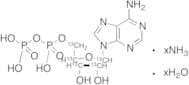
Formula:C10H15N5O10P2Purezza:Min. 95 Area-%Colore e forma:White Off-White PowderPeso molecolare:427.2 g/molAdenosine 5’-Diphosphate-13C5 Ammonium Salt Hydrate
CAS:Prodotto controllatoStability Moisture Sensitive
Applications Adenosine 5’-Diphosphate-13C5 Ammonium Salt Hydrate is the isotope labelled analog of Adenosine 5’-Diphosphate Ammonium Salt Hydrate (A281700); a nucleoside diphosphate that interacts with a family of ADP receptors found on platelets (P2Y1, P2Y12 and P2X1), to induce platelet activation. ADP in the blood is converted to adenosine by the action of ecto-ADPases, inhibiting further platelet activation via adenosine receptors.
References Gamba, G. et al.: Haematologia, 58, 1215 (1973); Dejana, E. et al.: Thromb. Haemost., 39, 135 (1978)Formula:C513C5H15N5O10P2xNH3xH2OColore e forma:NeatPeso molecolare:432.16Adenosine 5'-Diphosphate-15N5
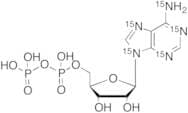
CAS:Prodotto controllatoFormula:C10H1515N5O10P2Colore e forma:NeatPeso molecolare:432.168Adenosine 5’-Diphosphate Ammonium Salt Hydrate
CAS:Prodotto controllatoApplications A nucleoside diphosphate that interacts with a family of ADP receptors found on platelets (P2Y1, P2Y12 and P2X1), to induce platelet activation. ADP in the blood is converted to adenosine by the action of ecto-ADPases, inhibiting further platelet activation via adenosine receptors. Important in energy flow
References Gamba, G. et al.: Haematologia, 58, 1215 (1973); Dejana, E. et al.: Thromb. Haemost., 39, 135 (1978);Formula:C10H15N5O10P2xNH3xH2OColore e forma:NeatPeso molecolare:427.20 (anhydrous free acid)Adenosine 5’-Diphosphate-13C5
CAS:Adenosine 5’-diphosphate (ADP) is a potent activator of the G-protein coupled receptor, P2Y. This receptor has been shown to be present on platelets, which are cells that are involved in the clotting process. ADP also inhibits the ion channel activity of the Na+, K+ ATPase. The effects of ADP on myocardial infarct have been studied in a model system consisting of isolated papillary muscle from rats. Adenosine 5’-diphosphate is not an inhibitor of protein synthesis, but does inhibit polymerase chain reaction amplification. It is used as a pharmacological agent for bowel disease and for treatment of chronic obstructive pulmonary disease.END>Formula:C5C5H15N5O10P2Purezza:Min. 95%Peso molecolare:432.2 g/molRef: ST-EA-CP-A88045
10mgPrezzo su richiesta25mgPrezzo su richiesta50mgPrezzo su richiesta100mgPrezzo su richiesta