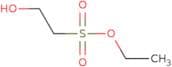
CAS 58337-44-3
:Isetionato di etile
Descrizione:
Isetionato di etile è un composto organico classificato come un estere sulfonato, specificamente un estere etilico dell'acido isetionico. Tipicamente è un liquido incolore o giallo pallido con un odore lieve e piacevole. Isetionato di etile è noto per le sue proprietà tensioattive, rendendolo utile in varie formulazioni per la cura personale e cosmetici, come shampoo e gel doccia, dove agisce come agente detergente e schiumogeno. Il composto è solubile in acqua e ha una buona compatibilità con altri tensioattivi, migliorando le prestazioni complessive delle formulazioni. Inoltre, è considerato delicato sulla pelle, rendendolo adatto per applicazioni su pelli sensibili. Isetionato di etile è anche riconosciuto per la sua capacità di migliorare la texture e la sensazione dei prodotti, contribuendo a una sensazione di pelle liscia e morbida. La sua stabilità in varie condizioni e il basso potenziale di irritazione aumentano ulteriormente il suo fascino nella formulazione di prodotti per la cura della pelle e dei capelli. In generale, Isetionato di etile è apprezzato per le sue proprietà multifunzionali nell'industria cosmetica.
Formula:C4H10O4S
InChI:InChI=1/C4H10O4S/c1-2-8-9(6,7)4-3-5/h5H,2-4H2,1H3
SMILES:CCOS(=O)(=O)CCO
Sinonimi:- Ethanesulfonic acid, 2-hydroxy-, ethyl ester
- Ethyl 2-hydroxyethanesulfonate
- Ethyl hydroxyethanesulfonate
Ordinare per
Purezza (%)
0
100
|
0
|
50
|
90
|
95
|
100
4 prodotti.
Ref: 4Z-P-155004
5mgPrezzo su richiesta10mgPrezzo su richiesta25mgPrezzo su richiesta50mgPrezzo su richiesta100mgPrezzo su richiestaEthyl Isethionate
CAS:Ethyl isethionate is a chemical compound that belongs to the group of ethyl esters. It has been used as an additive in food, and it has also been shown to be effective against L1210 and other cancer cells. Ethyl isethionate has been shown to have anti-inflammatory properties and can inhibit prostaglandin synthesis. The linear regression analysis demonstrated that fatty acids can react with anions to form esters, which may be the mechanism by which ethyl isethionate was formed. Ethyl isethionate also reacts with fluorine, which results in the formation of fluoroethyl esters. This reaction may lead to the formation of busulfan, a chemotherapy drug used for treating leukemia and Hodgkin's disease. Another possible route for the synthesis of ethyl isethionate involves alkylation of long-chain chlorides with fatty acids or trifluoromethanesulfonic acid.Formula:C4H10O4SPurezza:Min. 95%Peso molecolare:154.18 g/molRef: ST-EA-CP-P124008
10mgPrezzo su richiesta25mgPrezzo su richiesta50mgPrezzo su richiesta100mgPrezzo su richiesta