


CAS 58822-25-6
:(5-leucina)encefalina
Descrizione:
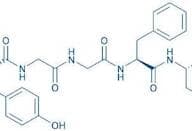
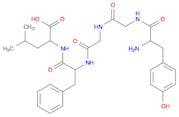
(5-leucina)encefalina, noto anche come Leu-enkephalina, è un pentapeptide che appartiene alla classe dei peptidi oppioidi endogeni. È composto da cinque aminoacidi, specificamente Tyr-Gly-Gly-Phe-Leu, ed è principalmente coinvolto nella modulazione del dolore, dello stress e delle risposte emotive nel corpo. Questo peptide agisce come un ligando per i recettori oppioidi, in particolare i recettori delta e mu, che sono cruciali per mediare gli effetti analgesici. La Leu-enkephalina è sintetizzata nel sistema nervoso centrale e nella midollare surrenale e gioca un ruolo significativo nei meccanismi naturali di sollievo dal dolore del corpo. La sua struttura presenta un residuo di leucina all'estremità C-terminale, che è essenziale per la sua affinità di legame e attività biologica. La sostanza è nota per le sue proprietà neuroprotettive e potenziali applicazioni terapeutiche nella gestione del dolore e nei disturbi dell'umore. Inoltre, è soggetta a degradazione enzimatica, che influisce sulla sua durata d'azione nei processi fisiologici. In generale, (5-leucina)encefalina è un componente vitale del sistema oppioide endogeno del corpo, contribuendo a varie funzioni fisiologiche.
Formula:C28H37N5O7
InChI:InChI=1/C28H37N5O7/c1-17(2)12-23(28(39)40)33-27(38)22(14-18-6-4-3-5-7-18)32-25(36)16-30-24(35)15-31-26(37)21(29)13-19-8-10-20(34)11-9-19/h3-11,17,21-23,34H,12-16,29H2,1-2H3,(H,30,35)(H,31,37)(H,32,36)(H,33,38)(H,39,40)/t21-,22-,23-/m0/s1
SMILES:CC(C)C[C@@H](C(=O)O)N=C([C@H](Cc1ccccc1)N=C(CN=C(CN=C([C@H](Cc1ccc(cc1)O)N)O)O)O)O
Sinonimi:- Leu-Enkephalin
- Leu5-Enkephalin
- Tyrosylglycylglycylphenylalanylleucine
- L-tyrosylglycylglycyl-L-phenylalanyl-L-leucine
- 152: PN: US20030176421 PAGE: 54-55 claimed protein
- 1-5-Dynorphin
- 1-5-β-Neoendorphin (human)
- 2: PN: WO2008052043 SEQID: 1 claimed protein
- 26: PN: WO2005095443 SEQID: 26 claimed protein
- 4: PN: US20060040879 SEQID: 4 claimed protein
- 5-L-Leucine-enkephalin
- 693: PN: WO2004005342 PAGE: 46 claimed protein
- 9: PN: WO2008008805 SEQID: 9 unclaimed protein
- Dynorphin-(1-5)
- Enkephalin, leucine
- Ici 114740
- Leucine enkephalin
- Leucyl-enkephalin
- L-Leucine, L-tyrosylglycylglycyl-L-phenylalanyl-
- L-Leucine, N-[N-[N-(N-L-tyrosylglycyl)glycyl]-L-phenylalanyl]-
- L-Leucine-enkephalin
- L-Tyrosinylglycylglycyl-L-phenylalanyl-L-leucine
- N-[N-[N-(N-L-tirosilglicil)glicil]-L-fenilalanil]-L-leucina
- N-[N-[N-(N-L-Tyrosylglycyl)glycyl]-L-phenylalanyl]-L-leucin
- N-[N-[N-(N-L-tyrosylglycyl)glycyl]-L-phenylalanyl]-L-leucine
- Nsc 350588
- Vedi altri sinonimi
Ordinare per
Purezza (%)
0
100
|
0
|
50
|
90
|
95
|
100
7 prodotti.
Leu-Enkephalin
CAS:N-terminal sequence of dynorphin A and the neoendorphins.Formula:C28H37N5O7Purezza:98.6%Colore e forma:WhitePeso molecolare:555.63Ref: 54-BUP11200
10mgPrezzo su richiesta25mgPrezzo su richiesta50mgPrezzo su richiesta100mgPrezzo su richiesta[Leu5]-Enkephalin
CAS:[Leu5]-Enkephalin (Leu-enkephalin) is an endogenous neuropeptide involved in nociception and an agonist of δ-opioid and μ-opioid receptors (Kis = 4.0 and 3.4 nMFormula:C28H37N5O7Purezza:99.87% - 99.88%Colore e forma:SolidPeso molecolare:555.62Leucine-Enkephalin
CAS:Leucine-Enkephalin is a research tool that binds to the opioid receptor. It is an activator of the receptor and can be used in cell biology, pharmacology, and as a ligand or antibody for receptor studies. Leucine-Enkephalin has been shown to inhibit ion channels in vitro and can be used to study protein interactions. This peptide also exhibits pharmacological effects in vivo, including analgesia, inhibition of gastrointestinal motility, and induction of emesis.Formula:C28H37N5O7Purezza:Min. 95%Peso molecolare:555.62 g/molLeucine-Enkephalin (Human, Porcine, Bovine, Rat, Mouse)
CAS:Leucine-Enkephalin is a peptide that is composed of the amino acids leucine and enkephalin. It functions as an endogenous opioid with effects on the brain that include analgesia, sedation, and appetite suppression. Leucine-Enkephalin stimulates κ-opioid receptors in the brain and has been shown to reduce neuronal death caused by energy metabolism deficiency or cerebral ischemia. This peptide also causes autophagy and neurokinin-1 receptor activation, which can lead to significant interactions with physiological effects such as symptoms of anxiety, depression, or addiction.Formula:C28H37N5O7•H2OPurezza:Min. 95%Peso molecolare:573.64 g/molRef: ST-EA-CP-L28019
10mgPrezzo su richiesta25mgPrezzo su richiesta50mgPrezzo su richiesta100mgPrezzo su richiesta


![[Leu5]-Enkephalin](/_next/image/?url=https%3A%2Fstatic.cymitquimica.com%2Fproducts%2F54%2Fthumb%2FBUP11200.jpg&w=3840&q=75)

![[Leu5]-Enkephalin](/_next/image/?url=https%3A%2Fstatic.cymitquimica.com%2Fproducts%2FTM%2Fthumb%2FT7173.jpg&w=3840&q=75)


![[Leu5]-Enkephalin](/_next/image/?url=https%3A%2Fstatic.cymitquimica.com%2Fproducts%2FST-EA%2Fthumb%2FEA-CP-L28019.jpg&w=3840&q=75)
