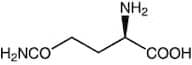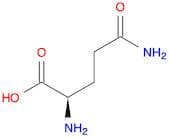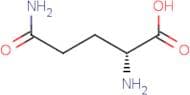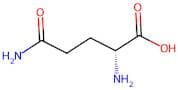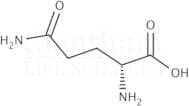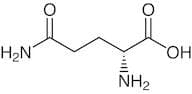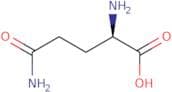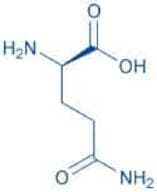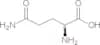
CAS 5959-95-5
:D(-)-Glutammina
Descrizione:
D(-)-Glutammina, con il numero CAS 5959-95-5, è un amminoacido che funge da mattoncino per le proteine e gioca un ruolo cruciale in vari processi metabolici. È l'enantiomero D della glutamina, che è un amminoacido non essenziale comunemente presente nel corpo. D(-)-Glutammina è caratterizzato dalla sua capacità di partecipare al metabolismo dell'azoto ed è coinvolto nella sintesi di nucleotidi e neurotrasmettitori. È solubile in acqua ed espone un pH neutro in soluzione. Questo amminoacido è importante per le funzioni cellulari, in particolare nel sistema immunitario e nel mantenimento dell'integrità della mucosa intestinale. D(-)-Glutammina è spesso utilizzato in ricerche e contesti clinici, in particolare in studi relativi al metabolismo, alla segnalazione cellulare e alla nutrizione. La sua stabilità e reattività lo rendono un composto prezioso nelle applicazioni biochimiche. Tuttavia, è importante notare che la forma L della glutamina è più prevalente nei sistemi biologici, mentre la forma D è meno comunemente riscontrata in natura.
Formula:C5H10N2O3
InChI:InChI=1/C5H10N2O3/c6-3(5(9)10)1-2-4(7)8/h3H,1-2,6H2,(H2,7,8)(H,9,10)/t3-/m1/s1
InChI key:InChIKey=ZDXPYRJPNDTMRX-GSVOUGTGSA-N
SMILES:[C@@H](CCC(N)=O)(C(O)=O)N
Sinonimi:- (2R)-2-Amino-4-carbamoylbutanoic acid
- (2R)-5-Amino-2-azaniumyl-5-oxopentanoate
- (R)-2,5-Diamino-5-oxopentanoic acid
- <span class="text-smallcaps">D</span>-Glutamine
- D(-)-Glutamic acid-5-amide
- D-Gln-OH
- Glutamine, <span class="text-smallcaps">D</span>-
- H-D-Gln-OH
- Glutamine, D-
- D-Glutamine
- D-2-Aminoglutaramic acid, D-Glutamic acid 5-amide
- D-Glutamine (9CI)
- D-Gln
- Glutamine,D-(8Cl)
- D-2-AMINOGLUTARAMIC ACID
- (2R)-2-amino-4-carbamoyl-butanoic acid
- Citric Acid, Monohydrate, Crystal, Reagent
- (R)-2-AMINO-4-CARBAMOYL-BUTYRIC ACID
- D-GLUTAMINE extrapure
- Vedi altri sinonimi
Ordinare per
Purezza (%)
0
100
|
0
|
50
|
90
|
95
|
100
13 prodotti.
D-Glutamine, 99+%
CAS:Kinase inhibitor; has antivasospastic propertiesFormula:C5H10N2O3Purezza:99+%Colore e forma:White, Powder or crystals or crystalline powderPeso molecolare:146.15(2R)-2,5-diamino-5-oxo-pentanoic acid
CAS:(2R)-2,5-diamino-5-oxo-pentanoic acidPurezza:98%Peso molecolare:146.14g/molD-Glutamine
CAS:Formula:C5H10N2O3Purezza:≥ 98.0%Colore e forma:White or almost white crystalline powderPeso molecolare:146.14D-Glutamine
CAS:Formula:C5H10N2O3Purezza:>98.0%(T)Colore e forma:White to Almost white powder to crystalPeso molecolare:146.15D-glutamine
CAS:D-glutamine, an D type stereoisomer of glutamine, is one of the 20 amino acids which is encoded by the standard genetic code.Formula:C5H10N2O3Purezza:99.99%Colore e forma:White Or Off-White PowderPeso molecolare:146.14H-D-Gln-OH
CAS:M02933 - H-D-Gln-OH
Formula:C5H10N2O3Purezza:97%Colore e forma:SolidPeso molecolare:146.146D-Glutamine extrapure, 99%
CAS:Formula:C5H10N2O3Purezza:min. 99%Colore e forma:White, Crystalline powder, Clear, ColourlessPeso molecolare:146.2Ref: ST-EA-CP-G54006
10mgPrezzo su richiesta25mgPrezzo su richiesta50mgPrezzo su richiesta100mgPrezzo su richiestaD-Glutamine
CAS:D-Glutamine is the most abundant amino acid in the body and is important for protein synthesis. It is used to activate transcription and as a source of energy for cells, especially in times of oxidative stress. D-Glutamine can be used to treat diseases caused by infectious agents, such as listeriosis, bacterial sepsis, and viral encephalitis. D-Glutamine also has been shown to reduce neuronal death and improve memory function in animal models. D-Glutamine can be synthesized from l-glutamine by an enzyme called glutaminase. This reaction requires ATP hydrolysis and produces glutamate, which then reacts with ammonia to form glutamine. In this way, it is possible to bypass the need for dietary intake of glutamine. Glutamines are also classified as biocompatible polymers because they do not elicit a strong immune response or cause inflammation when introduced into the body.Formula:C5H10N2O3Purezza:Min. 95%Colore e forma:White PowderPeso molecolare:146.14 g/molH-D-Gln-OH
CAS:Bachem ID: 4007503.
Formula:C5H10N2O3Purezza:> 99%Colore e forma:White PowderPeso molecolare:146.15