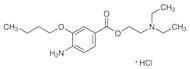
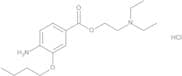
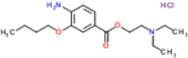
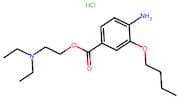
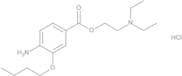
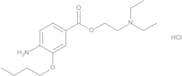
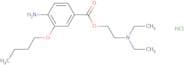
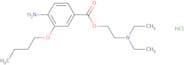
CAS 5987-82-6
:Cloridrato di ossibuprocaina
Descrizione:
Cloridrato di ossibuprocaina, noto anche come proximetacaina, è un anestetico locale appartenente alla classe degli anestetici esteri. È comunemente usato in oftalmologia per la sua capacità di fornire anestesia superficiale durante vari interventi oculari. La sostanza appare come una polvere cristallina bianca o bianco sporco ed è solubile in acqua, il che facilita la sua applicazione in soluzioni acquose. Cloridrato di ossibuprocaina agisce bloccando i canali del sodio, inibendo così la propagazione degli impulsi nervosi e causando una perdita temporanea di sensibilità nell'area mirata. Il suo inizio d'azione è relativamente rapido e la durata dell'anestesia può variare a seconda della concentrazione utilizzata e dell'applicazione specifica. Il composto è generalmente ben tollerato, sebbene gli effetti collaterali potenziali possano includere irritazione locale o reazioni allergiche. Grazie alla sua efficacia e al profilo di sicurezza, Cloridrato di ossibuprocaina è ampiamente utilizzato in contesti clinici, in particolare per procedure che coinvolgono l'occhio, come la tonometria e la chirurgia della cataratta.
Formula:C17H28N2O3·ClH
InChI:InChI=1S/C17H28N2O3.ClH/c1-4-7-11-21-16-13-14(8-9-15(16)18)17(20)22-12-10-19(5-2)6-3;/h8-9,13H,4-7,10-12,18H2,1-3H3;1H
InChI key:InChIKey=PRGUDWLMFLCODA-UHFFFAOYSA-N
SMILES:C(OCCN(CC)CC)(=O)C1=CC(OCCCC)=C(N)C=C1.Cl
Sinonimi:- 2-(Diethylamino)ethyl 4-amino-3-butoxybenzoate hydrochloride
- 2-[(4-amino-3-butoxybenzoyl)oxy]-N,N-diethylethanaminium chloride
- Benoxil
- Benoxinate Hcl
- Benzoic acid, 4-amino-3-butoxy-, 2-(diethylamino)ethyl ester, hydrochloride (1:1)
- Benzoic acid, 4-amino-3-butoxy-, 2-(diethylamino)ethyl ester, monohydrochloride
- Boxinate
- Cebesine
- Conjucaine
- Conjuncain
- Dorsacaine
- Dorsacaine hydrochloride
- Lacrimin
- Minims
- Novesin
- Novesine
- Oxybuprocaine HCL
- Oxybuprocaine hydrochloride
- Vedi altri sinonimi
Ordinare per
Purezza (%)
0
100
|
0
|
50
|
90
|
95
|
100
15 prodotti.
Oxybuprocaine Hydrochloride
CAS:Formula:C17H28N2O3·HClPurezza:>98.0%(T)(HPLC)Colore e forma:White to Light yellow powder to crystalPeso molecolare:344.88OXYBUPROCAINE HYDROCHLORIDE CRS
CAS:OXYBUPROCAINE HYDROCHLORIDE CRSFormula:C17H29ClN2O3Colore e forma:Added ModifiedPeso molecolare:344.8768Oxybuprocaine hydrochloride
CAS:Oxybuprocaine hydrochlorideFormula:C17H28N2O3HClPurezza:99.8%Colore e forma:WhitePeso molecolare:344.18667Benoxinate Hydrochloride
CAS:Aromatic amino-alcohol-phenols, aromatic amino-acid-phenols and other aromatic amino compounds with oxygen functionFormula:C17H28N2O3·HClColore e forma:Off-White White PowderPeso molecolare:308.20999Oxybuprocaine hydrochloride
CAS:Oxybuprocaine hydrochloride (Oxybuprocaine HCl), a local anesthetic, is used especially in otolaryngology and ophthalmology.Formula:C17H29ClN2O3Purezza:>99.99%Colore e forma:White Crystalline PowderPeso molecolare:344.88Benoxinate hydrochloride
CAS:Formula:C17H29ClN2O3Colore e forma:White to off-white powder or crystalsPeso molecolare:344.88Oxybuprocaine Hydrochloride
CAS:Prodotto controllatoFormula:C17H28N2O3·ClHColore e forma:NeatPeso molecolare:344.88Ref: 4Z-O-097001
5mgPrezzo su richiesta10mgPrezzo su richiesta25mgPrezzo su richiesta50mgPrezzo su richiesta100mgPrezzo su richiestaBenoxinate Hydrochloride
CAS:Prodotto controllatoApplications Benoxinate is a local anesthetic used in ophthalmology to numb the surface of the eye for a variety of procedures.
References Ogbuehi, K.C., et al.: Clin. Ophthalmol., 6, 871 (2012); Hung, C.H., et al.: Anesthesia. Anal., 110, 238 (2009); Schmidt, A.C., et al.: Pharma. Res., 22, 2121 (2005);Formula:C17H28N2O3·ClHColore e forma:NeatPeso molecolare:344.88Oxybuprocaine hydrochloride
CAS:Prodotto controllatoOxybuprocaine hydrochloride is a local anesthetic that belongs to the group of x-ray diffraction data. It is a chemical compound that has been shown to be effective in inducing anesthesia in humans. Oxybuprocaine hydrochloride binds to proteins, such as benzalkonium chloride, and inhibits cell growth. It also has an anti-inflammatory effect by preventing the release of prostaglandins. Oxybuprocaine hydrochloride stabilizes chemical bonds and does not react with oxygen or water, making it a suitable candidate for use in eye drops and other solutions for application to skin cells. As well as this, oxybuprocaine hydrochloride can be used as a contrast agent for x-rays when dissolved in human serum or nutrient solution and can be detected using an electrochemical detector.Formula:C17H29ClN2O3Purezza:Min. 95%Colore e forma:White PowderPeso molecolare:344.88 g/mol2-(Diethylamino)ethyl 4-amino-3-butoxybenzoate hydrochloride
CAS:Formula:C17H29ClN2O3Purezza:99+%Colore e forma:SolidPeso molecolare:344.88Oxybuprocaine hydrochloride
CAS:Prodotto controllatoOxybuprocaine hydrochloride is a local anesthetic agent that blocks nerve conduction and inhibits the generation of action potentials. It has a high lipid solubility, which allows for rapid onset and short duration of action. Oxybuprocaine hydrochloride is used in the treatment of corneal ulcers, eye disorders, and other conditions where pain relief is desired. The safety and efficacy of oxybuprocaine hydrochloride has been studied in pregnant women, fetal bovine serum, and other animal models. In vitro studies demonstrated that it is chemically stable when exposed to benzalkonium chloride or benoxinate. Clinical relevance in humans has been established by demonstrating that human serum does not contain sufficient quantities of oxybuprocaine to cause toxicity.Formula:C17H29ClN2O3Purezza:Min. 95%Peso molecolare:344.88 g/mol