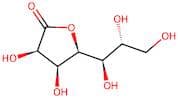
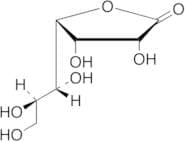
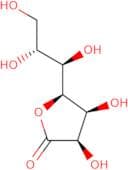
CAS 60046-25-5
:D-Glucoeptono-1,4-lattone
- (3R,4S,5S)-3,4-dihydroxy-5-[(1R,2R)-1,2,3-trihydroxypropyl]dihydrofuran-2(3H)-one (non-preferred name)
- (4S,5S)-3,4-dihydroxy-5-[(1R,2R)-1,2,3-trihydroxypropyl]dihydrofuran-2(3H)-one (non-preferred name)
- <span class="text-smallcaps">D</span>-Glucoheptono-1,4-lactone
- <span class="text-smallcaps">D</span>-gluco-Heptonic acid, γ-lactone, (2ξ)-
- Glucoheptonic acid, γ-lactone
- alpha-D-Glucoheptonic gamma-lactone
- D-gluco-Heptonic acid, γ-lactone, (2ξ)-
- D-Glucoheptono-1,4-lactone
D-Glucoheptonic acid-1,4-lactone
CAS:D-Glucoheptonic acid-1,4-lactoneColore e forma:White To Off White PowderPeso molecolare:208.17g/molD-Glucoheptono-1,4-lactone
CAS:Prodotto controllatoApplications It is used in the synthesis of Howiinol A and its analogs. Howiinol A was one of the active antitumor constituents from the root and stem bark of Goniothamus howii (Annonaceae), and it was synthesized in 9 steps from α-D-glucoheptonic γ-lactone. Twenty-six analogs were also synthesized in searching for new antitumor compounds with high potency.
References Dhanvantari, S., et al.: J. Biol. Chem., 275, 29887 (2000), Kjellin, U., et al.: Langmuir, 17, 1941 (2001),Formula:C7H12O7Colore e forma:NeatPeso molecolare:208.17D-Glucoheptonic acid-1,4-lactone
CAS:D-Glucoheptonic acid-1,4-lactone is a chiral compound that can be used as an enantiomer of the natural sugar glucose. The human liver has been shown to metabolize this compound into proton and an analog of glucofuranose. This means that D-Glucoheptonic acid-1,4-lactone is able to be broken down by glycosidases. D-Glucoheptonic acid-1,4-lactone also inhibits α-L-rhamnosidase and other enzymes responsible for the breakdown of carbohydrates. This inhibition may lead to increased blood glucose levels in humans. D-Glucoheptonic acid-1,4-lactone has been shown to have inhibitory activities against both bacterial and mammalian enzymes. Hydrogen fluoride (HF) was used as a catalyst in the synthesis of this compound with benzylidene acetal
Formula:C7H12O7Purezza:Min. 95%Colore e forma:PowderPeso molecolare:208.17 g/molD-Glucoheptonic Acid-1,4-Lactone pure, 98%
CAS:Formula:C7H12O7Purezza:min. 98%Colore e forma:White to off - white, Crystalline powderPeso molecolare:208.17Ref: ST-EA-CP-A25041
10mgPrezzo su richiesta25mgPrezzo su richiesta50mgPrezzo su richiesta100mgPrezzo su richiesta