CAS 60283-51-4
:(Met(O)5)-Enkefalina
Descrizione:
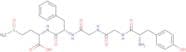
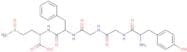
(Met(O)5)-Enkefalina, noto anche come una forma modificata del peptide oppioide endogeno enkephalina, è caratterizzato dalla sostituzione del residuo di metionina con un derivato di sulfoxido, che ne migliora la stabilità e la bioattività. Questo composto fa parte della famiglia dei peptidi oppioidi, che svolge un ruolo cruciale nella modulazione del dolore e nella neurotrasmissione. La modifica nella posizione della metionina altera le sue proprietà farmacologiche, aumentando potenzialmente la sua affinità per i recettori oppioidi. (Met(O)5)-Enkefalina presenta una struttura specifica che gli consente di interagire con il recettore mu-opioide, contribuendo ai suoi effetti analgesici. Inoltre, la sua solubilità e stabilità nei sistemi biologici possono essere migliorate grazie alle modifiche, rendendolo un argomento di interesse nella chimica medicinale e nello sviluppo di farmaci. Le caratteristiche uniche del composto, inclusa la sua natura peptidica e l'aminoacido modificato, lo posizionano come uno strumento prezioso per studiare le interazioni dei recettori oppioidi e sviluppare nuove terapie analgesiche.
Formula:C27H35N5O8S
InChI:InChI=1/C27H35N5O8S/c1-41(40)12-11-21(27(38)39)32-26(37)22(14-17-5-3-2-4-6-17)31-24(35)16-29-23(34)15-30-25(36)20(28)13-18-7-9-19(33)10-8-18/h2-10,20-22,33H,11-16,28H2,1H3,(H,29,34)(H,30,36)(H,31,35)(H,32,37)(H,38,39)/t20-,21-,22-,41?/m0/s1
SMILES:CS(=O)CC[C@@H](C(=O)O)N=C([C@H](Cc1ccccc1)N=C(CN=C(CN=C([C@H](Cc1ccc(cc1)O)N)O)O)O)O
Sinonimi:- H-Tyr-Gly-Gly-Phe-Met(O)-OH
- L-tyrosylglycylglycyl-N-[(1S)-1-carboxy-3-(methylsulfinyl)propyl]-L-phenylalaninamide
Ordinare per
Purezza (%)
0
100
|
0
|
50
|
90
|
95
|
100
2 prodotti.
(Met(O)5)-Enkephalin
CAS:Met-enkephalin is a molecule that is formed from two of the three parts of the endorphin molecule, which are Tyr-Gly-Gly-Phe and Met(O)OH. It is a neurotransmitter that has been shown to inhibit pain in humans and animals. In coelomocytes, met-enkephalin binds to receptors on the cell membrane and inhibits the release of dopamine by binding to dopamine receptors. The sulfoxide group of this molecule can be reduced to form enkephalinase, which is an enzyme that cleaves Met(O)OH from the peptide chain. This process is not known to occur in humans or other mammals. Met-enkephalin has been localized in ganglia cells in animals, but not humans. It has also been found in messenger RNA (mRNA) for translation into protein, but it does not appear to be translated into protein in humans or other mammals.Formula:C27H35N5O8SPurezza:Min. 95%Peso molecolare:589.66 g/mol(Met(O)5)-Enkephalin
CAS:Enkephalins are a group of endogenous peptides that are the most potent natural analgesic and have been shown to relieve pain by inhibiting neurotransmitters. The (Met(O)5)-enkephalin analog is a structural analog of the enkephalin peptide with a sulfoxide linkage at position 5. This analog has been shown to inhibit acetylcholine release from intestinal ganglia, which may be related to its effects on postsynaptic potentials and glutamate release. This compound also absorbs in the small intestine, where it is taken into the blood stream and transported to the brain. The (Met(O)5)-enkephalin analog has been shown to reduce pain in Sprague-Dawley rats, as well as inhibit intestinal transit time and stimulate intestinal motility.
Formula:C27H35N5O8SPurezza:Min. 95%Peso molecolare:589.67 g/mol