CAS 606-23-5
:1,3-Indandione
Descrizione:
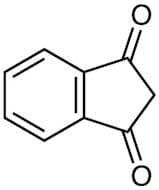
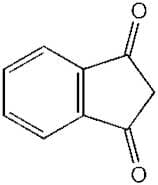
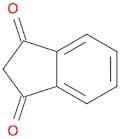
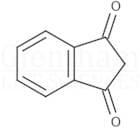
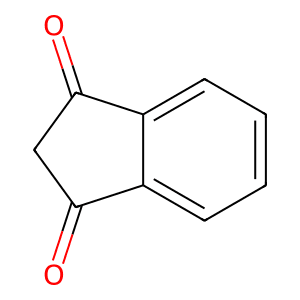
1,3-Indandione, con il numero CAS 606-23-5, è un composto organico caratterizzato dalla sua struttura biciclica, che consiste in un sistema di indeno fuso e diketone. Si presenta come un solido cristallino giallo-arancio ed è noto per la sua capacità di subire varie reazioni chimiche, tra cui condensazione e ossidazione. Questo composto è spesso utilizzato nella sintesi organica e come blocco di costruzione nella preparazione di coloranti, prodotti farmaceutici e agrochimici. La sua funzionalità di diketone gli consente di partecipare a reazioni come le aggiunte di Michael e la formazione di enolati, rendendolo un intermedio versatile nella chimica sintetica. Inoltre, 1,3-Indandione mostra proprietà di fluorescenza, che possono essere sfruttate in applicazioni analitiche. Il composto è moderatamente solubile in solventi organici e la sua reattività può essere influenzata dalla presenza di sostituenti sugli anelli aromatici. Devono essere adottate precauzioni di sicurezza quando si maneggia questa sostanza, poiché può comportare rischi per la salute se ingerita o inalata. In generale, 1,3-Indandione è un composto prezioso sia nelle applicazioni di ricerca che industriali.
Formula:C9H6O2
InChI:InChI=1S/C9H6O2/c10-8-5-9(11)7-4-2-1-3-6(7)8/h1-4H,5H2
InChI key:InChIKey=UHKAJLSKXBADFT-UHFFFAOYSA-N
SMILES:O=C1C=2C(C(=O)C1)=CC=CC2
Sinonimi:- 1,3-Diketohydrindene
- 1,3-Dioxobenzocyclopentane
- 1,3-Indandione
- 1H-Indene-1,3(2H)-dione
- 2H-Indene-1,3-dione
- 3-hydroxy-1H-inden-1-one
- Indan-1,3-Dione
- Indan-1,3-dion
- Indandione
- Indane-1,3-dione
- Indano-1,3-Diona
- Indene-1,3(2H)-dione
- Nsc 26329
- Nsc 6312
- Vedi altri sinonimi
Ordinare per
Purezza (%)
0
100
|
0
|
50
|
90
|
95
|
100
10 prodotti.
1,3-Indandione
CAS:Formula:C9H6O2Purezza:>97.0%(GC)Colore e forma:Light yellow to Brown to Dark red powder to crystalPeso molecolare:146.151,3-Indanedione, 97%
CAS:It is used in the first stage of forensic identification of latent fingerprints. It is particularly useful for paper, and for items printed with thermal inks such as receipts. This Thermo Scientific Chemicals brand product was originally part of the Alfa Aesar product portfolio. Some documentation aFormula:C9H6O2Purezza:97%Colore e forma:White to cream or yellow to yellow-green to pale green to pale brown, Powder or crystalsPeso molecolare:146.15Ref: IN-DA0032M2
1kgPrezzo su richiesta5kgPrezzo su richiesta10kgPrezzo su richiesta1g25,00€5g26,00€10g40,00€25g60,00€50g116,00€100g169,00€500g564,00€1,3-Indanedione
CAS:Formula:C9H6O2Purezza:≥ 97.0%Colore e forma:Yellow to dark-yellow or yellow-green powder or crystalsPeso molecolare:146.15Indane-1,3-dione
CAS:Indane-1,3-dioneFormula:C9H6O2Purezza:98%Colore e forma: light yellow to beige/brown crystalline solidPeso molecolare:146.14g/mol1,3-Indanedione
CAS:1,3-Indanedione is an organic compound that is a reactive fatty acid. It reacts with copper to form a complex. The reaction mechanism of 1,3-Indanedione with copper is not yet fully understood. 1,3-Indanedione has been shown to be effective against prostate cancer cells at an optimum concentration. This compound also has potential use in the treatment of other types of cancers and as a light emitting material in photonics applications.Formula:C9H6O2Purezza:Min. 95%Colore e forma:Beige PowderPeso molecolare:146.14 g/mol1,3-Indanedione pure, 96%
CAS:Formula:C9H6O2Purezza:min. 96.0%Colore e forma:Light yellow-green to pale green to pale brown, Crystalline powderPeso molecolare:146.151,3-Indandione
CAS:Prodotto controllatoApplications 1,3-Indandione is one of the starting materials in the one-pot multi-component synthesis of indenone-fused heterocyclic derivatives. Also it acts as electron-withdrawing end group used for organic photovoltaic cell application.
References Bayayt, M., et al.: Tetrahedron, 73, 1196-1204 (2017); Lim, E.: Mol. Cryst. Liq. Cryst., 635, 94-101 (2016);Formula:C9H6O2Colore e forma:NeatPeso molecolare:146.141,3-Indanedione, 70%
CAS:1,3-Indanedione is a precursor of indane diones that is used in the synthesis of fluorescent molecules. In the presence of light, 1,3-indanedione produces light emission and can be used as a chemiluminescent probe. In the presence of trifluoroacetic acid and copper complex, 1,3-indanedione undergoes intramolecular hydrogen transfer to form an intermediate which reacts with malonic acid to form an alkyl radical. The alkyl radical then reacts with hydrochloric acid to produce an ionic polymerization product. The biological sample is reactive with fatty acids and can be used for the detection of prostate cancer cells.Formula:C9H6O2Purezza:(%) Min. 70%Colore e forma:PowderPeso molecolare:146.14 g/mol