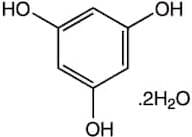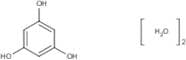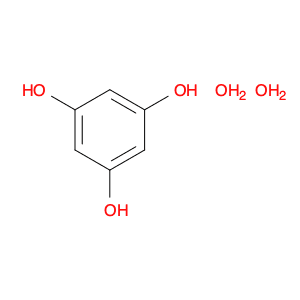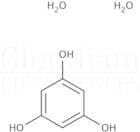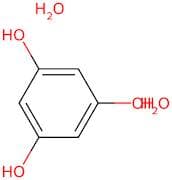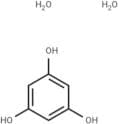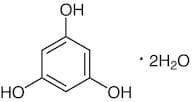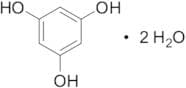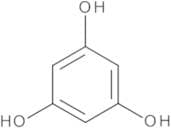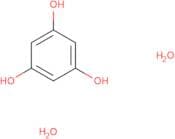
CAS 6099-90-7
:1,3,5-Benzenetriolo, idrato (1:2)
- 1,3,5-Benzenetriol dihydrate
- 1,3,5-Benzenetriol, hydrate (1:2)
- 1,3,5-Trihydroxy Benzene Dihydrate
- 1,3,5-Trihydroxybenzene dihydrate
- 1,3,5-Trihydroxybenzene.2H2O
- Benzene-1,3,5-Triol Dihydrate
- Phloroglucinol dehydrate
- Phloroglucinol, dihydrate
- PHLOROGLUCONOL extrapure AR
- 1,3,5-Trihydro-Benzene
- PHLOROGLUCINOL,REAGENT
- Phloroglucinoldihydrate,98%
- PHLOROGLUCINOL(RG)
- 1,3,5-TRIHYDROXYBENZENE
- PHLOROGLUCIN
- PHLOROGLUCIN DIHYDRATE
- PHLOROGLUCINOL
- phloroglucinol---plant cell culture*tested
- PHLOROGLUCINOL DIHYDRATE R. G.
- PHLORGLUCINOL DIHYDRATE
- Phlorogluctinol
- PHLOROGLUEIN (1,3,5-TRINYDROCYBENZENE)
- PHLOROGLUCINOL2-HYDRATE
- Vedi altri sinonimi
Phloroglucinol dihydrate, 98%
CAS:Phloroglucinol dihydrate is utilized in the preparation of active pharmaceutical ingredients such as flopropione. It acts as a reagent for the Tollens’ test for pentoses. It is mixed with hydrochloric acid and plays an important role for the detection of lignin (Wiesner test). It is involved in t
Formula:C6H10O5Purezza:98%Colore e forma:Crystals or powder or crystalline powder, White to cream to brownPeso molecolare:162.14Phloroglucinol dihydrate
CAS:Phloroglucinol dihydrate analytical standard provided with chromatographic purity, to be used as reference material for qualitative determination.Formula:C6H6O3H2OPurezza:(HPLC) ≥95%Colore e forma:PowderPeso molecolare:162.15Benzene-1,3,5-triol dihydrate
CAS:Formula:C6H10O5Purezza:98%Colore e forma:SolidPeso molecolare:162.1406Phloroglucinol dihydrate
CAS:Formula:C6H6O32H2OPurezza:≥ 97.5%Colore e forma:White to brown or cream powder or crystalsPeso molecolare:162.14Benzene-1,3,5-triol dihydrate
CAS:Benzene-1,3,5-triol dihydratePurezza:98%Peso molecolare:162.14g/molPhloroglucinol dihydrate
CAS:Phloroglucinol dihydrate is a useful organic compound for research related to life sciences. The catalog number is T124553 and the CAS number is 6099-90-7.Formula:C6H10O5Colore e forma:SolidPeso molecolare:162.141Phloroglucinol Dihydrate
CAS:Formula:C6H6O3·2H2OPurezza:>98.0%(GC)Colore e forma:White to Yellow to Orange powder to crystalPeso molecolare:162.14Phloroglucinol Dihydrate
CAS:Applications Phloroglucinol Dihydrate is a reactant used in the synthesis of [2-13C, 4-13C]-(2R,3S)-catechin and [2-13C, 4-13C]-(2R,3R)-epicatechin.
References Sharma, P.K., et. al.: J. Labelled Compd. Rad., 53, 605 (2010)Formula:C6H6O3·2H2OColore e forma:Yellow SolidPeso molecolare:162.14Phloroglucinol
CAS:Prodotto controllatoApplications Antispasmodic. Dyes and metabolites.
References Mizuuchi, Y., et al.: Biol. Pharm. Bull., 31, 2205 (2008), Li, Y., et al.: Bioorg. Med. Chem., 17, 1963 (2009), da Silva, S., et al.: Eur. J. Med. Chem., 44, 312 (2009), Zhu, Q., et al.: J. Agric. Food Chem., 57, 1065 (2009),Formula:C6H6O3·2H2OColore e forma:White To Off-WhitePeso molecolare:162.14Phloroglucinol dihydrate
CAS:Phloroglucinol dihydrate is a chemical substance that can be used as a denaturant, conditioner and deodorant. It is soluble in water and has been shown to have enzyme-inhibiting properties. Phloroglucinol dihydrate has been shown to have anti-inflammatory properties by inhibiting the production of prostaglandins. This compound also has optical properties, which are determined by its chromene structure. There is no phase transition temperature for this compound because it does not melt or freeze.
Formula:C6H6O3•(H2O)2Purezza:Min. 95%Colore e forma:PowderPeso molecolare:162.14 g/mol