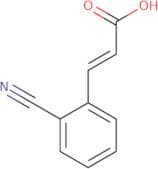
CAS 61147-65-7
:acido 3-(2-cianofenil)prop-2-enoico
Descrizione:
acido 3-(2-cianofenil)prop-2-enoico, noto anche come un derivato dell'acido cinnamico, è caratterizzato dalle sue uniche caratteristiche strutturali, inclusa una struttura di acido prop-2-enoico con un sostituente cianofenile. Questo composto tipicamente mostra un sistema di doppi legami coniugati, che contribuisce alla sua potenziale reattività e stabilità. La presenza del gruppo ciano (-C≡N) ne aumenta la polarità e può influenzare la sua solubilità in vari solventi. Come acido organico, può partecipare a reazioni acido-base, e il suo gruppo funzionale acido carbossilico (-COOH) è responsabile delle sue proprietà acide. Il composto può anche mostrare interessanti proprietà ottiche grazie al suo sistema coniugato, rendendolo di interesse in varie applicazioni, tra cui sintesi organica e scienza dei materiali. Inoltre, le sue caratteristiche strutturali possono consentire interazioni con sistemi biologici, suggerendo potenziali applicazioni in prodotti farmaceutici o agrochimici. In generale, acido 3-(2-cianofenil)prop-2-enoico è un composto versatile con una gamma di proprietà chimiche che possono essere esplorate in vari campi scientifici.
Formula:C10H7NO2
InChI:InChI=1/C10H7NO2/c11-7-9-4-2-1-3-8(9)5-6-10(12)13/h1-6H,(H,12,13)/b6-5+
Sinonimi:- (2E)-3-(2-Cyanophenyl)acrylic acid
- 2-Cyanocinnamic acid
- 2-Propenoic acid, 3-(2-cyanophenyl)-, (2E)-
Ordinare per
Purezza (%)
0
100
|
0
|
50
|
90
|
95
|
100
1 prodotti.
2-Cyanocinnamic acid
CAS:<p>2-Cyanocinnamic acid is a fatty acid that has been shown to inhibit the synthesis of proteins. It binds to cytochrome c oxidase, inhibiting mitochondrial respiration and electron transport, leading to decreased ATP production. 2-Cyanocinnamic acid is not easily transported out of mitochondria, which leads to its accumulation in the mitochondrial matrix. This accumulation causes synergistic inhibition with glutamate, leading to a decrease in ATP production and an increase in intracellular levels of reactive oxygen species (ROS). The use of 2-cyanoacrylic acid as a mitochondrial transport inhibitor has been proposed for the treatment of obesity and diabetes.<br>2-Cyanocinnamic acid also inhibits fatty acid uptake by binding to the protein translocase at the outer membrane of cells. This binding prevents monomers from entering the cell, where they are broken down by beta oxidation and converted into acetyl-CoA, which can be used for energy production or stored as triglycer</p>Formula:C10H7NO2Purezza:Min. 95%Peso molecolare:173.17 g/mol