CAS 616-16-0
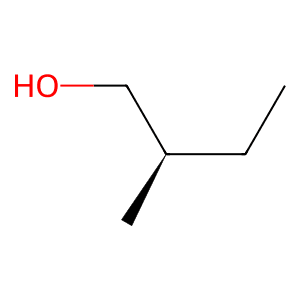
:(+)-2-Metil-1-butanolo
Descrizione:
(+)-2-Metil-1-butanolo, noto anche come alcool isoamilico, è un alcool a catena ramificata caratterizzato dalla sua formula molecolare C5H12O. È un liquido incolore con un odore caratteristico che ricorda le banane, spesso associato al suo utilizzo in applicazioni di aromatizzazione e profumeria. Questo composto ha un punto di ebollizione che tipicamente rientra nell'intervallo di temperature moderate, rendendolo una sostanza volatile. È solubile in acqua in misura limitata ed è più solubile in solventi organici, riflettendo la sua natura anfifilica. La presenza del gruppo funzionale idrossile (-OH) conferisce proprietà tipiche degli alcoli, come la capacità di partecipare a legami idrogeno, che influisce sulle sue proprietà fisiche e reattività. (+)-2-Metil-1-butanolo è spesso utilizzato nella sintesi di vari prodotti chimici e come solvente in applicazioni industriali. Inoltre, è importante nella produzione di esteri utilizzati nell'industria alimentare e delle bevande, contribuendo al profilo aromatico di alcuni prodotti. Le considerazioni di sicurezza includono la infiammabilità e i potenziali effetti sulla salute in caso di inalazione o contatto con la pelle.
Formula:C5H12O
InChI:InChI=1S/C5H12O/c1-3-5(2)4-6/h5-6H,3-4H2,1-2H3/t5-/m1/s1
InChI key:InChIKey=QPRQEDXDYOZYLA-RXMQYKEDSA-N
SMILES:[C@@H](CC)(CO)C
Sinonimi:- ((R)-2-Methylbutan-1-ol
- (+)-2-Methyl-1-butanol
- (+)-2-Methylbutanol
- (2R)-2-Methyl-1-butanol
- (R)-(+)-2-Methyl-1-butanol
- 1-Butanol, 2-methyl-, (2R)-
- 1-Butanol, 2-methyl-, (R)-
- 1-Butanol, 2-methyl-, d-
Ordinare per
Purezza (%)
0
100
|
0
|
50
|
90
|
95
|
100
3 prodotti.
(R)-2-METHYLBUTAN-1-OL
CAS:Formula:C5H12OPurezza:98%Colore e forma:No data available.Peso molecolare:88.15(R)-2-Methylbutanol
CAS:(R)-2-Methylbutanol is a volatile pheromone that is produced by both sexes of the avocado tree. It is emitted from the flowers, fruits, and leaves of the plant as well as from wounds on the bark and branches. (R)-2-Methylbutanol has also been identified in other plants such as pine trees. This compound is synthesized in organisms through a cross-coupling reaction and an acetylation reaction. The acetylation reaction involves the addition of an acetyl group to an organic molecule, which may be accomplished using a host plant or synthetic reagents. The cross-coupling reaction involves two molecules that are coupled together by a metal catalyst such as palladium or nickel. In this process, one molecule donates a pair of electrons to another molecule, which accepts them and becomes reduced. This compound has been found to be important for microhabitat selection in some insects because it plays a role in pheromFormula:C5H12OPurezza:Min. 95%Peso molecolare:88.15 g/mol