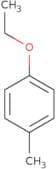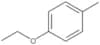
CAS 622-60-6
:1-etossi-4-metilbenzene
Descrizione:
1-etossi-4-metilbenzene, noto anche come p-etossitoluene, è un composto organico caratterizzato dalla sua struttura aromatica, che consiste in un anello benzenico sostituito da un gruppo etossile (-OCH2CH3) e un gruppo metile (-CH3) nelle posizioni para. Questo composto è un liquido incolore a giallo pallido con un piacevole odore aromatico. È moderatamente solubile in acqua ma più solubile in solventi organici come etanolo ed etere. La presenza dei gruppi etossile e metile influenza la sua reattività chimica, rendendolo un intermedio utile nella sintesi organica e in varie reazioni chimiche, inclusa la sostituzione aromatica elettrofila. Inoltre, 1-etossi-4-metilbenzene presenta proprietà tipiche dei composti aromatici, come stabilità e risonanza. È importante maneggiare questa sostanza con cura, poiché può comportare rischi per la salute se inalata o ingerita, e devono essere adottate le opportune misure di sicurezza durante il suo utilizzo in ambienti di laboratorio o industriali.
Formula:C9H12O
InChI:InChI=1S/C9H12O/c1-3-10-9-6-4-8(2)5-7-9/h4-7H,3H2,1-2H3
InChI key:InChIKey=WSWPHHNIHLTAHB-UHFFFAOYSA-N
SMILES:O(CC)C1=CC=C(C)C=C1
Sinonimi:- Phenetole, p-methyl-
- 1-Ethoxy-4-methylbenzene
- 4-Methylphenetole
- p-Methylphenetole
- Benzene, 1-ethoxy-4-methyl-
Ordinare per
Purezza (%)
0
100
|
0
|
50
|
90
|
95
|
100
1 prodotti.
1-Ethoxy-4-methylbenzene
CAS:1-Ethoxy-4-methylbenzene (EMB) is a chemical intermediate that can be used to produce methanesulfonate, an intermediate in the synthesis of pharmaceuticals. It is a colorless liquid with a boiling point of 119 degrees Celsius and a molecular weight of 130.11. The yield of EMB varies depending on the conditions used, but it is typically between 33% and 75%. Kinetics studies have been conducted using termini, which are dyes that react with the carbonyl group on EMB to produce fluorescent products. The kinetics can be seen through microscopy and high-performance liquid chromatography techniques. Nitrate has been shown to be a good catalyst for this reaction mechanism, which involves the formation of an alkyl radical from the splitting of water molecules and the oxidation of metoprolol by nitrate radicals. High concentrations are needed for this reaction to occur because metoprolol is unstable at low concentrations.BR>Formula:C9H12OPurezza:Min. 95%Peso molecolare:136.19 g/mol