CAS 6244-92-4
:Lauroil-CoA
Descrizione:
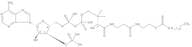
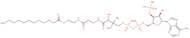
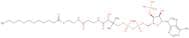
Lauroil-CoA, noto anche come coenzima A lauroil, è un derivato dell'acil-CoA che svolge un ruolo cruciale nel metabolismo e nella biosintesi dei lipidi. È caratterizzato da un acido grasso a catena lunga, specificamente l'acido laurico, che consiste di 12 atomi di carbonio. La struttura di Lauroil-CoA include un gruppo di coenzima A che facilita il suo coinvolgimento in varie reazioni biochimiche, in particolare nella sintesi e degradazione degli acidi grassi. Questo composto si trova tipicamente in compartimenti cellulari come i mitocondri e il citoplasma, dove partecipa a vie metaboliche, inclusa l'ossidazione degli acidi grassi e la sintesi di lipidi complessi. Lauroil-CoA è anche importante nella formazione di lipidi di membrana e molecole di segnalazione. La sua attività è regolata da vari enzimi, comprese le acil-CoA sintetasiche e le aciltransferasi, che modulano la sua disponibilità e funzione nei processi metabolici. In generale, Lauroil-CoA è essenziale per mantenere l'equilibrio energetico cellulare e l'omeostasi lipidica.
Formula:C33H58N7O17P3S
InChI:InChI=1S/C33H58N7O17P3S/c1-4-5-6-7-8-9-10-11-12-13-24(42)61-17-16-35-23(41)14-15-36-31(45)28(44)33(2,3)19-54-60(51,52)57-59(49,50)53-18-22-27(56-58(46,47)48)26(43)32(55-22)40-21-39-25-29(34)37-20-38-30(25)40/h20-22,26-28,32,43-44H,4-19H2,1-3H3,(H,35,41)(H,36,45)(H,49,50)(H,51,52)(H2,34,37,38)(H2,46,47,48)/t22-,26-,27-,28+,32-/m1/s1
InChI key:InChIKey=YMCXGHLSVALICC-GMHMEAMDSA-N
SMILES:O[C@H]1[C@H](N2C=3C(N=C2)=C(N)N=CN3)O[C@H](COP(OP(OCC([C@H](C(NCCC(NCCSC(CCCCCCCCCCC)=O)=O)=O)O)(C)C)(=O)O)(=O)O)[C@H]1OP(=O)(O)O
Sinonimi:- Coenzyme A, S-dodecanoate
- Coenzyme A, S-laurate
- Coenzyme A, lauroyl-
- Dodecanethioic acid, S-ester with coenzyme A
- Dodecanoyl-coa
- Dodecanoyl-coenzyme A
- Lauroyl-coa
- Lauroyl-coenzyme A
- Lauryl coenzyme A
- Lauryl-CoA
- S-{(9R)-1-[(2R,3S,4R,5R)-5-(6-amino-9H-purin-9-yl)-4-hydroxy-3-(phosphonooxy)tetrahydrofuran-2-yl]-3,5,9-trihydroxy-8,8-dimethyl-3,5-dioxido-10,14-dioxo-2,4,6-trioxa-11,15-diaza-3lambda~5~,5lambda~5~-diphosphaheptadecan-17-yl} dodecanethioate (non-preferred name)
Ordinare per
Purezza (%)
0
100
|
0
|
50
|
90
|
95
|
100
5 prodotti.
Lauroyl-coenzyme A
CAS:Lauroyl-coenzyme A acts as an acyl carrier, involved in lipid metabolism, biosynthesis, and fatty acid transport.Formula:C33H58N7O17P3SColore e forma:SolidPeso molecolare:949.84Dodecanoyl Coenzyme A free acid
CAS:Formula:C33H58N7O17P3SPurezza:>95%Colore e forma:SolidPeso molecolare:949.84Lauroyl coenzyme A potassium salt
CAS:Lauroyl coenzyme A potassium salt is a potent inhibitor of fatty acid synthase. It has the ability to inhibit the enzyme activity of fatty acid synthase in vitro, which belongs to the class of irreversible inhibitors. Lauroyl coenzyme A potassium salt inhibits the synthesis of fatty acids by inhibiting the enzyme activity of fatty acid synthase. This inhibitor also reversibly inhibits other enzymes with a similar mechanism, such as acetyl-coenzyme A carboxylase and phosphatidate phosphohydrolase. The reaction mechanism can be understood through titration calorimetry studies, demonstrating that lauroyl coenzyme A potassium salt binds to the active site of these enzymes and blocks access to substrates. The binding affinity is higher for wild type strains than for mutant strains, which may be due to differences in protein structure or other factors. Lauroyl coenzyme A potassium salt has been shown to have no effect on wild-type strains but inhibits polymerFormula:C33H55N7O17P3SK3Purezza:Min. 95%Colore e forma:PowderPeso molecolare:1,064.11 g/molLauroyl coenzyme A
CAS:Lauroyl CoA is a body-fat molecule that can be formed from acetyl-coenzyme A, which is an intermediate in the metabolism of fatty acids. It is used in analysis as a standard for enzyme activities and as a substrate for reactions involving enzymes with coenzyme A. Reaction mechanisms are determined using titration calorimetry and structural analyses are performed using analytical methods such as infrared spectroscopy and nuclear magnetic resonance spectroscopy. Lauroyl CoA is also used to study the effects of the protein toll-like receptor 4 on hepatic steatosis. The wild-type strain of Escherichia coli was used to measure the activity of bacterial synthetases containing lauroyl CoA.
Formula:C33H58N7O17P3SPurezza:Min. 95%Colore e forma:PowderPeso molecolare:949.84 g/mol