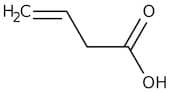
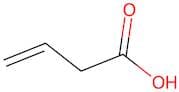
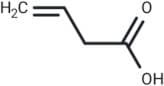
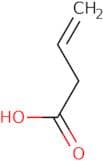
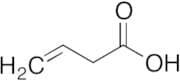
CAS 625-38-7
:Acido 3-butenoico
Descrizione:
Acido 3-butenoico, noto anche come acido crotonico, è un acido carbossilico insaturo caratterizzato dalla sua catena di quattro carboni con un doppio legame tra il secondo e il terzo atomo di carbonio. La sua formula molecolare è C4H6O2 e presenta un gruppo funzionale acido carbossilico (-COOH) a un'estremità della catena. Questo composto è un liquido incolore con un odore pungente ed è solubile in acqua, alcol ed etere. Acido 3-butenoico è noto per la sua reattività a causa della presenza del doppio legame, che gli consente di partecipare a varie reazioni chimiche, tra cui polimerizzazione ed esterificazione. Viene utilizzato nella sintesi di vari prodotti chimici, tra cui farmaci, agrochimici e come blocco di costruzione nella sintesi organica. Inoltre, può essere coinvolto nella produzione di polimeri e tensioattivi. Le considerazioni di sicurezza includono il suo potenziale di causare irritazione della pelle e degli occhi, richiedendo misure di gestione appropriate in ambienti di laboratorio e industriali.
Formula:C4H6O2
InChI:InChI=1S/C4H6O2/c1-2-3-4(5)6/h2H,1,3H2,(H,5,6)
InChI key:InChIKey=PVEOYINWKBTPIZ-UHFFFAOYSA-N
SMILES:C(C(O)=O)C=C
Sinonimi:- 3-Butenoic acid
- Acetic acid, ethenyl-
- But-3-Enoate
- But-3-Enoic Acid
- NSC 44546
- Vinylacetic acid, (3-Butenoic acid)
- β-Butenoic acid
- Vinylacetic acid
Ordinare per
Purezza (%)
0
100
|
0
|
50
|
90
|
95
|
100
8 prodotti.
Vinylacetic acid, 96%
CAS:Vinylacetic acid used in the preparation of strained nitroso Diels-Aldrer adducts which undergo a domino ROC metathesis in the presence of Ru-carbene catalysts and olefins. It is used in the synthesis of polyethylene glycolated boltorn coatings. It was used to study the inhibition of the enzyme-cataFormula:C4H6O2Purezza:96%Colore e forma:Liquid, Clear colorless to yellowPeso molecolare:86.093-Butenoic acid
CAS:3-Butenoic acid aids in creating 3,6-dihydro-1,2-oxazine for domino metathesis with alkenes.Formula:C4H6O2Colore e forma:SolidPeso molecolare:86.093-Butenoic acid
CAS:3-Butenoic acid is a versatile compound that has various applications across different industries. In the field of healthcare, it has been found to be effective in treating bacterial vaginosis, a common vaginal infection caused by an imbalance of bacteria. Additionally, it has shown virologic properties, making it potentially useful in antiviral therapies.
Formula:C4H6O2Purezza:Min. 95 Area-%Peso molecolare:86.09 g/mol3-Butenoic acid
CAS:3-Butenoic acid is a fatty acid that belongs to the group of short chain carboxylic acids. It is used in detergent compositions where it functions as a cationic surfactant and has a hydroxyl group that can be used for polymerization reactions. 3-Butenoic acid is also used as an analytical reagent, e.g., in electrochemical impedance spectroscopy, in which it has been shown to have phase transition temperature of around 38°C. 3-Butenoic acid can be synthesized by reacting butanol with hydrochloric acid and copper chloride in the presence of a cationic surfactant such as alkyltrimethylammonium chloride or benzalkonium chloride. 3-Butenoic acid also acts as a Jak1 inhibitor and has receptor activity against all types of receptors, including those for histamine, acetylcholine, dopamine, serotonin, and GABA (gamma aminobFormula:C4H6O2Purezza:Min. 95 Area-%Colore e forma:Colorless Clear LiquidPeso molecolare:86.09 g/molVinylacetic Acid
CAS:Prodotto controllatoStability Light Sensitive
Applications Vinylacetic Acid can be used as a reagent in the synthesis of 4-Phenyl-3-butenoic Acid which is an in vivo inhibitor of the peptide amidating enzyme peptidylglycine hydroxylase.
Not a dangerous good if item is equal to or less than 1g/ml and there is less than 100g/ml in the package
References Bradbury, A.F., et al.: Eur. J. Biochem., 189, 33 (1990)Formula:C4H6O2Colore e forma:NeatPeso molecolare:86.09