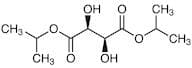
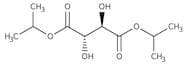
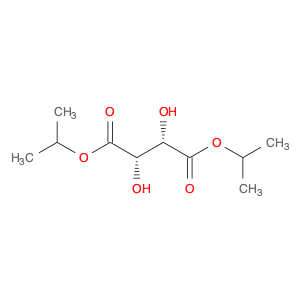
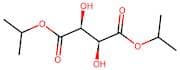
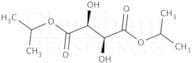
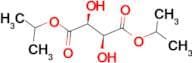
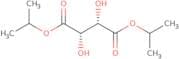
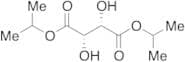
CAS 62961-64-2
:Diisopropil (-)-tartrato
Descrizione:
Diisopropil (-)-tartrato, con il numero CAS 62961-64-2, è un composto organico che appartiene alla classe dei tartrati, che sono esteri derivati dall'acido tartarico. Questa sostanza è caratterizzata dalla sua natura chirale, mostrando attività ottica grazie alla presenza di più stereocentri. Di solito appare come un liquido incolore o giallo pallido ed è nota per la sua bassa volatilità e moderata solubilità nei solventi organici. Diisopropil (-)-tartrato è spesso utilizzato come ausiliario chirale nella sintesi asimmetrica, facilitando la produzione di composti enantiomericamente puri. Le sue applicazioni si estendono all'industria farmaceutica, dove svolge un ruolo nello sviluppo di vari farmaci. Il composto è generalmente stabile in condizioni standard, ma deve essere maneggiato con cura, come molti prodotti chimici organici, per evitare potenziali pericoli. In generale, Diisopropil (-)-tartrato è apprezzato per la sua utilità nella stereochimica e il suo ruolo nel migliorare l'efficienza dei processi sintetici.
Formula:C10H18O6
InChI:InChI=1S/C10H18O6/c1-5(2)15-9(13)7(11)8(12)10(14)16-6(3)4/h5-8,11-12H,1-4H3/t7-,8-/m0/s1
InChI key:InChIKey=XEBCWEDRGPSHQH-YUMQZZPRSA-N
SMILES:[C@H]([C@@H](C(OC(C)C)=O)O)(C(OC(C)C)=O)O
Sinonimi:- (-)-Dipt
- (2S,3S)-Diisopropyl tartrate
- <span class="text-smallcaps">D</span>-(-)-Diisopropyl tartrate
- <span class="text-smallcaps">D</span>-(-)-Tartaric acid diisopropyl ester
- Butanedioic acid, 2,3-dihydroxy-, 1,4-bis(1-methylethyl) ester, (2S,3S)-
- Butanedioic acid, 2,3-dihydroxy-, bis(1-methylethyl) ester, (2S,3S)-
- Butanedioic acid, 2,3-dihydroxy-, bis(1-methylethyl) ester, [S-(R*,R*)]-
- D-(-)-Tartaric Acid Diisopropyl Ester
- Diisopropyl (-)-<span class="text-smallcaps">D</span>-tartrate
- Diisopropyl (-)-tartrate
- Diisopropyl (S,S)-tartrate
- Diisopropyl D-Tartrate
- bis(1-methylethyl) (2R,3S)-2,3-dihydroxybutanedioate
- dipropan-2-yl (2S,3S)-2,3-dihydroxybutanedioate
- Vedi altri sinonimi
Ordinare per
Purezza (%)
0
100
|
0
|
50
|
90
|
95
|
100
8 prodotti.
Diisopropyl D-(-)-Tartrate
CAS:Formula:C10H18O6Purezza:>98.0%(GC)Colore e forma:Colorless to Almost colorless clear liquidPeso molecolare:234.25(-)-Diisopropyl D-tartrate, 98%
CAS:This Thermo Scientific Chemicals brand product was originally part of the Alfa Aesar product portfolio. Some documentation and label information may refer to the legacy brand. The original Alfa Aesar product / item code or SKU reference has not changed as a part of the brand transition to Thermo Sci
Formula:C10H18O6Purezza:98%Colore e forma:Clear colorless, Liquid or viscous liquidPeso molecolare:234.25(2S,3S)-Diisopropyl 2,3-dihydroxysuccinate
CAS:Formula:C10H18O6Purezza:98%Colore e forma:LiquidPeso molecolare:234.2463D-(-)-Tartaric acid diisopropyl ester
CAS:D-(-)-Tartaric acid diisopropyl esterPurezza:98%Peso molecolare:234.25g/mol(2S,3S)-Diisopropyl 2,3-dihydroxysuccinate
CAS:Purezza:95.0%Colore e forma:Liquid, ClearPeso molecolare:234.2480010986328Diisopropyl D-tartrate
CAS:Diisopropyl tartrate is a chemical compound that has been used in the synthesis of antibiotics. It is bifunctional, meaning that it can act as both a nucleophile and a base. The chloride forms a nucleophilic addition with the allyl group, forming an intermediate that is an excellent leaving group for the final product. Diisopropyl tartrate is used to synthesize monomers for polymers, such as chloroprene and styrene, which are used in the manufacture of plastics and rubber. This chemical is also used in catalytic asymmetric reactions, where it acts as a catalyst by stabilizing one enantiomer over another to promote stereoselective reactions.Formula:C10H18O6Purezza:Min. 95%Colore e forma:Colorless Clear LiquidPeso molecolare:234.25 g/molD-(-)-Diisopropyl Tartrate
CAS:Prodotto controllatoApplications D-(-)-Diisopropyl Tartrate is a reagent for kinetic resolution of racemic allylic alcohols and α-furfuryl amides by enantioselective epoxidation.
References Lee, E., et al.: J. Org. Chem., 1994, 59 1444; Jung, M., et al.: J. Am. Chem. Soc., 115, 12208 (1993); Wang, Z., et al.: Tetrahedron, 49, 2641 (1993)Formula:C16H17N3O4S2Colore e forma:NeatPeso molecolare:379.454