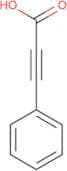
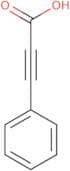
CAS 637-44-5
:Acido fenilpropiolico
Descrizione:
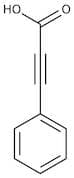
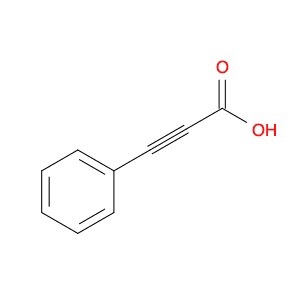
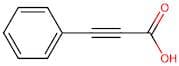
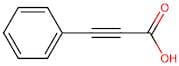
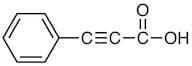
Acido fenilpropiolico, con il numero CAS 637-44-5, è un composto organico caratterizzato dal suo gruppo funzionale alchino e da un moiety di acido carbossilico. Presenta un gruppo fenile attaccato a una catena di tre carboni che termina in un acido carbossilico, rendendolo un membro della famiglia degli acidi propenoici. Questo composto è tipicamente un liquido o solido incolore o giallo pallido, a seconda della sua purezza e temperatura. Acido fenilpropiolico è noto per la sua reattività, in particolare a causa della presenza del legame triplo, che può partecipare a varie reazioni chimiche, comprese cicloadizioni e polimerizzazioni. È anche riconosciuto per le sue potenziali applicazioni nella sintesi organica e come mattoncino nello sviluppo di farmaci e agrochimici. Inoltre, mostra un certo grado di attività biologica, che è stata esplorata in contesti di ricerca. Tuttavia, devono essere adottate precauzioni di sicurezza quando si maneggia questo composto, poiché può comportare rischi per la salute in caso di esposizione.
Formula:C9H6O2
InChI:InChI=1S/C9H6O2/c10-9(11)7-6-8-4-2-1-3-5-8/h1-5H,(H,10,11)
InChI key:InChIKey=XNERWVPQCYSMLC-UHFFFAOYSA-N
SMILES:C(#CC(O)=O)C1=CC=CC=C1
Sinonimi:- 2-Propynoic acid, 3-phenyl-
- 3-Phenyl-2-propynoic acid
- 3-Phenylprop-2-Ynoate
- 3-Phenylprop-2-Ynoic Acid
- 3-Phenylpropargylic acid
- 3-Phenylpropiolic acid
- 3-Phenylpropynoic acid
- 4-Phenylpropynoic acid
- Benzenepropynoic acid
- NSC 13669
- Phenyl Propiolic Acid
- Phenyl-2-propynoic acid
- Phenylacetylenecarboxylic acid
- Phenylacetylenecarboxylic acid~3-Phenylpropynoic acid
- Phenylacetylenemonocarboxylic acid
- Phenylpropargylic acid
- Phenylpropiolic acid, (3-Phenylpropynoic acid)
- Phenylpropioplic Acid
- Phenylpropynoic acid
- Propiolic acid, phenyl-
- β-Phenylpropargylic acid
- Vedi altri sinonimi
Ordinare per
Purezza (%)
0
100
|
0
|
50
|
90
|
95
|
100
11 prodotti.
Phenylpropiolic acid, 98+%
CAS:Phenylpropiolic acid is used as a Pharmaceutical Intermediates, laboratory chemicals. This Thermo Scientific Chemicals brand product was originally part of the Alfa Aesar product portfolio. Some documentation and label information may refer to the legacy brand. The original Alfa Aesar product / itemFormula:C9H6O2Purezza:98+%Colore e forma:White to cream, Crystals or powder or crystalline powderPeso molecolare:146.15Phenylpropiolic acid, 10mM (in DMSO)
CAS:Phenylpropiolic acid, 10mM (in DMSO)Purezza:≥98%Peso molecolare:146.14g/molPhenylpropiolic acid
CAS:Phenylpropiolic acid is an endogenous metabolite.Formula:C9H6O2Purezza:99.94%Colore e forma:SolidPeso molecolare:146.14Phenylpropiolic Acid
CAS:Formula:C9H6O2Purezza:>98.0%(T)Colore e forma:White to Light yellow to Light red powder to crystalPeso molecolare:146.15Phenylpropiolic acid
CAS:Phenylpropiolic acid is a chemical that is used as a reagent in organic synthesis and as a building block for the synthesis of other chemicals. This compound can be used as a building block to produce more complex compounds, such as phenylpropanolamine, which is used in some over-the-counter drugs. Phenylpropiolic acid has been shown to be useful in the synthesis of research chemicals and has also been shown to have high reactivity with many different types of compounds. It can serve as a versatile intermediate or scaffold for reactions that require an aromatic ring or an electron-rich center.
Formula:C9H6O2Peso molecolare:146.15 g/molRef: 3D-P-4190
-Unit-kgkgPrezzo su richiesta1kgPrezzo su richiesta100gPrezzo su richiesta250gPrezzo su richiesta500gPrezzo su richiestaPhenylpropiolic acid
CAS:Phenylpropiolic acid is an organic compound that is used as a building block for the synthesis of other organic compounds. It has been shown to have inhibitory effects on squamous cell carcinoma cells and may be useful in the treatment of this type of cancer. This compound is also a strong inhibitor of mitochondrial membrane potential, which leads to the inhibition of cellular respiration and death. Phenylpropiolic acid has been shown to act as a copper chelator in biological systems, which may be due to its ability to form complexes with copper ions at low pH.Formula:C9H6O2Purezza:Min. 95%Colore e forma:White PowderPeso molecolare:146.14 g/mol