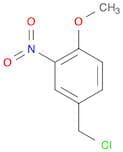
CAS 6378-19-4
:4-(Clorometil)-1-metossi-2-nitrobenzene
- 3-Nitro-4-methoxybenzyl chloride
- 4-(Chloromethyl)-1-(methyloxy)-2-nitrobenzene
- 4-(Chloromethyl)-1-Methoxy-2-Nitrobenzene
- 4-Methoxy-3-nitrobenzyl chloride
- Anisole, 4-(chloromethyl)-2-nitro-
- Benzene, 4-(chloromethyl)-1-methoxy-2-nitro-
- NSC 19935
- 4-(Chloromethyl)-2-nitroanisole
- Nsc19935
- tetrasodium 2-[[7-[[bis(carboxylatomethyl)amino]methyl]-9-(2-carboxyphenyl)-3-hydroxy-6-oxo-2-xanthenyl]methyl-(carboxylatomethyl)amino]acetate
- 1-Chloromethyl-4-methoxy-3-nitrobenzene
4-(Chloromethyl)-1-methoxy-2-nitrobenzene
CAS:Formula:C8H8ClNO3Colore e forma:SolidPeso molecolare:201.60704-(Chloromethyl)-1-methoxy-2-nitrobenzene
CAS:4-(Chloromethyl)-1-methoxy-2-nitrobenzene is a heterocyclic compound that belongs to the group of germicides. It is prepared by the reaction of potassium carbonate with methylamine and 4-chloro-1-methoxybenzene. The chloromethyl group in this compound can be replaced by other halogens, such as bromine or iodine, in order to produce other derivatives. This type of chemical has been used in the past as a fungicide, but is now mostly used as a precursor for dyes. 4-(Chloromethyl)-1-methoxy-2-nitrobenzene has an analogous reaction with amines, which are compounds containing nitrogen and hydrogen atoms that have one or more organic substituents. These reactions are useful for producing drugs such as amphetamines, barbiturates, and some types of antibiotics.
Formula:C8H8ClNO3Purezza:Min. 95%Peso molecolare:201.61 g/mol