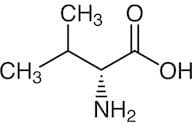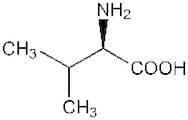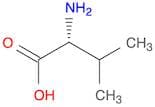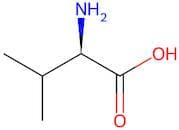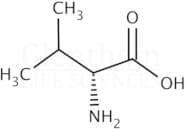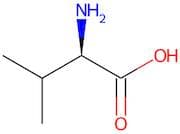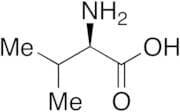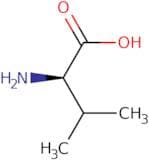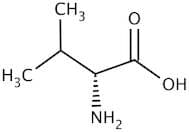
CAS 640-68-6
:D-Valina
- (-)-2-Amino-3-methylbutyric acid
- (2R)-2-Amino-3-methylbutanoic acid
- (R)-2-Amino-3-methylbutanoic acid
- (R)-3-Methyl-2-aminobutanoic acid
- (R)-Valine
- <span class="text-smallcaps">D</span>-(-)-Valine
- D-2-Amino-3-methylbutanoic acid
- D-Valin
- D-valina
- H-D-Val-OH
- Nsc 20654
- Valine, <span class="text-smallcaps">D</span>-
- Valine, D-
- D-(-)-Valine
- Vedi altri sinonimi
D-Valine
CAS:Formula:C5H11NO2Purezza:>98.0%(T)Colore e forma:White to Almost white powder to crystalPeso molecolare:117.15D-Valine, 98+%
CAS:This Thermo Scientific Chemicals brand product was originally part of the Alfa Aesar product portfolio. Some documentation and label information may refer to the legacy brand. The original Alfa Aesar product / item code or SKU reference has not changed as a part of the brand transition to Thermo SciFormula:C5H11NO2Purezza:98+%Colore e forma:White, Crystals or powder or crystalline powder or flakesPeso molecolare:117.15(R)-2-Amino-3-methylbutanoic acid
CAS:Formula:C5H11NO2Purezza:97%Colore e forma:SolidPeso molecolare:117.1463D-Valine
CAS:Formula:C5H11NO2Purezza:98.0 - 101.0 %Colore e forma:White crystalline powderPeso molecolare:117.15D-Valine
CAS:D-Valine
Formula:C5H11NO2Purezza:98%Colore e forma: white to off-white flakesPeso molecolare:117.15g/molRef: 4Z-V-047003
5mgPrezzo su richiesta10mgPrezzo su richiesta25mgPrezzo su richiesta50mgPrezzo su richiesta100mgPrezzo su richiestaD-Valine
CAS:D-Valine (H-D-Val-OH) is the enantiomer of L-Valine.Formula:C5H11NO2Purezza:99.93%Colore e forma:White CrystalsPeso molecolare:117.15D-Valine
CAS:Prodotto controllatoApplications D-Valine is an isomer of the essential amino acid L-Valine. D-Valine has been used as a selective agent in epithelial cells in culture since it inhibits cells that lack the enzyme D-amino acid oxidase. D-Valine has also been shown to inhibit proliferation of contaminating fibroblasts in smooth muscle cells from human myometrium. D-Valine solution showed tumor growth inhibition and improvements of the nutritional status in AH109A hepatoma-bearing rats.
References Gilbert, S.F. et al.: Cell, 5, 11 (1975); Hongpaisan, J. et al.: Cell Biol. Int., 24, 1 (2000); Sasamura, T. et al.: J, Nutrit. Sci. Vitaminol., 44, 89 (1998);Formula:C5H11NO2Colore e forma:NeatPeso molecolare:117.15D-Valine
CAS:D-Valine is a non-essential amino acid that is synthesized from 2-oxoglutarate and glutamine. D-Valine has been shown to be an intermediate in microbial metabolism, where it is converted to L-valine by the enzyme d-amino acid oxidase. It has also been shown to have antihypertensive properties in rat models of hypertension. The synthesis of D-valine from glucose can occur through two different pathways: one involves the conversion of L-glutamic acid to L-alanine then to pyruvic acid, which is then converted to L-lactate and then d-malic acid; the other pathway involves the conversion of L-glutamate to citric acid, which can then be converted into succinic acid and eventually d-malic acid. Structural analysis has revealed that D-valine contains a hydrogen bond between its carboxyl group and nitrogen atom in a neighboring molecule. This hydrogen
Formula:C5H11NO2Purezza:Min. 95%Colore e forma:White PowderPeso molecolare:117.15 g/molD-Valine extrapure CHR, 99%
CAS:Formula:C5H11NO2Purezza:min. 99%Colore e forma:White, Crystalline powder, Clear, ColourlessPeso molecolare:117.15