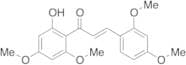
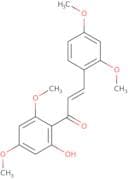
CAS 64200-22-2
:2-Propen-1-one,3-(2,4-dimetossifenile)-1-(2-idrossi-4,6-dimetossifenile)-, (2E)-
- 2-Propen-1-one,3-(2,4-dimethoxyphenyl)-1-(2-hydroxy-4,6-dimethoxyphenyl)-, (E)-
- Cerasidin
- 2'-HYDROXY-2,4,4',6'-TETRAMETHOXYCHALCONE
- (2E)-3-(2,4-Dimethoxyphenyl)-1-(2-hydroxy-4,6-dimethoxyphenyl)-2-propen-1-one
- 2,4-Dimethoxyflavokawain B
- 2-Propen-1-one, 3-(2,4-dimethoxyphenyl)-1-(2-hydroxy-4,6-dimethoxyphenyl)-, (2E)-
Cerasidin
CAS:Prodotto controllatoApplications Cerasidin has the general structure of chalcones (aromatic ketone and enone), and are important biological compounds. Due to this, Cerasidin has been used for cytotoxic studies, and studies involving α7 acetylcholine nicotine receptors as a possible positive allosteric modulators with other chalcone structures.
References Balsera, B., et al.: Eur. J. Med. Chem., 86, 724-39 (2014); Rajeshbabu, K.A., et al.: World Res J Pharmaceut Res., 3, 380-88 (2014);Formula:C19H20O6Colore e forma:NeatPeso molecolare:344.3582'-Hydroxy-2,4,4',6'-tetramethoxychalcone
CAS:2'-Hydroxy-2,4,4',6'-tetramethoxychalcone (HTMC) is a bioactive substance that has been shown to have anticancer properties. HTMC has been shown to have allopathic effects in a statistically significant manner and has been used in traditional herbal medicine for centuries. The mechanisms of action are not well understood but may be due to its ability to inhibit the activity of arjunic acid and flavonoids. HTMC is found in plants such as tropical trees and herbs from India, including Acacia catechu and Tinospora cordifolia. It also has pharmacological properties, which may be due to its derivates that are isolated from these plants. HTMC shows no adverse effects on humans when taken orally at doses up to 1 g/day for 28 days.
Formula:C19H20O6Purezza:Min. 95%Colore e forma:PowderPeso molecolare:344.36 g/mol